


Homework Answers
1.
HCl is a strong acid and NaOH is a strong base. Hence, they will undergo neutralization reaction to form a salt and water as follows:

Note that the reaction is already balanced as both sides have same number of each type of atoms.
HCl is a strong acid and NH3 is a weak Lewis base. Hence, they form a acid-base complex as given below:

Note that the above reaction is also balanced.
Now, the balanced reaction between strong base NaOH and NH4Cl can be written as follows:

Note that this is simply a displacement reaction when cation of one reactant combines with anion of another.
2.
For a generic reaction

The enthalpy change for the reaction,  , can be written in terms of the enthalpies of formation,
  , of the reactants and products as follows:

Where a, b, c and d are stoichiometric coefficients in the balanced reaction.
Hence, for our reactions:
The enthalpy of the neutralization reaction  can be written as

For the second reaction:
The enthalpy of the reaction  can be written as

Now, for the third reaction of NH4Cl and NaOH,
we can write the enthalpy change of the reaction as

Now, we have to prove that

Hence, lets evaluate the right hand side of the equation and check if it equals the LHS.
Hence, subtracting equation (2 ) from equation (1).
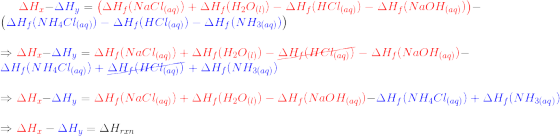
Note that the right hand side of the third step of the above equation is equal to enthalpy change calculated in equation 3.
Hence, it is proved.
Add Answer to:
1. Write balanced equations for the two reactions that will be carried out in this experiment...
Questions: 1. Write balanced equations for each of the four different acid-base reactions in this experiment....
 Questions: 1. Write balanced equations for each of the four different acid-base reactions in this experiment. Include phases (s, 1, g, aq) for reactants and products. Naoteit HChagj- NaOH agl+ NH2 (09) t HUiagy NHz 491 HadtNaa (a4) Hao t NaCats HCaHso (44) NH4 ca) + C211202a) t 2. How does the enthalpy of neutralization change when you switch from a strong acid to a weak acid with the same base? From a strong base to a weak base with...
Show using Hess's Law how the enthalpy of reaction for HCLg + NaOH (you don't need...
 Show using Hess's Law how the enthalpy of reaction for HCLg + NaOH (you don't need specific numbers, just call it AH) minus the enthalpy of reaction for HCL) + NH3(aq) (call it AH) should be equal to the enthalpy of reaction for NaOH. + NH,CIQ). Show all work.
Show using Hess's Law how the enthalpy of reaction for HCLg + NaOH (you don't need...
 Show using Hess's Law how the enthalpy of reaction for HCLg + NaOH (you don't need specific numbers, just call it AH) minus the enthalpy of reaction for HCL) + NH3(aq) (call it AH) should be equal to the enthalpy of reaction for NaOH. + NH,CIQ). Show all work.
I know that this is the answer, but how do I cancel out equations to reach...
 I know that this is the answer, but how do I cancel
out equations to reach it ?
Calculate the enthalpy change to be expected for the dissolution of NaOH ((s) and (aq) mean solid and aqueous) using Hess's Law: NaOH(s) NaOH(aq) Use the enthalpy change for NaOH-HCI pair that your class measured in this experiment, and the data from the following table: Reaction* AH(kJ/mol %H2(g) + 2Cl2(g) → HCl(g) - 92.31 Na(s) + 1202(g) + 12H2(g) → NaOH(s) -...
I know that this is the answer, but how do I cancel
out equations to reach it ?
Calculate the enthalpy change to be expected for the dissolution of NaOH ((s) and (aq) mean solid and aqueous) using Hess's Law: NaOH(s) NaOH(aq) Use the enthalpy change for NaOH-HCI pair that your class measured in this experiment, and the data from the following table: Reaction* AH(kJ/mol %H2(g) + 2Cl2(g) → HCl(g) - 92.31 Na(s) + 1202(g) + 12H2(g) → NaOH(s) -...
POST LABORATORY QUESTIONS 1. a. For the neutralization reaction that you carried out between HCl(aq) and...
 POST LABORATORY QUESTIONS 1. a. For the neutralization reaction that you carried out between HCl(aq) and NaOH (ag). how many moles of NaCl(aq) were produced? b. For the neutralization reaction that you carried out between HCl(aq) and NaOH() how many moles of NaCl(aq) were produced? 2. Calculate AHan for the neutralization of HCl(aq) and NaOH(aq) in kilojoules per mol of NaCl b. Calculate A Hexn for the neutralization of HCl (aq) and NaOH(s) in kilojoules per mol of NaCl 3....
4. Write balanced molecular and ionic equations for following reactions: a. CaCOs(s) and HCI(aq) b. Well...
 4. Write balanced molecular and ionic equations for following reactions: a. CaCOs(s) and HCI(aq) b. Well 5CINi(NO32 NaOH and HCl(aq) c. HCI(aq) NH3(aq) d. CH3COOH(aq)+ NaOH(aq)
4. You will conduct the two solvation reactions and three neutralization reactions in this experiment. In...
 4. You will conduct the two solvation reactions and three neutralization reactions in this experiment. In the space provided below, write the balanced net ionic reaction equations from the descriptions. Use the table of thermodynamic data in your text (AHf(NaOH(s)= -425.61 kJ-mol) to calculate the molar enthalpy of the reactions. These will be the accepted values you will compare to the experimental values you calculate using data collected during the experiment. Part I: Solid sodium hydroxide is combined with water...
Write complete, balanced equations for each of the following reactions. If no reaction is predicted, enter...
Write complete, balanced equations for each of the following reactions. If no reaction is predicted, enter "no reaction": (a) Mg(OH)2(aq) + H3PO4(aq) → (b) HCl(aq) + NaOH(aq) → (c) H3PO4(aq) + Ca(OH)2(aq) → (d) Fe(s) + CuSO4(aq) → (e) AgNO3(aq) + Cu(s) → (f) C5H12(g) + O2(g) →
Write the molecular, ionic, and net equations of the 5 following reactions. (Must be balanced if...
Write the molecular, ionic, and net equations of the 5 following reactions. (Must be balanced if not already balanced) Cu2+ (s) + 2HNO3 (l) --> Cu(NO3)2 (s) + NO-2 (?) + H2O (l) Cu(NO3)2 (l) + NaOH (?) --> Cu(OH)2 (?) + NaNO3 (?) Cu(OH)2 (aq) --> CuO (s) + H2O (l) CuO (s) + H2SO4 (s) --> CuSO4 (aq) + H2O (l) CuSO4 (aq) + Mg2+ (s) --> MgSO4 (aq) + Cu2+ (s) I have placed question marks for...
1. Read the write up through the Data Analysis section. A student carried out the experiment...
 1. Read the write up through the Data Analysis section. A student carried out the experiment described there. The student used 0.4894 g of Mg in the first reaction and found that the temperature of the solution went from 22.1 to 42.7'C. In the second reaction, 0.803 g of Mgo was used and the solution went from 22.7 to 28.7*C. Calculate the following. Show all calculations. AH, The enthalpy of the reaction of magnesium with acid. AT = Mass of...
 Questions: 1. Write balanced equations for each of the four different acid-base reactions in this experiment. Include phases (s, 1, g, aq) for reactants and products. Naoteit HChagj- NaOH agl+ NH2 (09) t HUiagy NHz 491 HadtNaa (a4) Hao t NaCats HCaHso (44) NH4 ca) + C211202a) t 2. How does the enthalpy of neutralization change when you switch from a strong acid to a weak acid with the same base? From a strong base to a weak base with...
 Show using Hess's Law how the enthalpy of reaction for HCLg + NaOH (you don't need specific numbers, just call it AH) minus the enthalpy of reaction for HCL) + NH3(aq) (call it AH) should be equal to the enthalpy of reaction for NaOH. + NH,CIQ). Show all work.
 Show using Hess's Law how the enthalpy of reaction for HCLg + NaOH (you don't need specific numbers, just call it AH) minus the enthalpy of reaction for HCL) + NH3(aq) (call it AH) should be equal to the enthalpy of reaction for NaOH. + NH,CIQ). Show all work.
 I know that this is the answer, but how do I cancel
out equations to reach it ?
Calculate the enthalpy change to be expected for the dissolution of NaOH ((s) and (aq) mean solid and aqueous) using Hess's Law: NaOH(s) NaOH(aq) Use the enthalpy change for NaOH-HCI pair that your class measured in this experiment, and the data from the following table: Reaction* AH(kJ/mol %H2(g) + 2Cl2(g) → HCl(g) - 92.31 Na(s) + 1202(g) + 12H2(g) → NaOH(s) -...
I know that this is the answer, but how do I cancel
out equations to reach it ?
Calculate the enthalpy change to be expected for the dissolution of NaOH ((s) and (aq) mean solid and aqueous) using Hess's Law: NaOH(s) NaOH(aq) Use the enthalpy change for NaOH-HCI pair that your class measured in this experiment, and the data from the following table: Reaction* AH(kJ/mol %H2(g) + 2Cl2(g) → HCl(g) - 92.31 Na(s) + 1202(g) + 12H2(g) → NaOH(s) -...
 POST LABORATORY QUESTIONS 1. a. For the neutralization reaction that you carried out between HCl(aq) and NaOH (ag). how many moles of NaCl(aq) were produced? b. For the neutralization reaction that you carried out between HCl(aq) and NaOH() how many moles of NaCl(aq) were produced? 2. Calculate AHan for the neutralization of HCl(aq) and NaOH(aq) in kilojoules per mol of NaCl b. Calculate A Hexn for the neutralization of HCl (aq) and NaOH(s) in kilojoules per mol of NaCl 3....
 4. Write balanced molecular and ionic equations for following reactions: a. CaCOs(s) and HCI(aq) b. Well 5CINi(NO32 NaOH and HCl(aq) c. HCI(aq) NH3(aq) d. CH3COOH(aq)+ NaOH(aq)
 4. You will conduct the two solvation reactions and three neutralization reactions in this experiment. In the space provided below, write the balanced net ionic reaction equations from the descriptions. Use the table of thermodynamic data in your text (AHf(NaOH(s)= -425.61 kJ-mol) to calculate the molar enthalpy of the reactions. These will be the accepted values you will compare to the experimental values you calculate using data collected during the experiment. Part I: Solid sodium hydroxide is combined with water...
 1. Read the write up through the Data Analysis section. A student carried out the experiment described there. The student used 0.4894 g of Mg in the first reaction and found that the temperature of the solution went from 22.1 to 42.7'C. In the second reaction, 0.803 g of Mgo was used and the solution went from 22.7 to 28.7*C. Calculate the following. Show all calculations. AH, The enthalpy of the reaction of magnesium with acid. AT = Mass of...
Most questions answered within 3 hours.
-
Where is the error in this code sequence?
String s1 = "Hello";
String s2 = "ello";...
asked 10 months ago -
Financial data for Joel de Paris, Inc., for last year
follow:
Joel de Paris, Inc.
Balance...
asked 10 months ago -
Consider this reaction:
Al2(SO4)3 (aq)+ BaCl3
(aq) Al2Cl6 (aq)- +
3BaSO4(s) . What is the...
asked 10 months ago -
Suppose that Savneet is considering increasing her
recent random sample from 20 car rentals to 40...
asked 10 months ago -
Trucks arrive at an unloading terminal at an average rate of 120
per hour.
Trucks arrive...
asked 10 months ago -
Why are methanol and ethanol completely soluble in water while
octanol is not very little soluble....
asked 10 months ago -
A facilities manager at a university reads in a research report
that the mean amount of...
asked 10 months ago -
When the CuSO4 is rehydrated by adding water to the anhydrous
compound, is this an endothermic...
asked 10 months ago -
A ray of sunlight is passing from diamond into crown glass; the
angle of incidence is...
asked 10 months ago -
A block of mass 0.249 kg is placed on top of a light, vertical
spring of...
asked 10 months ago -
how do the kidneys compensate in the presences of acidosis
a) trigger hyperventilate
b) reserve acid...
asked 10 months ago -
Question 501 pts
The rental rate of capital to the firm increases. Which of the
following...
asked 10 months ago