Your group manages an investment fund. Your job is to advise
clients on what portfolio best suits their needs, given their
characteristics. You have three different customer types: I. A
young Deakin Commerce graduate (Stephanie) with a long and
successful career ahead of her. II. A middle-aged couple (Harold
and Meredith) who are high income earners. They plan to retire in
10 years’ time. III. An older member of the work force (Akhter) who
is hoping to retire in the next 18 months. There are 3 different
portfolio packages that you offer your clients: PORTFOLIO ALPHA:
70% shares; 20% property; 10% cash. PORTFOLIO BETA: 50% bonds; 30%
shares; 20% property. PORTFOLIO GAMMA: 50% cash; 30% bonds; 20%
property. Your task is to answer the following questions by
referring to your textbook, other finance books, the media, the
internet etc.: 1. By using the information in TABLE 1: (a)
Calculate the historical returns for each of the above portfolios
for the years between 2003 and 2017. Present the answers/numbers in
the table. (b) Calculate the expected (average) return, denoted by
E(R), and risk (standard deviation), denoted by σ, for each of the
four asset classes as well as those three portfolios. Present your
answers in Table 1. The completed table SHOULD be submitted with
your assignment. Students are encouraged to employ Microsoft Excel
for these workings. (5 marks) 2. Explain what is meant by expected
return and risk in finance. You need to address the relationship
between these two concepts in your explanation. Use your answers
from Question 1 (for both assets and portfolios) above to
illustrate this relationship. (5 marks) 3. Discuss the meaning of
diversification in finance and how it impacts the risk and the
return. You need to address the concept of correlation and how the
correlation coefficient impacts on the risk of a portfolio in your
discussion. Refer to your answers from Question 1 to illustrate
diversification. (5 marks)4. How do we measure the systematic risk
component of an asset? Assets A and B have betas of 0.5 and 2
respectively. Which asset is riskier? If the market return
decreases/increases by 10%, how would such movement impact Assets A
and B? (5 marks) 5. It is assumed that your investors are risk
averse. Explain what is meant by ‘risk aversion’ as it relates to
finance. Is risk aversion related to different stages of ‘investing
life cycle’? (5 marks) 6. For each of the three customer types that
you have, recommend the most suitable portfolio option and justify
your choice. Use language here that the customers wilunderstand.
You should use a graph here to show the historical return
performance of each of your portfolios to assist with your
recommendation. (5 marks)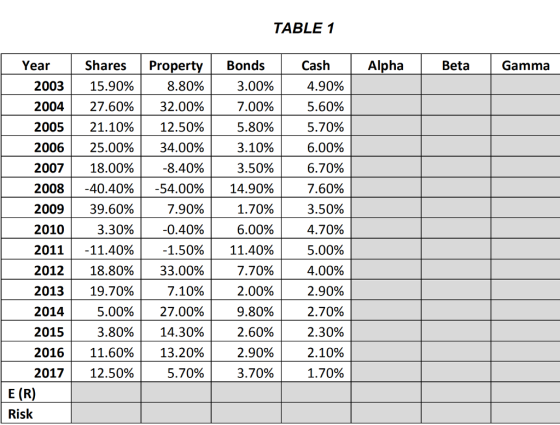
Homework Answers
Answer:
Part 1
Portfolio Return in a particular year= weightage of Shares* Return for shares+weightage of Property* Return for Property+weightage of Bonds* Return for Bonds+weightage of cash* Return for Cash
Sample Calculation for ALPH for year 2003
Portfolio return= 70%*15.90% +20%*8.80% +0%* 3.00% +10%* 4.90% =13.38%
E(r)= Sum of all returns from 2003 to 2017/15
Risk=Standard Deviation=
Where r is the rate of return in a particular year.
| Weightage | |||||||
| Portfolio | Shares | Property | Bonds | Cash | |||
| Alpha | 70% | 20% | 0% | 10% | |||
| Beta | 30% | 20% | 50% | 0% | |||
| Gamma | 0% | 20% | 30% | 50% | |||
| Year | Shares | Property | Bonds | Cash | Alph | Beta | Gamma |
| 2003 | 15.90% | 8.80% | 3.00% | 4.90% | 13.38% | 8.03% | 5.11% |
| 2004 | 27.60% | 32.00% | 7.00% | 5.60% | 26.28% | 18.18% | 11.30% |
| 2005 | 21.10% | 12.50% | 5.80% | 5.70% | 17.84% | 11.73% | 7.09% |
| 2006 | 25.00% | 34.00% | 3.10% | 6.00% | 24.90% | 15.85% | 10.73% |
| 2007 | 18.00% | -8.40% | 3.50% | 6.70% | 11.59% | 5.47% | 2.72% |
| 2008 | -40.40% | -54.00% | 14.90% | 7.60% | -38.32% | -15.47% | -2.53% |
| 2009 | 39.60% | 7.90% | 1.70% | 3.50% | 29.65% | 14.31% | 3.84% |
| 2010 | 3.30% | -0.40% | 6.00% | 4.70% | 2.70% | 3.91% | 4.07% |
| 2011 | -11.40% | -1.50% | 11.40% | 5.00% | -7.78% | 1.98% | 5.62% |
| 2012 | 18.80% | 33.00% | 7.70% | 4.00% | 20.16% | 16.09% | 10.91% |
| 2013 | 19.70% | 7.10% | 2.00% | 2.90% | 15.50% | 8.33% | 3.47% |
| 2014 | 5.00% | 27.00% | 9.80% | 2.70% | 9.17% | 11.80% | 9.69% |
| 2015 | 3.80% | 14.30% | 2.60% | 2.30% | 5.75% | 5.30% | 4.79% |
| 2016 | 11.60% | 13.20% | 2.90% | 2.10% | 10.97% | 7.57% | 4.56% |
| 2017 | 12.50% | 5.70% | 3.70% | 1.70% | 10.06% | 6.74% | 3.10% |
| E(R) | 11.34% | 8.75% | 5.67% | 4.36% | 10.12% | 7.99% | 5.63% |
| Risk | 18.69% | 21.71% | 3.87% | 1.79% | 16.49% | 8.10% | 3.77% |
Part 2) Expected return is average of all return for given time period for a particular asset. It tell us how much return we can expect from an asset looking at its past performance.
E(r)= Sum of all returns from 2003 to 2017/15
Standard Deviation is used to quantify the amount of variation or dispersion of a set of rate of return.A low standard deviation indicates that the returns tend to be close to the mean (also called the expected rate of return) of the set, while a high standard deviation indicates that the returns are spread out over a wider range of values. Since standard deviation is measured around expected rate of return so if standard deviation is low then there asset is low risky and there is high chances of getting expected return and if standard deviation is high then there asset is high risky and there is less chances of getting expected return.
standard deviation is calculating from below formula
Risk=Standard Deviation=
From above table we can find that property is more risky than other assets.
Part 3)
Diversification is a means of managing risk, and it is
accomplished by mixing a variety of assets within a single
portfolio. The goal of diversification is to minimize the impact
that the performance of any one security will have on the overall
performance of the whole portfolio. As such, diversification lowers
the risk associated with the portfolio.
Correlation measure the relationship between the changes of two or
more financial variables over time. if the two assets are
positively correlated than increase or decrease in one asset will
also increase or decrease in another asset. It means the portfolio
is not well diversified and it is more risky.
if the two assets are negatively correlated than increase or decrease in one asset will also decrease or increase in another asset. It means the portfolio is well diversified and it is less risky. Examples are Shares and Bonds are negatively correlated.
From above table we found that portfolio Alpha is not diversified because it has higher standard deviation where as portfolio gamma is well diversified because it has lower standard deviation.
Part 4)
Systematic Risk: Systematic risk is the risk inherent to the entire market. Systematic risk, also known as “undiversifiable risk,” “volatility” or “market risk,” affects the overall market, not just a particular stock or industry. This type of risk is both unpredictable and impossible to completely avoid.
For systematic risk we measure Beta, which measures how volatile that investment is compared to the overall market. A beta of greater than 1 means the investment has more systematic risk than the market, while less than 1 means less systematic risk than the market. A beta equal to one means the investment carries the same systematic risk as the market.
For Asset B ( Beta =2) is more riskier than asset A(beta=0.5) because asset B has beta value greater than 1 where as asset A has beta value less than 1.
if market return increase or decrease by 10% then asset A will increase / decrease by beta*10%=0.5*10%=5% .whereas
asset B will increase/decrease by 2*10%=20%.
Add Answer to:
Your group manages an investment fund. Your job is to advise
clients on what portfolio best...
Your group manages an investment fund. Your job is to advise clients on what portfolio best...
 Your group manages an investment fund. Your job is to advise clients on what portfolio best suits their needs, given their characteristics. You have three different customer types I. A young Deakin Commerce graduate (Stephanie) with a long and successful career 11, A middle-aged couple (Harold and Meredith) who are high income earners. They plan ahead of her to retire in 10 years' time. III. An older member of the work force (Akhter) who is hoping to retire in the...
You are managing an investment portfolio X on behalf of your clients. Assume the assets within...
 You are managing an investment portfolio X on behalf of your clients. Assume the assets within portfolio X belong to three asset classes: stocks, fixed income and cash, with weights 60%, 9% and 31%. Suppose the benchmark index weights had been set at 65% equity, 18 % bonds and 17% money market. Question 2 (8 marks) The return of the benchmark index and the managed portfolio X for each asset class for last year were as follows Benchmark Index Portfolio...
e. What is the standard deviation of expected returns, so, for each portfolio? Portfolio AB: %...
 e. What is the standard deviation of expected returns, so, for each portfolio? Portfolio AB: % (Round to two decimal places.) You have been asked for your advice in selecting a portfolio of assets and have been supplied with the following data: You have been told that you can create two portfolios —one consisting of assets A and B and the other consisting assets A and C-by investing equal proportions (50%) in each of the two component assets. a. What...
Investment Portfolio You are an investment manager for Simple Asset Management, a company that specializes in...
Investment Portfolio You are an investment manager for Simple Asset Management, a company that specializes in developing simple investment portfolios consisting of no more than three assets such as stocks, bonds, etc., for investors who like to keep things simple. One of your more popular investments is called the All World Fund and is composed of global stocks with good dividend yields. A client is interested in constructing a portfolio that consists of the All World Fund and the Treasury...
2. 3: Risk and Rates of Return: Risk in Portfolio Context Risk and Rates of Return:...
 2. 3: Risk and Rates of Return: Risk in Portfolio Context Risk
and Rates of Return: Risk in Portfolio Context The capital asset
pricing model (CAPM) explains how risk should be considered when
stocks and other assets are held . The CAPM states that any stock's
required rate of return is the risk-free rate of return plus a risk
premium that reflects only the risk remaining diversification. Most
individuals hold stocks in portfolios. The risk of a stock held in...
2. 3: Risk and Rates of Return: Risk in Portfolio Context Risk
and Rates of Return: Risk in Portfolio Context The capital asset
pricing model (CAPM) explains how risk should be considered when
stocks and other assets are held . The CAPM states that any stock's
required rate of return is the risk-free rate of return plus a risk
premium that reflects only the risk remaining diversification. Most
individuals hold stocks in portfolios. The risk of a stock held in...
According to contemporary investment theory it is safer to diversify your portfolio by selecting a variety of investment...
 According to contemporary investment theory it is safer to
diversify your portfolio by selecting a variety of investments
rather than choosing a single investment option. Using the problem
solved in class add constraints so that each fund type is used for
a minimum of 5% of the total portfolio. (the optimal solution
should indicate to total annual return of 17.56%) Complete the same
SolverTable by changing beta with the new model that incorporates
the new constraints. Describe the differences between...
According to contemporary investment theory it is safer to
diversify your portfolio by selecting a variety of investments
rather than choosing a single investment option. Using the problem
solved in class add constraints so that each fund type is used for
a minimum of 5% of the total portfolio. (the optimal solution
should indicate to total annual return of 17.56%) Complete the same
SolverTable by changing beta with the new model that incorporates
the new constraints. Describe the differences between...
You are an investment manager considering two mutual funds. The first is an equity fund and...
 You are an investment manager considering two mutual funds. The first is an equity fund and the second is a long- term corporate bond fund. It is possible to borrow or to lend limitless sums safely at 1.25%pa. The data on the risky funds are as follows: Fund Expected return Expected standard deviation Equity Fund 8% 16% Bond Fund 3% 5% The correlation coefficient between the fund returns is 0.10 a You form a risky portfolio P that is equally...
You have been asked for your advice in selecting a portfolio of assets and have been...
 You have been asked for your advice in selecting a portfolio of assets and have been supplied with the following data: You have been told that you can create two portfolios-one consisting of assets A and B and the other consisting of assets A and C-by investing equal proportions (50%) in each of the two component assets. a. What is the average expected return, r, for each asset over the 3-year period? b. What is the standard deviation, s, for...
3. You are evaluating two investment alternatives. One is a passive market portfolio with an expected...
 3. You are evaluating two investment alternatives. One is a passive market portfolio with an expected return of 10% and a standard deviation of 16%. The other is a fund that is actively managed by your broker. This fund has an expected return of 15% and a standard deviation of 20%. The risk-free rate is currently 7%. Answer the questions below based on this information. a. What is the slope of the Capital Market Line? b. What is the slope...
A pension fund manager is considering three mutual funds for investment. The first one is a...
A pension fund manager is considering three mutual funds for investment. The first one is a stock fund, the second is a bond fund and the third is a money market fund. The money market fund yields a risk-free return of 5%. The inputs for the risky funds are given in the following table. Fund Expected Return Standard Deviation Stock fund 13% 33% Bond fund 6% 16% The correlation coefficient between the stock and the bond funds is 0.4. a....
 Your group manages an investment fund. Your job is to advise clients on what portfolio best suits their needs, given their characteristics. You have three different customer types I. A young Deakin Commerce graduate (Stephanie) with a long and successful career 11, A middle-aged couple (Harold and Meredith) who are high income earners. They plan ahead of her to retire in 10 years' time. III. An older member of the work force (Akhter) who is hoping to retire in the...
 You are managing an investment portfolio X on behalf of your clients. Assume the assets within portfolio X belong to three asset classes: stocks, fixed income and cash, with weights 60%, 9% and 31%. Suppose the benchmark index weights had been set at 65% equity, 18 % bonds and 17% money market. Question 2 (8 marks) The return of the benchmark index and the managed portfolio X for each asset class for last year were as follows Benchmark Index Portfolio...
 e. What is the standard deviation of expected returns, so, for each portfolio? Portfolio AB: % (Round to two decimal places.) You have been asked for your advice in selecting a portfolio of assets and have been supplied with the following data: You have been told that you can create two portfolios —one consisting of assets A and B and the other consisting assets A and C-by investing equal proportions (50%) in each of the two component assets. a. What...
 2. 3: Risk and Rates of Return: Risk in Portfolio Context Risk
and Rates of Return: Risk in Portfolio Context The capital asset
pricing model (CAPM) explains how risk should be considered when
stocks and other assets are held . The CAPM states that any stock's
required rate of return is the risk-free rate of return plus a risk
premium that reflects only the risk remaining diversification. Most
individuals hold stocks in portfolios. The risk of a stock held in...
2. 3: Risk and Rates of Return: Risk in Portfolio Context Risk
and Rates of Return: Risk in Portfolio Context The capital asset
pricing model (CAPM) explains how risk should be considered when
stocks and other assets are held . The CAPM states that any stock's
required rate of return is the risk-free rate of return plus a risk
premium that reflects only the risk remaining diversification. Most
individuals hold stocks in portfolios. The risk of a stock held in...
 According to contemporary investment theory it is safer to
diversify your portfolio by selecting a variety of investments
rather than choosing a single investment option. Using the problem
solved in class add constraints so that each fund type is used for
a minimum of 5% of the total portfolio. (the optimal solution
should indicate to total annual return of 17.56%) Complete the same
SolverTable by changing beta with the new model that incorporates
the new constraints. Describe the differences between...
According to contemporary investment theory it is safer to
diversify your portfolio by selecting a variety of investments
rather than choosing a single investment option. Using the problem
solved in class add constraints so that each fund type is used for
a minimum of 5% of the total portfolio. (the optimal solution
should indicate to total annual return of 17.56%) Complete the same
SolverTable by changing beta with the new model that incorporates
the new constraints. Describe the differences between...
 You are an investment manager considering two mutual funds. The first is an equity fund and the second is a long- term corporate bond fund. It is possible to borrow or to lend limitless sums safely at 1.25%pa. The data on the risky funds are as follows: Fund Expected return Expected standard deviation Equity Fund 8% 16% Bond Fund 3% 5% The correlation coefficient between the fund returns is 0.10 a You form a risky portfolio P that is equally...
 You have been asked for your advice in selecting a portfolio of assets and have been supplied with the following data: You have been told that you can create two portfolios-one consisting of assets A and B and the other consisting of assets A and C-by investing equal proportions (50%) in each of the two component assets. a. What is the average expected return, r, for each asset over the 3-year period? b. What is the standard deviation, s, for...
 3. You are evaluating two investment alternatives. One is a passive market portfolio with an expected return of 10% and a standard deviation of 16%. The other is a fund that is actively managed by your broker. This fund has an expected return of 15% and a standard deviation of 20%. The risk-free rate is currently 7%. Answer the questions below based on this information. a. What is the slope of the Capital Market Line? b. What is the slope...
Most questions answered within 3 hours.
-
Where is the error in this code sequence?
String s1 = "Hello";
String s2 = "ello";...
asked 11 months ago -
Financial data for Joel de Paris, Inc., for last year
follow:
Joel de Paris, Inc.
Balance...
asked 11 months ago -
Consider this reaction:
Al2(SO4)3 (aq)+ BaCl3
(aq) Al2Cl6 (aq)- +
3BaSO4(s) . What is the...
asked 11 months ago -
Suppose that Savneet is considering increasing her
recent random sample from 20 car rentals to 40...
asked 11 months ago -
Trucks arrive at an unloading terminal at an average rate of 120
per hour.
Trucks arrive...
asked 11 months ago -
Why are methanol and ethanol completely soluble in water while
octanol is not very little soluble....
asked 11 months ago -
A facilities manager at a university reads in a research report
that the mean amount of...
asked 11 months ago -
When the CuSO4 is rehydrated by adding water to the anhydrous
compound, is this an endothermic...
asked 11 months ago -
A ray of sunlight is passing from diamond into crown glass; the
angle of incidence is...
asked 11 months ago -
A block of mass 0.249 kg is placed on top of a light, vertical
spring of...
asked 11 months ago -
how do the kidneys compensate in the presences of acidosis
a) trigger hyperventilate
b) reserve acid...
asked 11 months ago -
Question 501 pts
The rental rate of capital to the firm increases. Which of the
following...
asked 11 months ago