
Homework Answers
Add Answer to:
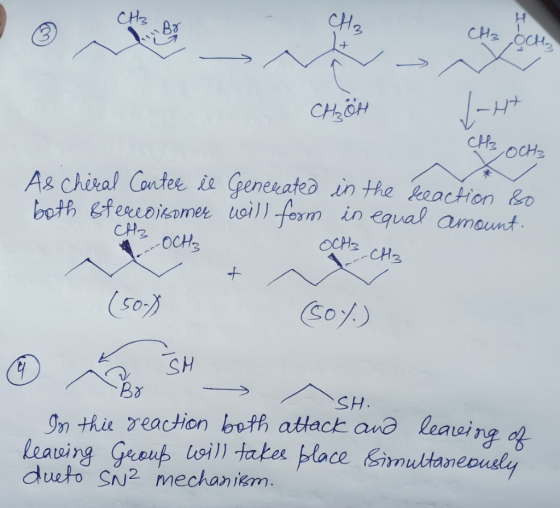
3. Draw the products of the following Sn1 reaction: H₃C Br + CH3OH-02 tot (R)-3-Bromo-3-methylhexane 4....
Draw the SN1 mechanism of the reaction between (R)-3-methylhexane and ethanol. Show lone pairs, electron pushing...
 Draw the SN1 mechanism of the reaction between (R)-3-methylhexane
and ethanol. Show lone pairs, electron pushing arrows, 3-D view to
reflect appropriate stereochemistry, reactants,intermediates, and
products. name the product. draw and completely label a reaction
energy diagram corresponding to the mechanism you have drawn.
B. Draw the Snl mechanism of the reaction between (R)-3-bromo-3-methylhexane and ethanol. Show lone pairs, electron pushing arrows, 3-D view to reflect appropriate stereochemistry, reactants, intermediates, and products. You do not have to show transition states....
Draw the SN1 mechanism of the reaction between (R)-3-methylhexane
and ethanol. Show lone pairs, electron pushing arrows, 3-D view to
reflect appropriate stereochemistry, reactants,intermediates, and
products. name the product. draw and completely label a reaction
energy diagram corresponding to the mechanism you have drawn.
B. Draw the Snl mechanism of the reaction between (R)-3-bromo-3-methylhexane and ethanol. Show lone pairs, electron pushing arrows, 3-D view to reflect appropriate stereochemistry, reactants, intermediates, and products. You do not have to show transition states....
1.1 What is the major product formed upon treatment of (R) 1-bromo-4-methylhexane with sodium cyanide? Draw...
 1.1 What is the major product formed upon treatment of (R)
1-bromo-4-methylhexane with sodium cyanide? Draw the structure of
your selection.
a.(R) 1-cyano-4-methylhexane
b.(S) 1-cyano-4-methylhexane
c.(R) 4-methyl-1-hexene
d.(S) 4-methyl-1-hexene
1.2 What is the major product formed upon treatment of (R)
2-bromohexane with sodium cyanide? Draw the structure of your
selection
a.(R) 2-cyanohexane
b.(S)2-cyanohexane
c. 1-hexene
d. 2-hexene
1.3 Select the major organic product obtained from the following
reaction
1.4 Select the major organic product obtained from the following
reaction
1.5...
1.1 What is the major product formed upon treatment of (R)
1-bromo-4-methylhexane with sodium cyanide? Draw the structure of
your selection.
a.(R) 1-cyano-4-methylhexane
b.(S) 1-cyano-4-methylhexane
c.(R) 4-methyl-1-hexene
d.(S) 4-methyl-1-hexene
1.2 What is the major product formed upon treatment of (R)
2-bromohexane with sodium cyanide? Draw the structure of your
selection
a.(R) 2-cyanohexane
b.(S)2-cyanohexane
c. 1-hexene
d. 2-hexene
1.3 Select the major organic product obtained from the following
reaction
1.4 Select the major organic product obtained from the following
reaction
1.5...
Draw the products for the following reactions first assuming they occur by an SN1 mechanism and...
 Draw the products for the following reactions first assuming they occur by an SN1 mechanism and then for an SN2 mechanism. 2. 0-Na -00 OH () Br +NaOH H-O-Na ? (iii) ulll OH +NaOH Нас" CH3 (v) CН3З CH0NA ? +NaOCHs
9. a) Write the detailed Sn1 mechanism for the reaction of (S)-3-bromo-3-methylhexane with H20, showing curved...
 9. a) Write the detailed Sn1 mechanism for the reaction of (S)-3-bromo-3-methylhexane with H20, showing curved arrows, relevant lone pairs, formal charges, stereochemistry for each step. Include any transition states and/or intermediates, and name the product(s). b) A racemic mixture results from a reaction of the chiral alkylbromide starting material below, and acetate. at hope ܬ Write the complete mechanism for the synthesis. Show the curly arrows, relevant lone pairs and all formal charges for each step. Include any transition...
3. (continued) For each reaction, draw the structure of the major product(s) including stereochemistry where appropriate....
 3. (continued) For each reaction, draw the structure of the major product(s) including stereochemistry where appropriate. Fill in the box below each arrow with the mechanism(s) that will be followed (SN1/E1, SN2, or E2). For SN1/E1 reactions, draw products for both. g) Сн,сн,он h) CH2O- Na CH3OH i) Me. Br A Eto Nat Me
Predict the most likely reaction mechanism (SN1, SN2, E1, E2) and draw all products. Nato=CH₂ E2 ran Br major 2. Dr...
 Predict the most likely reaction mechanism (SN1, SN2, E1, E2) and draw all products. Nato=CH₂ E2 ran Br major 2. Draw complete mechanism with arrows for the SN1/E1 mechanism. Check for carbocation rearrangements. CH3 SMI 애 + H₂O7
1.1What is the major product formed upon radical bromination of (S)-3-methylhexane? Select the best response. Draw...
1.1What is the major product formed upon radical bromination of (S)-3-methylhexane? Select the best response. Draw the full mechanism. A. (S)-3-bromo-3-methylhexane B. (R)-3-bromo-3-methylhexane C. A mixture of (R) and (S) 3-Bromo-3-methylhexane D. (3R)-1-bromo-3-methylhexane 1.2 What is the major product obtained from the reaction of 2-methyl-2-butene with hydrogen bromide in the presence of peroxides?Select the best response. Draw the mechanism. A. 2,3-dibromo-2-methylbutane B. 2-bromo-3-methylbutane C. 2-bromo-2-methylbutane D. (E)-1-bromo-2-methyl-2-butene 1.3 There are 4 major products formed upon treatment of (E)-3-methyl-2-hexene with HBr...
30. Late papers not accepted. Work Independently. 1. Predict the most likely reaction mechanism (SN1, SN2,...
 30. Late papers not accepted. Work Independently. 1. Predict the most likely reaction mechanism (SN1, SN2, E1, E2) and draw all products. CH₂ Na O=CH₂ Hic Br 2 Draw complete mechanism with arrows for the SNI/E1 mechanism. Check for carbocation rearrangements CH3 + H2O 3. Which is the major product for the following reaction? Y CH + NaOH CH HO HO H₃ CH₂ H₃ HOCH CH₂ H₃ CHE CH₂ CH₂ CH3 CH 4. Name the following including the R/S, E/Z...
Draw the products of the following reaction and identify the following as SN1, SN2. For letters...
 Draw the products of
the following reaction and identify the following as SN1, SN2. For
letters G and H.
NaOH DMSO g. OB Br NaCN h. 2.. Draw the products of the following reaction and label the follow SN2, E1 or E2 reaction. { HEAT FAVORS ELIMINATION}(18 poi 0BN is a bulty hindved proton C 30 carbau so v CH3 CI DBN a. El el Br NaOEt, heat - NaBv Na08t isa protic solvcut ad involee Ad cliuinitiar Readrans b....
Draw the products of
the following reaction and identify the following as SN1, SN2. For
letters G and H.
NaOH DMSO g. OB Br NaCN h. 2.. Draw the products of the following reaction and label the follow SN2, E1 or E2 reaction. { HEAT FAVORS ELIMINATION}(18 poi 0BN is a bulty hindved proton C 30 carbau so v CH3 CI DBN a. El el Br NaOEt, heat - NaBv Na08t isa protic solvcut ad involee Ad cliuinitiar Readrans b....
S-3-chloro-3-methylhexane reacts with an iodide anion, I-. a) Will this reaction proceed via an SN1, SN2,...
S-3-chloro-3-methylhexane reacts with an iodide anion, I-. a) Will this reaction proceed via an SN1, SN2, E1, or E2 reaction mechanism? b) What is the IUPAC name of the product(s) of this reaction? Include R and S designations if relevant. c) After the reaction has occurred, will the product solution be optically active?
 Draw the SN1 mechanism of the reaction between (R)-3-methylhexane
and ethanol. Show lone pairs, electron pushing arrows, 3-D view to
reflect appropriate stereochemistry, reactants,intermediates, and
products. name the product. draw and completely label a reaction
energy diagram corresponding to the mechanism you have drawn.
B. Draw the Snl mechanism of the reaction between (R)-3-bromo-3-methylhexane and ethanol. Show lone pairs, electron pushing arrows, 3-D view to reflect appropriate stereochemistry, reactants, intermediates, and products. You do not have to show transition states....
Draw the SN1 mechanism of the reaction between (R)-3-methylhexane
and ethanol. Show lone pairs, electron pushing arrows, 3-D view to
reflect appropriate stereochemistry, reactants,intermediates, and
products. name the product. draw and completely label a reaction
energy diagram corresponding to the mechanism you have drawn.
B. Draw the Snl mechanism of the reaction between (R)-3-bromo-3-methylhexane and ethanol. Show lone pairs, electron pushing arrows, 3-D view to reflect appropriate stereochemistry, reactants, intermediates, and products. You do not have to show transition states....
 1.1 What is the major product formed upon treatment of (R)
1-bromo-4-methylhexane with sodium cyanide? Draw the structure of
your selection.
a.(R) 1-cyano-4-methylhexane
b.(S) 1-cyano-4-methylhexane
c.(R) 4-methyl-1-hexene
d.(S) 4-methyl-1-hexene
1.2 What is the major product formed upon treatment of (R)
2-bromohexane with sodium cyanide? Draw the structure of your
selection
a.(R) 2-cyanohexane
b.(S)2-cyanohexane
c. 1-hexene
d. 2-hexene
1.3 Select the major organic product obtained from the following
reaction
1.4 Select the major organic product obtained from the following
reaction
1.5...
1.1 What is the major product formed upon treatment of (R)
1-bromo-4-methylhexane with sodium cyanide? Draw the structure of
your selection.
a.(R) 1-cyano-4-methylhexane
b.(S) 1-cyano-4-methylhexane
c.(R) 4-methyl-1-hexene
d.(S) 4-methyl-1-hexene
1.2 What is the major product formed upon treatment of (R)
2-bromohexane with sodium cyanide? Draw the structure of your
selection
a.(R) 2-cyanohexane
b.(S)2-cyanohexane
c. 1-hexene
d. 2-hexene
1.3 Select the major organic product obtained from the following
reaction
1.4 Select the major organic product obtained from the following
reaction
1.5...
 Draw the products for the following reactions first assuming they occur by an SN1 mechanism and then for an SN2 mechanism. 2. 0-Na -00 OH () Br +NaOH H-O-Na ? (iii) ulll OH +NaOH Нас" CH3 (v) CН3З CH0NA ? +NaOCHs
 9. a) Write the detailed Sn1 mechanism for the reaction of (S)-3-bromo-3-methylhexane with H20, showing curved arrows, relevant lone pairs, formal charges, stereochemistry for each step. Include any transition states and/or intermediates, and name the product(s). b) A racemic mixture results from a reaction of the chiral alkylbromide starting material below, and acetate. at hope ܬ Write the complete mechanism for the synthesis. Show the curly arrows, relevant lone pairs and all formal charges for each step. Include any transition...
 3. (continued) For each reaction, draw the structure of the major product(s) including stereochemistry where appropriate. Fill in the box below each arrow with the mechanism(s) that will be followed (SN1/E1, SN2, or E2). For SN1/E1 reactions, draw products for both. g) Сн,сн,он h) CH2O- Na CH3OH i) Me. Br A Eto Nat Me
 Predict the most likely reaction mechanism (SN1, SN2, E1, E2) and draw all products. Nato=CH₂ E2 ran Br major 2. Draw complete mechanism with arrows for the SN1/E1 mechanism. Check for carbocation rearrangements. CH3 SMI 애 + H₂O7
 30. Late papers not accepted. Work Independently. 1. Predict the most likely reaction mechanism (SN1, SN2, E1, E2) and draw all products. CH₂ Na O=CH₂ Hic Br 2 Draw complete mechanism with arrows for the SNI/E1 mechanism. Check for carbocation rearrangements CH3 + H2O 3. Which is the major product for the following reaction? Y CH + NaOH CH HO HO H₃ CH₂ H₃ HOCH CH₂ H₃ CHE CH₂ CH₂ CH3 CH 4. Name the following including the R/S, E/Z...
 Draw the products of
the following reaction and identify the following as SN1, SN2. For
letters G and H.
NaOH DMSO g. OB Br NaCN h. 2.. Draw the products of the following reaction and label the follow SN2, E1 or E2 reaction. { HEAT FAVORS ELIMINATION}(18 poi 0BN is a bulty hindved proton C 30 carbau so v CH3 CI DBN a. El el Br NaOEt, heat - NaBv Na08t isa protic solvcut ad involee Ad cliuinitiar Readrans b....
Draw the products of
the following reaction and identify the following as SN1, SN2. For
letters G and H.
NaOH DMSO g. OB Br NaCN h. 2.. Draw the products of the following reaction and label the follow SN2, E1 or E2 reaction. { HEAT FAVORS ELIMINATION}(18 poi 0BN is a bulty hindved proton C 30 carbau so v CH3 CI DBN a. El el Br NaOEt, heat - NaBv Na08t isa protic solvcut ad involee Ad cliuinitiar Readrans b....
Most questions answered within 3 hours.
-
Where is the error in this code sequence?
String s1 = "Hello";
String s2 = "ello";...
asked 11 months ago -
Financial data for Joel de Paris, Inc., for last year
follow:
Joel de Paris, Inc.
Balance...
asked 11 months ago -
Consider this reaction:
Al2(SO4)3 (aq)+ BaCl3
(aq) Al2Cl6 (aq)- +
3BaSO4(s) . What is the...
asked 11 months ago -
Suppose that Savneet is considering increasing her
recent random sample from 20 car rentals to 40...
asked 11 months ago -
Trucks arrive at an unloading terminal at an average rate of 120
per hour.
Trucks arrive...
asked 11 months ago -
Why are methanol and ethanol completely soluble in water while
octanol is not very little soluble....
asked 11 months ago -
A facilities manager at a university reads in a research report
that the mean amount of...
asked 11 months ago -
When the CuSO4 is rehydrated by adding water to the anhydrous
compound, is this an endothermic...
asked 11 months ago -
A ray of sunlight is passing from diamond into crown glass; the
angle of incidence is...
asked 11 months ago -
A block of mass 0.249 kg is placed on top of a light, vertical
spring of...
asked 11 months ago -
how do the kidneys compensate in the presences of acidosis
a) trigger hyperventilate
b) reserve acid...
asked 11 months ago -
Question 501 pts
The rental rate of capital to the firm increases. Which of the
following...
asked 11 months ago