
Homework Answers
Add Answer to:
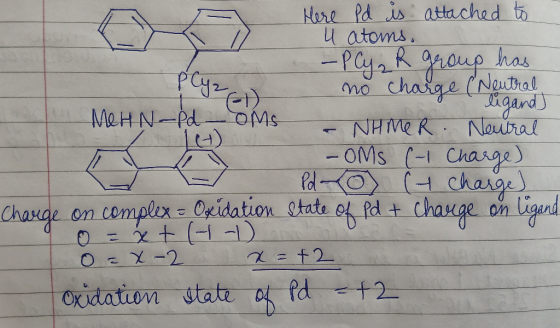
2. The molecule below is currently sold as a pre-catalyst for Buchwald-Hartwig coupling reactions. Cyap MeHN-PO-OMS...
write a 2-step mechanism to convert the pre-catalyst above to the active Pd catalyst upon the...
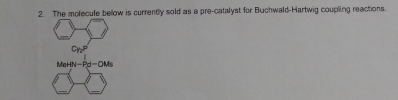 write a 2-step mechanism to convert the pre-catalyst above to
the active Pd catalyst upon the addition of base. please include
all products of the reaction.
2. The molecule below is currently sold as a pre-catalyst for Buchwald-Hartwig coupling reactions. CY2P MeHN-Pd-OMs
write a 2-step mechanism to convert the pre-catalyst above to
the active Pd catalyst upon the addition of base. please include
all products of the reaction.
2. The molecule below is currently sold as a pre-catalyst for Buchwald-Hartwig coupling reactions. CY2P MeHN-Pd-OMs
21.18 Predict the product from each of the folllowing reactions. B(OH)2 Pd catalyst Ho,C Pd catalyst...
 21.18 Predict the product from each of the folllowing reactions. B(OH)2 Pd catalyst Ho,C Pd catalyst HN (The product is used as a fluorescent labeling agent in automated DNA sequencing. See Section 25.6A.) Pd catalyst NH PPO
198 CHAPTER 5 Chemical Reactions Practice Problems 5.24 Determine if the reactions in Problem 500 reversible or ir...
 198 CHAPTER 5 Chemical Reactions Practice Problems 5.24 Determine if the reactions in Problem 500 reversible or irreversible. 5.25 Write the products and balance the follos tion for the complete combustion of ethane CH() + O2(g) —? 5.21 Categorize the following reactions as synthesis, decomposition, or exchange reactions in the forward direction: a. Cuo(s) + 2HCl(aq) —> CuCl2(aq) + H2O(1) b. CH,206(ag) -> 2C,H,O(aq) + 2CO (9) c. 2H269) + O2(8) = 2H2O) 5.22 Categorize the following reactions as synthesis,...
2. Briefly explain why ethanol, and not hexane, was used as a solvent in this reaction?...
 2. Briefly explain why ethanol, and not hexane, was used as a solvent in this reaction? 3. Why it is necessary to filter the crude coupling product through a column of anhydrous MgSO4? 4. Briefly explain why aryl bromides and iodides, rather than aryl chlorides or fluorides, are typically used as substrates in Pd-catalyzed coupling reactions. 5. Propose a synthesis for the molecule A shown below, using benzene, phenyl boronic acid, tert-butyl bromide and any inorganic reagents needed. A retrosynthetic...
1. What is meant by the term precatalyst? Draw the structure of the catalyst that actively...
 1. What is meant by the term precatalyst? Draw the
structure of the catalyst that actively performs the isomerization
of 1-heptene.
2. What is the oxidation state of nickel in NiCl2, the
precatalyst, and the active catalyst?
3. Is the reaction for the formation of the catalyst
(13-2) an oxidation/reduction reaction? If so, what is being
oxidized and what is being reduced?
I frankly don't even know where to begin. Thank you in
advance; all the information I have is...
1. What is meant by the term precatalyst? Draw the
structure of the catalyst that actively performs the isomerization
of 1-heptene.
2. What is the oxidation state of nickel in NiCl2, the
precatalyst, and the active catalyst?
3. Is the reaction for the formation of the catalyst
(13-2) an oxidation/reduction reaction? If so, what is being
oxidized and what is being reduced?
I frankly don't even know where to begin. Thank you in
advance; all the information I have is...
For each of the following alkynes perform all the reactions shown below . h. Lindlar's Catalyst,...
 For
each of the following alkynes perform all the reactions shown below
.
h. Lindlar's Catalyst, H . LI, NH . KMno k. 1.Os, 2. Zn/HCI
For
each of the following alkynes perform all the reactions shown below
.
h. Lindlar's Catalyst, H . LI, NH . KMno k. 1.Os, 2. Zn/HCI
Question 12 (1 point) What product is expected from the sequence of reactions shown below. 1....
 Question 12 (1 point) What product is expected from the sequence of reactions shown below. 1. Cl2 / CCIA 2. 2KOH /heat 3. H2 / Lindlar's catalyst O i E 100 + % & Po 3. H2 / Lindlar's catalyst O A OD * E O AI & o 9 8 % 7 5 6 u
What are the products of the following reactions? Part A + H, Pd/C Draw the molecule...
 What are the products of the following reactions?
Part A + H, Pd/C Draw the molecule on the canvas by choosing buttons from the Tools bond is active by default. D) , o . H: 1200 @ray . \'Z Part B Lindlar + H2 catalyst Draw the molecule on the canvas by choosing buttons from the Tools bond is active by default. D , 0, Ⓡ. H: 1200 mm Part Na NH3(liq) -78 °C Draw the molecule on the canvas...
What are the products of the following reactions?
Part A + H, Pd/C Draw the molecule on the canvas by choosing buttons from the Tools bond is active by default. D) , o . H: 1200 @ray . \'Z Part B Lindlar + H2 catalyst Draw the molecule on the canvas by choosing buttons from the Tools bond is active by default. D , 0, Ⓡ. H: 1200 mm Part Na NH3(liq) -78 °C Draw the molecule on the canvas...
Which of the following reactions can be used to prepare the compound below? Ph ? Ph...
 Which of the following reactions can be used to prepare the compound below? Ph ? Ph Select one or more: B-H Ph Ph-Br, Pd(PPh), KOH ? Ph- ? a. Ph (1) Li, hexanes (2) Cul Ph Br Ph Ph-Br ? ? b. Ph Pd(PPhz), KOH Ph Br Ph + Ph-B(OME) ? Ph C. Ph Ph Ph-Br Pd(PPhz), Et N ? d. Ph Ph Ph Grubbs catalyst ? e. Ph
Which of the following reactions can be used to prepare the compound below? ? Ph Ph...
 Which of the following reactions can be used to prepare the compound below? ? Ph Ph Select one or more: (1) Li, hexanes (2) Cul ? Br Ph Ph-Br Ph Ph ? a. Ph + Ph-Br Pd(PPh.)., Et N ? Ph Ph b. Ph Grubbs catalyst ? Ph Ph c. Pd(PPh ).. KOH BO Ph Ph-B(OME) Ph d. ? Ph BH Ph-Br Pd(PPh ). KOH Ph ? Ph Ph e
 write a 2-step mechanism to convert the pre-catalyst above to
the active Pd catalyst upon the addition of base. please include
all products of the reaction.
2. The molecule below is currently sold as a pre-catalyst for Buchwald-Hartwig coupling reactions. CY2P MeHN-Pd-OMs
write a 2-step mechanism to convert the pre-catalyst above to
the active Pd catalyst upon the addition of base. please include
all products of the reaction.
2. The molecule below is currently sold as a pre-catalyst for Buchwald-Hartwig coupling reactions. CY2P MeHN-Pd-OMs
 21.18 Predict the product from each of the folllowing reactions. B(OH)2 Pd catalyst Ho,C Pd catalyst HN (The product is used as a fluorescent labeling agent in automated DNA sequencing. See Section 25.6A.) Pd catalyst NH PPO
 198 CHAPTER 5 Chemical Reactions Practice Problems 5.24 Determine if the reactions in Problem 500 reversible or irreversible. 5.25 Write the products and balance the follos tion for the complete combustion of ethane CH() + O2(g) —? 5.21 Categorize the following reactions as synthesis, decomposition, or exchange reactions in the forward direction: a. Cuo(s) + 2HCl(aq) —> CuCl2(aq) + H2O(1) b. CH,206(ag) -> 2C,H,O(aq) + 2CO (9) c. 2H269) + O2(8) = 2H2O) 5.22 Categorize the following reactions as synthesis,...
 2. Briefly explain why ethanol, and not hexane, was used as a solvent in this reaction? 3. Why it is necessary to filter the crude coupling product through a column of anhydrous MgSO4? 4. Briefly explain why aryl bromides and iodides, rather than aryl chlorides or fluorides, are typically used as substrates in Pd-catalyzed coupling reactions. 5. Propose a synthesis for the molecule A shown below, using benzene, phenyl boronic acid, tert-butyl bromide and any inorganic reagents needed. A retrosynthetic...
 1. What is meant by the term precatalyst? Draw the
structure of the catalyst that actively performs the isomerization
of 1-heptene.
2. What is the oxidation state of nickel in NiCl2, the
precatalyst, and the active catalyst?
3. Is the reaction for the formation of the catalyst
(13-2) an oxidation/reduction reaction? If so, what is being
oxidized and what is being reduced?
I frankly don't even know where to begin. Thank you in
advance; all the information I have is...
1. What is meant by the term precatalyst? Draw the
structure of the catalyst that actively performs the isomerization
of 1-heptene.
2. What is the oxidation state of nickel in NiCl2, the
precatalyst, and the active catalyst?
3. Is the reaction for the formation of the catalyst
(13-2) an oxidation/reduction reaction? If so, what is being
oxidized and what is being reduced?
I frankly don't even know where to begin. Thank you in
advance; all the information I have is...
 For
each of the following alkynes perform all the reactions shown below
.
h. Lindlar's Catalyst, H . LI, NH . KMno k. 1.Os, 2. Zn/HCI
For
each of the following alkynes perform all the reactions shown below
.
h. Lindlar's Catalyst, H . LI, NH . KMno k. 1.Os, 2. Zn/HCI
 Question 12 (1 point) What product is expected from the sequence of reactions shown below. 1. Cl2 / CCIA 2. 2KOH /heat 3. H2 / Lindlar's catalyst O i E 100 + % & Po 3. H2 / Lindlar's catalyst O A OD * E O AI & o 9 8 % 7 5 6 u
 What are the products of the following reactions?
Part A + H, Pd/C Draw the molecule on the canvas by choosing buttons from the Tools bond is active by default. D) , o . H: 1200 @ray . \'Z Part B Lindlar + H2 catalyst Draw the molecule on the canvas by choosing buttons from the Tools bond is active by default. D , 0, Ⓡ. H: 1200 mm Part Na NH3(liq) -78 °C Draw the molecule on the canvas...
What are the products of the following reactions?
Part A + H, Pd/C Draw the molecule on the canvas by choosing buttons from the Tools bond is active by default. D) , o . H: 1200 @ray . \'Z Part B Lindlar + H2 catalyst Draw the molecule on the canvas by choosing buttons from the Tools bond is active by default. D , 0, Ⓡ. H: 1200 mm Part Na NH3(liq) -78 °C Draw the molecule on the canvas...
 Which of the following reactions can be used to prepare the compound below? Ph ? Ph Select one or more: B-H Ph Ph-Br, Pd(PPh), KOH ? Ph- ? a. Ph (1) Li, hexanes (2) Cul Ph Br Ph Ph-Br ? ? b. Ph Pd(PPhz), KOH Ph Br Ph + Ph-B(OME) ? Ph C. Ph Ph Ph-Br Pd(PPhz), Et N ? d. Ph Ph Ph Grubbs catalyst ? e. Ph
 Which of the following reactions can be used to prepare the compound below? ? Ph Ph Select one or more: (1) Li, hexanes (2) Cul ? Br Ph Ph-Br Ph Ph ? a. Ph + Ph-Br Pd(PPh.)., Et N ? Ph Ph b. Ph Grubbs catalyst ? Ph Ph c. Pd(PPh ).. KOH BO Ph Ph-B(OME) Ph d. ? Ph BH Ph-Br Pd(PPh ). KOH Ph ? Ph Ph e
Most questions answered within 3 hours.
-
Where is the error in this code sequence?
String s1 = "Hello";
String s2 = "ello";...
asked 10 months ago -
Financial data for Joel de Paris, Inc., for last year
follow:
Joel de Paris, Inc.
Balance...
asked 10 months ago -
Consider this reaction:
Al2(SO4)3 (aq)+ BaCl3
(aq) Al2Cl6 (aq)- +
3BaSO4(s) . What is the...
asked 10 months ago -
Suppose that Savneet is considering increasing her
recent random sample from 20 car rentals to 40...
asked 10 months ago -
Trucks arrive at an unloading terminal at an average rate of 120
per hour.
Trucks arrive...
asked 10 months ago -
Why are methanol and ethanol completely soluble in water while
octanol is not very little soluble....
asked 10 months ago -
A facilities manager at a university reads in a research report
that the mean amount of...
asked 10 months ago -
When the CuSO4 is rehydrated by adding water to the anhydrous
compound, is this an endothermic...
asked 10 months ago -
A ray of sunlight is passing from diamond into crown glass; the
angle of incidence is...
asked 10 months ago -
A block of mass 0.249 kg is placed on top of a light, vertical
spring of...
asked 10 months ago -
how do the kidneys compensate in the presences of acidosis
a) trigger hyperventilate
b) reserve acid...
asked 10 months ago -
Question 501 pts
The rental rate of capital to the firm increases. Which of the
following...
asked 10 months ago