

Homework Answers
Add Answer to:
Part A Identify each of the following as an oxidation or a reduction. Drag the appropriate...
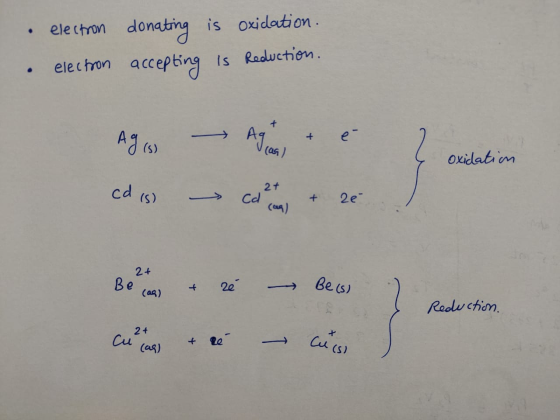
(1) Identify each of the following half-reactions as either an oxidation half-reaction or a reduction half-reaction....
(1) Identify each of the following half-reactions as either an oxidation half-reaction or a reduction half-reaction. half-reaction identification Cd(s)Cd2+(aq) + 2e- Ag+(aq) + e-Ag(s) Write a balanced equation for the overall redox reaction. Use smallest possible integer coefficients. ? + ? ? + ? 2. Identify each of the following half-reactions as either an oxidation half-reaction or a reduction half-reaction. half-reaction identification Mn(s)Mn2+(aq) + 2e- Zn2+(aq) + 2e-Zn(s) (2) Write a balanced equation for the overall redox reaction. Use smallest...
(1) Identify each of the following half-reactions as either an oxidation half-reaction or a reduction half...
 (1) Identify each of the following half-reactions as either an oxidation half-reaction or a reduction half reaction. identification half-reaction Ni (aq)+2e reduction Ni(s) Cd2 (aq) +2e oxidation Cd(s)- (2) Write a balanced equation for the overall redox reaction. Use smallest possible integer coefficients. + +
Identify the species (atoms/ elements) undergoing oxidation and reduction in the following equations, assign oxidation numbers...
 Identify the species (atoms/ elements) undergoing oxidation and
reduction in the following equations, assign oxidation numbers to
each, and write balanced net ionic equations.
a) Cu(s)
Cu2+(aq) + 2e-
b) Cl2(aq) + 2e-
Cl-(aq)
c) Cu(s) + Cl2(aq)
Cu2+(aq) + 2Cl-(aq)
d) 4CuO(s) + CH4(g)
4Cu(s) + CO2(g) + 2H2O(l)
e) 2CuSO4(aq) + 4KI(aq)
2CuI (aq) + 2K2SO4(aq) +
I2(aq)
f) Cu2O(s) + Fe(SO4)3 (aq) +
H2SO4(aq)
2CuSO4(aq) + 2FeSO4(aq) +
H2O(l)
Identify the species (atoms/ elements) undergoing oxidation and
reduction in the following equations, assign oxidation numbers to
each, and write balanced net ionic equations.
a) Cu(s)
Cu2+(aq) + 2e-
b) Cl2(aq) + 2e-
Cl-(aq)
c) Cu(s) + Cl2(aq)
Cu2+(aq) + 2Cl-(aq)
d) 4CuO(s) + CH4(g)
4Cu(s) + CO2(g) + 2H2O(l)
e) 2CuSO4(aq) + 4KI(aq)
2CuI (aq) + 2K2SO4(aq) +
I2(aq)
f) Cu2O(s) + Fe(SO4)3 (aq) +
H2SO4(aq)
2CuSO4(aq) + 2FeSO4(aq) +
H2O(l)
Given the following standard reduction potentials choose the cell which will work as a voltaic cell....
 Given the following standard reduction potentials choose the cell which will work as a voltaic cell. All cells below are written according to the usual cell diagram convention. Cu2+(aq) + 2e → Cu(s) E° = 0.34 V 2H+(aq) + 2e → H2(g) E° = 0.00 V Sn2+ (aq) + 2e → Sn(s) E° = -0.14 V Ni2+(aq) + 2e → Ni(s) E° = -0.26 V Cd2+(aq) + 2e → → Cd(s) E° = -0.40 V Sn(s) | Sn2+(aq) || Ni2+(aq)...
Refer to this table of reduction potentials to answer the questions. Reduction half-reaction Potential (V) +2.87...
 Refer to this table of reduction potentials to answer the questions. Reduction half-reaction Potential (V) +2.87 Electrolytic cells use electricity to cause a nonspontaneous redox reaction to occur. An electrolytic cell is constructed using the following components: • a power source, such as a battery, • the substance that will undergo electrolysis, and • two inert electrodes (usually platinum), which serve as the electrical connection between the power source and the substance undergoing electrolysis. As with any cell, oxidation occurs...
Part A Identify each of the following compounds as an aldehyde or a ketone. Drag the...
 Part A Identify each of the following compounds as an aldehyde or a ketone. Drag the appropriate items to their respective bins. H3C 0 CH3-CH-6-H Aldehyde Ketone
7.14 Identify each of the following as an oxidation or a reduction: A. O2(g)+4 e--202-(aq) Oxidation...
 7.14 Identify each of the following as an oxidation or a reduction: A. O2(g)+4 e--202-(aq) Oxidation B. Ag(s) Ag+(aq)+e- reduction C. Fe3+(aq)+e-Fe2+(aq) reduction D. 2Br-(aq) →Br2(1)+2 e- oxidation
8) Part C Classify the following mixtures as homogeneous or heterogeneous. Drag the appropriate i...
8) Part C Classify the following mixtures as homogeneous or heterogeneous. Drag the appropriate items to their respective bins. 1)steel 2)vodka 3)compost 4)honey 5)fruit salad Part B Classify each of the following substances as an element, a compound, or a mixture. Drag the appropriate items to their respective bins. 1) soft drink 2) hydrogen peroxide, HOOH 3)boron nitride, BN 4) argon, Ar 5) copper, Cu
2 Identify each of the following solids as molecular, ionic, or atomic. Drag the appropriate items...
 2
Identify each of the following solids as molecular, ionic, or atomic. Drag the appropriate items to their respective bins. Reset Help CS,(s) Cal (s) 1,(s) Pt(s) mic lonic Molecular
2
Identify each of the following solids as molecular, ionic, or atomic. Drag the appropriate items to their respective bins. Reset Help CS,(s) Cal (s) 1,(s) Pt(s) mic lonic Molecular
Separate the following redox reactions into half-reactions, and label each half-reaction as oxidation or reduction. Part...
Separate the following redox reactions into half-reactions, and label each half-reaction as oxidation or reduction. Part A Oxidation half-reaction for 2Li(s)+2H+(aq)→2Li+(aq)+H2(g). Express your answer as a chemical equation. Identify all of the phases in your answer. Part B Oxidation half-reaction for 2Ag+(aq)+Be(s)→Be2+(aq)+2Ag(s). Express your answer as a chemical equation. Identify all of the phases in your answer.
 (1) Identify each of the following half-reactions as either an oxidation half-reaction or a reduction half reaction. identification half-reaction Ni (aq)+2e reduction Ni(s) Cd2 (aq) +2e oxidation Cd(s)- (2) Write a balanced equation for the overall redox reaction. Use smallest possible integer coefficients. + +
 Identify the species (atoms/ elements) undergoing oxidation and
reduction in the following equations, assign oxidation numbers to
each, and write balanced net ionic equations.
a) Cu(s)
Cu2+(aq) + 2e-
b) Cl2(aq) + 2e-
Cl-(aq)
c) Cu(s) + Cl2(aq)
Cu2+(aq) + 2Cl-(aq)
d) 4CuO(s) + CH4(g)
4Cu(s) + CO2(g) + 2H2O(l)
e) 2CuSO4(aq) + 4KI(aq)
2CuI (aq) + 2K2SO4(aq) +
I2(aq)
f) Cu2O(s) + Fe(SO4)3 (aq) +
H2SO4(aq)
2CuSO4(aq) + 2FeSO4(aq) +
H2O(l)
Identify the species (atoms/ elements) undergoing oxidation and
reduction in the following equations, assign oxidation numbers to
each, and write balanced net ionic equations.
a) Cu(s)
Cu2+(aq) + 2e-
b) Cl2(aq) + 2e-
Cl-(aq)
c) Cu(s) + Cl2(aq)
Cu2+(aq) + 2Cl-(aq)
d) 4CuO(s) + CH4(g)
4Cu(s) + CO2(g) + 2H2O(l)
e) 2CuSO4(aq) + 4KI(aq)
2CuI (aq) + 2K2SO4(aq) +
I2(aq)
f) Cu2O(s) + Fe(SO4)3 (aq) +
H2SO4(aq)
2CuSO4(aq) + 2FeSO4(aq) +
H2O(l)
 Given the following standard reduction potentials choose the cell which will work as a voltaic cell. All cells below are written according to the usual cell diagram convention. Cu2+(aq) + 2e → Cu(s) E° = 0.34 V 2H+(aq) + 2e → H2(g) E° = 0.00 V Sn2+ (aq) + 2e → Sn(s) E° = -0.14 V Ni2+(aq) + 2e → Ni(s) E° = -0.26 V Cd2+(aq) + 2e → → Cd(s) E° = -0.40 V Sn(s) | Sn2+(aq) || Ni2+(aq)...
 Refer to this table of reduction potentials to answer the questions. Reduction half-reaction Potential (V) +2.87 Electrolytic cells use electricity to cause a nonspontaneous redox reaction to occur. An electrolytic cell is constructed using the following components: • a power source, such as a battery, • the substance that will undergo electrolysis, and • two inert electrodes (usually platinum), which serve as the electrical connection between the power source and the substance undergoing electrolysis. As with any cell, oxidation occurs...
 Part A Identify each of the following compounds as an aldehyde or a ketone. Drag the appropriate items to their respective bins. H3C 0 CH3-CH-6-H Aldehyde Ketone
 7.14 Identify each of the following as an oxidation or a reduction: A. O2(g)+4 e--202-(aq) Oxidation B. Ag(s) Ag+(aq)+e- reduction C. Fe3+(aq)+e-Fe2+(aq) reduction D. 2Br-(aq) →Br2(1)+2 e- oxidation
 2
Identify each of the following solids as molecular, ionic, or atomic. Drag the appropriate items to their respective bins. Reset Help CS,(s) Cal (s) 1,(s) Pt(s) mic lonic Molecular
2
Identify each of the following solids as molecular, ionic, or atomic. Drag the appropriate items to their respective bins. Reset Help CS,(s) Cal (s) 1,(s) Pt(s) mic lonic Molecular
Most questions answered within 3 hours.
-
Where is the error in this code sequence?
String s1 = "Hello";
String s2 = "ello";...
asked 11 months ago -
Financial data for Joel de Paris, Inc., for last year
follow:
Joel de Paris, Inc.
Balance...
asked 11 months ago -
Consider this reaction:
Al2(SO4)3 (aq)+ BaCl3
(aq) Al2Cl6 (aq)- +
3BaSO4(s) . What is the...
asked 11 months ago -
Suppose that Savneet is considering increasing her
recent random sample from 20 car rentals to 40...
asked 11 months ago -
Trucks arrive at an unloading terminal at an average rate of 120
per hour.
Trucks arrive...
asked 11 months ago -
Why are methanol and ethanol completely soluble in water while
octanol is not very little soluble....
asked 11 months ago -
A facilities manager at a university reads in a research report
that the mean amount of...
asked 11 months ago -
When the CuSO4 is rehydrated by adding water to the anhydrous
compound, is this an endothermic...
asked 11 months ago -
A ray of sunlight is passing from diamond into crown glass; the
angle of incidence is...
asked 11 months ago -
A block of mass 0.249 kg is placed on top of a light, vertical
spring of...
asked 11 months ago -
how do the kidneys compensate in the presences of acidosis
a) trigger hyperventilate
b) reserve acid...
asked 11 months ago -
Question 501 pts
The rental rate of capital to the firm increases. Which of the
following...
asked 11 months ago