Select a spinal column deviation of your choice. Describe the mechanism of this deviation, grades of...
Select a spinal column deviation of your choice. Describe the mechanism of this deviation, grades of injury, any muscles, ligaments, bones, sensory receptors and other soft tissue structures involved in the deviation. Embed an image of the deviation. What challenges could this spinal deviation present to this individual?
Homework Answers
Scoliosis is S shaped deviation or side ways curvature of spine.
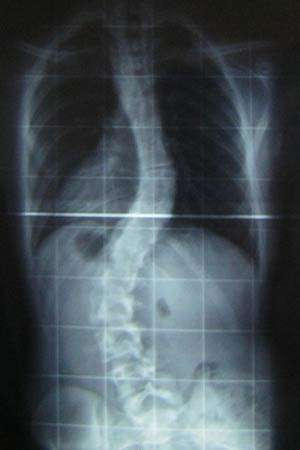
Scoliosis affect any age group but more common in children aged 10 to 15 years.Scoliosis affects about 2-3% of the pediatric age group and up to 30%of adults worldwide.Girls are affected eight times more than boys.Scoliosis may be a result of cerebral palsy , muscular dystrophy ,polio, any disease of vertebral column and any deformities while in womb of mother. Scoliosis causes back pain in adults. Older adults may also get affected by scoliosis as their bone density is declined . Usually the etiology of scoliosis is idiopathic.
Scoliosis is a deformity that is characterized by both sideways curvature and vertebral rotation. Vertebral rotation is the angle between the longitudinal axis of the vertebra and the mid-sagittal axis of the trunk (mid sagittal axis is the vertical plane dividing body into right and left side). The angle is shifted as the disease progresses, the vertebrae and spinous processes in the area of the major curve rotate toward the concavity of the curve. On the concave side of the curve, the ribs are close together and on convex side, the ribs remain separated.
As the vertebral bodies rotate in scoliosis, the spinous processes deviate towards the concave side followed by ribs. The anterior ribs on the concave side are pushed anteriorly and posterior ribs on the convex side are pushed posteriorly. Scoliosis can be treated .
As the spine is deviated , shape and size of thorax is altered resulting in any abnormalities in pulmonary function.In older adults more than 65 years of age commonly spinal stenosis, or narrowing of the spinal canal may occur leading to compression of the spinal nerves .If a curve is left untreated as a patient gets older scoliosis may cause major problems. If the curvature is more it may lead to more pain and imbalanced gait, since the body’s equilibrium is not maintained. In some cases if the angle of the curve is 70 degrees or greater, patients can suffer physical deformities. Such large curves can also cause pressure on the lungs, heart, and abdomen, leading to trouble breathing, fatigue, or early satiety, where the patient feels full after eating only a small amount of food due to their stomach being compressed.
Scoliosis causes back pain , uneven shoulders, misalignment of hip, and the curves may cause pressure on nerves nearby leading to numbness and weakness, body seems lean to one side.
Add Answer to:
Select a spinal column deviation of your choice. Describe the
mechanism of this deviation, grades of...
1. A. Name the three planes and the positions they each describe to identify a unique...
1. A. Name the three planes and the positions they each describe to identify a unique position in the human body. B. Name the two major ventral body cavities plus the major organs found in them. C. Name the cavities that the heart and lungs reside in. D. Finally, list the six levels of organization in nature. 2. A. Describe the three components of an atom in terms of charge and location. Define atomic mass and atomic number. B. For...
Assignment 5 Required Reading: Chapter 12 Head and Spinal Injuries
Assignment 5 Required Reading: Chapter 12 Head and Spinal Injuries, Chapter 13 Chest, abdominal, and Pelvic Injuries; Chapter 14 Bone, Join, and Muscle Injuries; Chapter 15 Extremity Injuries; Chapter 16 Splinting Extremities True or False- Mark each statement as true (T) or false (F)1. Remove objects embedded in an eyeball2. Scrub and rinse the roots of a knocked-out tooth3. Preserve a knocked-out tooth in mouth wash4. Inability to move the hands or feet, or both may indicate a spinal injury5. If...
1. According to the paper, what does lactate dehydrogenase (LDH) do and what does it allow...
 1. According to the paper, what does lactate dehydrogenase
(LDH) do and what does it allow to happen within the myofiber? (5
points)
2. According to the paper, what is the major disadvantage of
relying on glycolysis during high-intensity exercise? (5
points)
3. Using Figure 1 in the paper, briefly describe the different
sources of ATP production at 50% versus 90% AND explain whether you
believe this depiction of ATP production applies to a Type IIX
myofiber in a human....
1. According to the paper, what does lactate dehydrogenase
(LDH) do and what does it allow to happen within the myofiber? (5
points)
2. According to the paper, what is the major disadvantage of
relying on glycolysis during high-intensity exercise? (5
points)
3. Using Figure 1 in the paper, briefly describe the different
sources of ATP production at 50% versus 90% AND explain whether you
believe this depiction of ATP production applies to a Type IIX
myofiber in a human....
 1. According to the paper, what does lactate dehydrogenase
(LDH) do and what does it allow to happen within the myofiber? (5
points)
2. According to the paper, what is the major disadvantage of
relying on glycolysis during high-intensity exercise? (5
points)
3. Using Figure 1 in the paper, briefly describe the different
sources of ATP production at 50% versus 90% AND explain whether you
believe this depiction of ATP production applies to a Type IIX
myofiber in a human....
1. According to the paper, what does lactate dehydrogenase
(LDH) do and what does it allow to happen within the myofiber? (5
points)
2. According to the paper, what is the major disadvantage of
relying on glycolysis during high-intensity exercise? (5
points)
3. Using Figure 1 in the paper, briefly describe the different
sources of ATP production at 50% versus 90% AND explain whether you
believe this depiction of ATP production applies to a Type IIX
myofiber in a human....
Most questions answered within 3 hours.
-
Where is the error in this code sequence?
String s1 = "Hello";
String s2 = "ello";...
asked 10 months ago -
Financial data for Joel de Paris, Inc., for last year
follow:
Joel de Paris, Inc.
Balance...
asked 10 months ago -
Consider this reaction:
Al2(SO4)3 (aq)+ BaCl3
(aq) Al2Cl6 (aq)- +
3BaSO4(s) . What is the...
asked 10 months ago -
Suppose that Savneet is considering increasing her
recent random sample from 20 car rentals to 40...
asked 10 months ago -
Trucks arrive at an unloading terminal at an average rate of 120
per hour.
Trucks arrive...
asked 10 months ago -
Why are methanol and ethanol completely soluble in water while
octanol is not very little soluble....
asked 10 months ago -
A facilities manager at a university reads in a research report
that the mean amount of...
asked 10 months ago -
When the CuSO4 is rehydrated by adding water to the anhydrous
compound, is this an endothermic...
asked 10 months ago -
A ray of sunlight is passing from diamond into crown glass; the
angle of incidence is...
asked 10 months ago -
A block of mass 0.249 kg is placed on top of a light, vertical
spring of...
asked 10 months ago -
how do the kidneys compensate in the presences of acidosis
a) trigger hyperventilate
b) reserve acid...
asked 10 months ago -
Question 501 pts
The rental rate of capital to the firm increases. Which of the
following...
asked 10 months ago