
Homework Answers
Add Answer to:
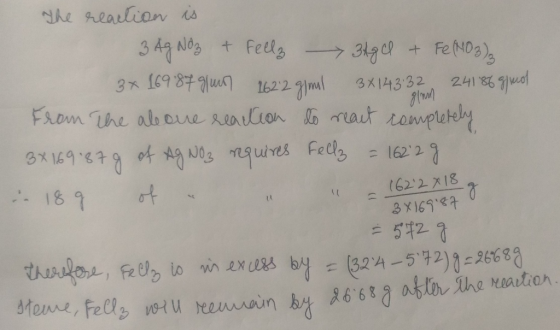
Silver nitrate, AgNOs, reacts with iron(III) chloride, FeCl3,to give silver chloride, AgCl, and iron(III) nitrate, Fe(NO3)....
For the following reaction, 5.09 grams of iron(II) chloride are mixed with excess silver nitrate Assume...
 For the following reaction, 5.09 grams of iron(II) chloride are mixed with excess silver nitrate Assume that the percent yield of iron(II) nitrate is 93.4% Iron(II) chloride(aq) + silver nitrate(aq) iron(II) nitrate(aq) + silver chloride(s) What is the ideal yield of iron(II) nitrate? What is the actual yield of iron(II) nitrate? grams grams Submit ANSWER Retry Entire Group 2 more group attempts remaining The equation for this reaction is: FeCl2(aq) + 2 AgNO3(aq) - Fe(NO3)2(aq) + 2 AgCl(s)
When silver nitrate reacts with barium chloride, silver chloride and barium nitrate are formed. 2AgNO_3(aq) +...
 When silver nitrate reacts with barium chloride, silver chloride and barium nitrate are formed. 2AgNO_3(aq) + BaCl_2(aq) rightarrow 2AgCl + Ba(NO_3)_2 What is the limiting reactant with 10.8 g of silver nitrate reacts with 15.0 g of barium chloride? What is the theoretical yield of the AgCl (in grams)? Limiting Reactant: How many grams of the excess reactant reacted? If the actual yield of AgCl was 9.314 g, what would the percent yield be? Is the percent yield reasonable? Explain...
A mixture consisting of only iron(III) chloride (FeCl3) and aluminum chloride (AlCl3) weighs 1.0397 g. When...
A mixture consisting of only iron(III) chloride (FeCl3) and aluminum chloride (AlCl3) weighs 1.0397 g. When the mixture is dissolved in water and an excess of silver nitrate is added, all the chloride ions associated with the original mixture are precipitated as insoluble silver chloride (AgCl). The mass of the silver chloride is found to be 3.0178 g. Calculate the mass percentages of iron(III) chloride and aluminum chloride in the original mixture. Mass percent FeCl3 = % Mass percent AlCl3...
The metathesis reaction between iron (III) nitrate and sodium sulfide is shown below 2 Fe(NO3)3(aq) +...
The metathesis reaction between iron (III) nitrate and sodium sulfide is shown below 2 Fe(NO3)3(aq) + 3 Na2S (aq) ➝ 6 NaNO3(aq) + Fe2S3(s) How many grams of solid iron (III) sulfide can be produced by the reaction of 250.0 ml of 0.400 M iron (III) nitrate solution with 350.0 ml of 0.250 M sodium sulfide solution? Determine the final concentration of each ion in solution at the end of the precipitation reaction. Na+ NO3– Fe+3 S–2
(A) For the following reaction, 5.83 grams of iron(II) chloride are mixed with excess silver nitrate....
(A) For the following reaction, 5.83 grams of iron(II) chloride are mixed with excess silver nitrate. The reaction yields 7.31grams of iron(II) nitrate. iron(II) chloride (aq) + silver nitrate (aq) iron(II) nitrate (aq) + silver chloride (s) What is the theoretical yield of iron(II) nitrate ? ____grams What is the percent yield of iron(II) nitrate ? __ % ----------------------------------------------- (B) According to the following reaction, how many grams of iodine are required for the complete reaction of 27.2 grams of...
For the following reaction, 4.96 grams of iron(II) chloride are mixed with excess silver nitrate. The...
For the following reaction, 4.96 grams of iron(II) chloride are mixed with excess silver nitrate. The reaction yields 5.72 grams of iron(II) nitrate. iron(II) chloride (aq) + silver nitrate (aq) ---> iron(II) nitrate (aq) + silver chloride (s) a. What is the theoretical yield of iron (ll) nitrate? b. What is the percent yield of iron (ll) nitrate?
Solutions of sodium carbonate and silver nitrate reacts to form silver carbonate and sodium nitrate. A...
 Solutions of sodium carbonate and silver nitrate reacts to form silver carbonate and sodium nitrate. A solution containing 2.35 g of sodium carbonate is mixed with one containing 12.8 g of silver nitrate. Show your work. Pay close attention to significant figures and units. Use 4 significant figures for the masses. Answers without work will receive a grade of 0 pts a) Write the chemical equation 2.359 Nalo 2 (sodem corrono b) Balanced the molecular equation c) Write the net...
a)What is the percent yield of the solid product when 16.56 g of iron(III) nitrate reacts...
a)What is the percent yield of the solid product when 16.56 g of iron(III) nitrate reacts in solution with excess sodium phosphate and 4.915 g of the precipitate is experimentally obtained? Fe(NO3)3(aq) + Na3PO4(aq) --> FePO4(s) + NaNO3(aq) [unbalanced] b) What is the experimental yield (in grams) of the solid product when the percent yield is 87.7 % when 8.134 g of barium chloride reacts in solution with excess sodium phosphate? BaCl2(aq) + Na3PO4(aq) --> Ba3(PO4)2(s) + NaCl(aq) [unbalanced]
One way the U.S. Environmental Protection Agency (EPA) tests for chloride contaminants in water is by...
 One way the U.S. Environmental Protection Agency (EPA) tests for chloride contaminants in water is by titrating a sample of silver nitrate solution. Any chloride anions in solution will combine with the silver cations to produce bright white silver chloride precipitate. Suppose an EPA chemist tests a 250 mL sample of groundwater known to be contaminated with Iron(III) chloride, which would react with silver nitrate solution like this: FeCl3(aq) + 3 AgNO3(aq) — 3 AgCl(s) + Fe(NO3),(aa) The chemist adds...
Iron metal reacts with chlorine gas giving iron(III)chloride. The balanced chemical equation for this reaction is:...
Iron metal reacts with chlorine gas giving iron(III)chloride. The balanced chemical equation for this reaction is: 2 Fe (s)+ 3 Cl2 (g) ---------> 2FeCl3 (s) If only 21.4 g of FeCl3 is obtained from 35.0 g of iron and excess Cl2, what is the percent yield?
 For the following reaction, 5.09 grams of iron(II) chloride are mixed with excess silver nitrate Assume that the percent yield of iron(II) nitrate is 93.4% Iron(II) chloride(aq) + silver nitrate(aq) iron(II) nitrate(aq) + silver chloride(s) What is the ideal yield of iron(II) nitrate? What is the actual yield of iron(II) nitrate? grams grams Submit ANSWER Retry Entire Group 2 more group attempts remaining The equation for this reaction is: FeCl2(aq) + 2 AgNO3(aq) - Fe(NO3)2(aq) + 2 AgCl(s)
 When silver nitrate reacts with barium chloride, silver chloride and barium nitrate are formed. 2AgNO_3(aq) + BaCl_2(aq) rightarrow 2AgCl + Ba(NO_3)_2 What is the limiting reactant with 10.8 g of silver nitrate reacts with 15.0 g of barium chloride? What is the theoretical yield of the AgCl (in grams)? Limiting Reactant: How many grams of the excess reactant reacted? If the actual yield of AgCl was 9.314 g, what would the percent yield be? Is the percent yield reasonable? Explain...
 Solutions of sodium carbonate and silver nitrate reacts to form silver carbonate and sodium nitrate. A solution containing 2.35 g of sodium carbonate is mixed with one containing 12.8 g of silver nitrate. Show your work. Pay close attention to significant figures and units. Use 4 significant figures for the masses. Answers without work will receive a grade of 0 pts a) Write the chemical equation 2.359 Nalo 2 (sodem corrono b) Balanced the molecular equation c) Write the net...
 One way the U.S. Environmental Protection Agency (EPA) tests for chloride contaminants in water is by titrating a sample of silver nitrate solution. Any chloride anions in solution will combine with the silver cations to produce bright white silver chloride precipitate. Suppose an EPA chemist tests a 250 mL sample of groundwater known to be contaminated with Iron(III) chloride, which would react with silver nitrate solution like this: FeCl3(aq) + 3 AgNO3(aq) — 3 AgCl(s) + Fe(NO3),(aa) The chemist adds...
Most questions answered within 3 hours.
-
Where is the error in this code sequence?
String s1 = "Hello";
String s2 = "ello";...
asked 11 months ago -
Financial data for Joel de Paris, Inc., for last year
follow:
Joel de Paris, Inc.
Balance...
asked 11 months ago -
Consider this reaction:
Al2(SO4)3 (aq)+ BaCl3
(aq) Al2Cl6 (aq)- +
3BaSO4(s) . What is the...
asked 11 months ago -
Suppose that Savneet is considering increasing her
recent random sample from 20 car rentals to 40...
asked 11 months ago -
Trucks arrive at an unloading terminal at an average rate of 120
per hour.
Trucks arrive...
asked 11 months ago -
Why are methanol and ethanol completely soluble in water while
octanol is not very little soluble....
asked 11 months ago -
A facilities manager at a university reads in a research report
that the mean amount of...
asked 11 months ago -
When the CuSO4 is rehydrated by adding water to the anhydrous
compound, is this an endothermic...
asked 11 months ago -
A ray of sunlight is passing from diamond into crown glass; the
angle of incidence is...
asked 11 months ago -
A block of mass 0.249 kg is placed on top of a light, vertical
spring of...
asked 11 months ago -
how do the kidneys compensate in the presences of acidosis
a) trigger hyperventilate
b) reserve acid...
asked 11 months ago -
Question 501 pts
The rental rate of capital to the firm increases. Which of the
following...
asked 11 months ago