
Homework Answers
Add Answer to:
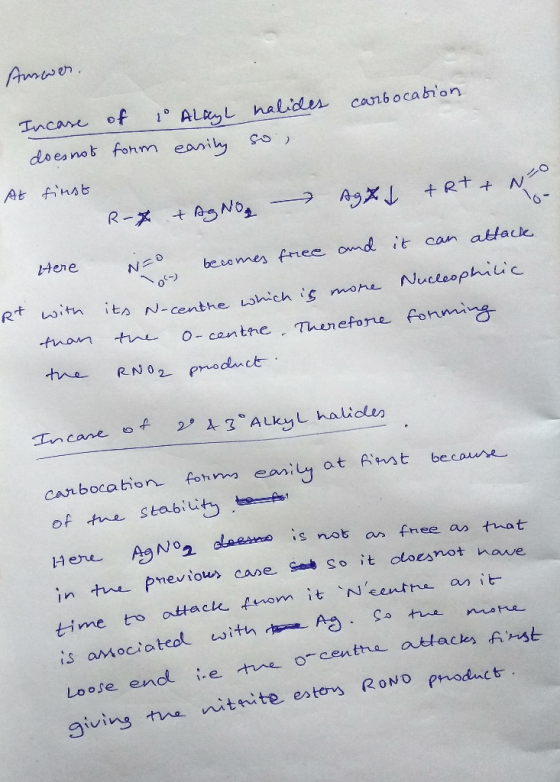
3. (8 pts) Silver nitrite is known to react with primary alkyl bromides or iodides to...
What are the most likely reasons contributing to this product distribution? 3. (8 pts) Silver nitrite...
 What are the most likely reasons contributing to this product
distribution?
3. (8 pts) Silver nitrite is known to react with primary alkyl bromides or iodides to form the corresponding nitro compounds (RNO2). However, it reacts with secondary and tertiary halides to form the corresponding nitrite esters (RONO). What are the most likely reasons contributing to this product distribution? R-X + AgNO RNO2 R = 1° only X = Br, 1 orRONO R = 29, 30 X = Br,
What are the most likely reasons contributing to this product
distribution?
3. (8 pts) Silver nitrite is known to react with primary alkyl bromides or iodides to form the corresponding nitro compounds (RNO2). However, it reacts with secondary and tertiary halides to form the corresponding nitrite esters (RONO). What are the most likely reasons contributing to this product distribution? R-X + AgNO RNO2 R = 1° only X = Br, 1 orRONO R = 29, 30 X = Br,
Which of the follow would you expect to react fastest with silver nitrate in ethanol? primary alkyl bromide primar...
 Which of the follow would you expect to react fastest with silver nitrate in ethanol? primary alkyl bromide primary alkyl chloride secondary alkyl chloride tertiary alkyl bromide
Question 1: draw a mechanism for each of the reactions. Explain why the different amines create...
 Question 1: draw a mechanism for each of the reactions.
Explain why the different amines create different products.
Question 2: Explain the product distribution. primary vs.
secondary or tertiary amines and their corresponding
products.
1. Draw a mechanism for each of the transformations (primary and secondary amines). Explain why the two different amines lead to different molecules. NaOH RNH2 + CHCI 1° amine R-NEC RNH + CHCI- 2º amine HNR2 2. What are some likely reasons that contribute to this...
Question 1: draw a mechanism for each of the reactions.
Explain why the different amines create different products.
Question 2: Explain the product distribution. primary vs.
secondary or tertiary amines and their corresponding
products.
1. Draw a mechanism for each of the transformations (primary and secondary amines). Explain why the two different amines lead to different molecules. NaOH RNH2 + CHCI 1° amine R-NEC RNH + CHCI- 2º amine HNR2 2. What are some likely reasons that contribute to this...
1.) which class of compounds listed below does not react with organocuprate reagents to form a...
1.) which class of compounds listed below does not react with organocuprate reagents to form a coupling product that contains a new carbon carbon bond? A. aryl halides B. vinyl halides C. tertiary halides D. primary halides *please explain* 2.) coupling reactions with vinyl halide‘s are stereo specific which choice below best describes the expected product when trans-1-bromohex-1-ene reacts with (CH3)2CuLi? A. The reaction will only yield a trans alkene B. the reaction will only yield a cis alkene C....
When acyl halides (R?COX) or acid anhydrides (R?OC?O?CO?R) react with primary amines (R?NH2) or secondary amines...
 When acyl halides (R?COX) or acid anhydrides (R?OC?O?CO?R) react
with primary amines (R?NH2) or secondary amines (R2NH), the
reaction yields an amide:
O || R?C?NR2
where R may be an alkyl group or hydrogen atom.
For example, propanoyl chloride
( O ||CH3CH2C?Cl)
reacts with ethanamine (CH3CH2NH2) to form
(O || CH3CH2C?NHCH2CH3).
The IUPAC name for the product isN-ethyl propanamide, as
it is formed from ethanamine and propanoyl
chloride.
Match the names of the products for the following reactions.
Identify the products by dragging the appropriate labels...
When acyl halides (R?COX) or acid anhydrides (R?OC?O?CO?R) react
with primary amines (R?NH2) or secondary amines (R2NH), the
reaction yields an amide:
O || R?C?NR2
where R may be an alkyl group or hydrogen atom.
For example, propanoyl chloride
( O ||CH3CH2C?Cl)
reacts with ethanamine (CH3CH2NH2) to form
(O || CH3CH2C?NHCH2CH3).
The IUPAC name for the product isN-ethyl propanamide, as
it is formed from ethanamine and propanoyl
chloride.
Match the names of the products for the following reactions.
Identify the products by dragging the appropriate labels...
13 SN1: Synthesis of tert-Butyl Chloride Alkyl halides can be prepared from their corresponding alcohols via...
 13 SN1: Synthesis of tert-Butyl Chloride Alkyl halides can be prepared from their corresponding alcohols via an acid catalyzed substitution reaction. The mechanism of these acid catalyzed substitution reactions are labeled as Syl (substitution, nucleophilic, unimolecular) and S2 (substitution, nucleophilic, bimolecular). Tertiary alcohols follow the Snl route, primary alcohols follow the S2 route, and secondary alcohols can follow either path. Under acidic conditions, the mechanism (Figure 1) of the Sul reaction involves rapid protonation of the alcohol, followed by the...
1. In both the sodium iodide test and the silver nitrate test, why does 2-bromobutane react faster...
 1. In both the sodium iodide
test and the silver nitrate test, why does 2-bromobutane react
faster than 2-chlorobutane?
Bromine is a better leaving group since it is a weaker base than
chlorine is.
2. a. Why does benzyl chloride react under both
SN1 and SN2 conditions?
Benzyl
chloride is a primary alkyl halide, hence reactive under SN2
conditions.
The
primary carbocation formed due to the departure of Cl- is
stabilized by the pi electrons in the benzene ring.
b. Why is...
1. In both the sodium iodide
test and the silver nitrate test, why does 2-bromobutane react
faster than 2-chlorobutane?
Bromine is a better leaving group since it is a weaker base than
chlorine is.
2. a. Why does benzyl chloride react under both
SN1 and SN2 conditions?
Benzyl
chloride is a primary alkyl halide, hence reactive under SN2
conditions.
The
primary carbocation formed due to the departure of Cl- is
stabilized by the pi electrons in the benzene ring.
b. Why is...
13 SN1: Synthesis of tert-Butyl Chloride Alkyl halides can be prepared from their corresponding alcohols via...
 13 SN1: Synthesis of tert-Butyl Chloride Alkyl halides can be prepared from their corresponding alcohols via an acid catalyzed substitution reaction. The mechanism of these acid catalyzed substitution reactions are labeled as Syl (substitution, nucleophilic, unimolecular) and S2 (substitution, nucleophilic, bimolecular). Tertiary alcohols follow the Snl route, primary alcohols follow the S2 route, and secondary alcohols can follow either path. Under acidic conditions, the mechanism (Figure 1) of the Sul reaction involves rapid protonation of the alcohol, followed by the...
Experiment 14 SN2: Synthesis of 1-Bromobutane Alkyl halides can be prepared from their corresponding alcohols via...
 Experiment 14 SN2: Synthesis of 1-Bromobutane Alkyl halides can be prepared from their corresponding alcohols via an acid catalyzed substitution reaction. The mechanism of these acid catalyzed substitution reactions are labeled as SNI (substitution, nucleophilie, unimolecular) and S2 (substitution, nucleophilie, bimolecular). Tertiary alcohols follow the Syl route, primary alcohols follow the S2, route and secondary alcohols can follow either path. Sth CyHe 81 CH? Br-CH e-OH- -C-OH OH Figure / Conversion of 1-butanol into 1-bromobutane by an Sp2 mechanism The...
13 SN1: Synthesis of tert-Butyl Chloride Alkyl halides can be prepared from their corresponding alcohols via...
 13 SN1: Synthesis of tert-Butyl Chloride Alkyl halides can be prepared from their corresponding alcohols via an acid catalyzed substitution reaction. The mechanism of these acid catalyzed substitution reactions are labeled as SNI (substitution, nucleophilic, unimolecular) and S 2 (substitution, nucleophilic, bimolecular). Tertiary alcohols follow the Syl route, primary alcohols follow the Sy2 route, and secondary alcohols can follow either path. Under acidic conditions, the mechanism (Figure 1) of the Syl reaction involves rapid protonation of the alcohol, followed by...
 What are the most likely reasons contributing to this product
distribution?
3. (8 pts) Silver nitrite is known to react with primary alkyl bromides or iodides to form the corresponding nitro compounds (RNO2). However, it reacts with secondary and tertiary halides to form the corresponding nitrite esters (RONO). What are the most likely reasons contributing to this product distribution? R-X + AgNO RNO2 R = 1° only X = Br, 1 orRONO R = 29, 30 X = Br,
What are the most likely reasons contributing to this product
distribution?
3. (8 pts) Silver nitrite is known to react with primary alkyl bromides or iodides to form the corresponding nitro compounds (RNO2). However, it reacts with secondary and tertiary halides to form the corresponding nitrite esters (RONO). What are the most likely reasons contributing to this product distribution? R-X + AgNO RNO2 R = 1° only X = Br, 1 orRONO R = 29, 30 X = Br,
 Which of the follow would you expect to react fastest with silver nitrate in ethanol? primary alkyl bromide primary alkyl chloride secondary alkyl chloride tertiary alkyl bromide
 Question 1: draw a mechanism for each of the reactions.
Explain why the different amines create different products.
Question 2: Explain the product distribution. primary vs.
secondary or tertiary amines and their corresponding
products.
1. Draw a mechanism for each of the transformations (primary and secondary amines). Explain why the two different amines lead to different molecules. NaOH RNH2 + CHCI 1° amine R-NEC RNH + CHCI- 2º amine HNR2 2. What are some likely reasons that contribute to this...
Question 1: draw a mechanism for each of the reactions.
Explain why the different amines create different products.
Question 2: Explain the product distribution. primary vs.
secondary or tertiary amines and their corresponding
products.
1. Draw a mechanism for each of the transformations (primary and secondary amines). Explain why the two different amines lead to different molecules. NaOH RNH2 + CHCI 1° amine R-NEC RNH + CHCI- 2º amine HNR2 2. What are some likely reasons that contribute to this...
 When acyl halides (R?COX) or acid anhydrides (R?OC?O?CO?R) react
with primary amines (R?NH2) or secondary amines (R2NH), the
reaction yields an amide:
O || R?C?NR2
where R may be an alkyl group or hydrogen atom.
For example, propanoyl chloride
( O ||CH3CH2C?Cl)
reacts with ethanamine (CH3CH2NH2) to form
(O || CH3CH2C?NHCH2CH3).
The IUPAC name for the product isN-ethyl propanamide, as
it is formed from ethanamine and propanoyl
chloride.
Match the names of the products for the following reactions.
Identify the products by dragging the appropriate labels...
When acyl halides (R?COX) or acid anhydrides (R?OC?O?CO?R) react
with primary amines (R?NH2) or secondary amines (R2NH), the
reaction yields an amide:
O || R?C?NR2
where R may be an alkyl group or hydrogen atom.
For example, propanoyl chloride
( O ||CH3CH2C?Cl)
reacts with ethanamine (CH3CH2NH2) to form
(O || CH3CH2C?NHCH2CH3).
The IUPAC name for the product isN-ethyl propanamide, as
it is formed from ethanamine and propanoyl
chloride.
Match the names of the products for the following reactions.
Identify the products by dragging the appropriate labels...
 13 SN1: Synthesis of tert-Butyl Chloride Alkyl halides can be prepared from their corresponding alcohols via an acid catalyzed substitution reaction. The mechanism of these acid catalyzed substitution reactions are labeled as Syl (substitution, nucleophilic, unimolecular) and S2 (substitution, nucleophilic, bimolecular). Tertiary alcohols follow the Snl route, primary alcohols follow the S2 route, and secondary alcohols can follow either path. Under acidic conditions, the mechanism (Figure 1) of the Sul reaction involves rapid protonation of the alcohol, followed by the...
 1. In both the sodium iodide
test and the silver nitrate test, why does 2-bromobutane react
faster than 2-chlorobutane?
Bromine is a better leaving group since it is a weaker base than
chlorine is.
2. a. Why does benzyl chloride react under both
SN1 and SN2 conditions?
Benzyl
chloride is a primary alkyl halide, hence reactive under SN2
conditions.
The
primary carbocation formed due to the departure of Cl- is
stabilized by the pi electrons in the benzene ring.
b. Why is...
1. In both the sodium iodide
test and the silver nitrate test, why does 2-bromobutane react
faster than 2-chlorobutane?
Bromine is a better leaving group since it is a weaker base than
chlorine is.
2. a. Why does benzyl chloride react under both
SN1 and SN2 conditions?
Benzyl
chloride is a primary alkyl halide, hence reactive under SN2
conditions.
The
primary carbocation formed due to the departure of Cl- is
stabilized by the pi electrons in the benzene ring.
b. Why is...
 13 SN1: Synthesis of tert-Butyl Chloride Alkyl halides can be prepared from their corresponding alcohols via an acid catalyzed substitution reaction. The mechanism of these acid catalyzed substitution reactions are labeled as Syl (substitution, nucleophilic, unimolecular) and S2 (substitution, nucleophilic, bimolecular). Tertiary alcohols follow the Snl route, primary alcohols follow the S2 route, and secondary alcohols can follow either path. Under acidic conditions, the mechanism (Figure 1) of the Sul reaction involves rapid protonation of the alcohol, followed by the...
 Experiment 14 SN2: Synthesis of 1-Bromobutane Alkyl halides can be prepared from their corresponding alcohols via an acid catalyzed substitution reaction. The mechanism of these acid catalyzed substitution reactions are labeled as SNI (substitution, nucleophilie, unimolecular) and S2 (substitution, nucleophilie, bimolecular). Tertiary alcohols follow the Syl route, primary alcohols follow the S2, route and secondary alcohols can follow either path. Sth CyHe 81 CH? Br-CH e-OH- -C-OH OH Figure / Conversion of 1-butanol into 1-bromobutane by an Sp2 mechanism The...
 13 SN1: Synthesis of tert-Butyl Chloride Alkyl halides can be prepared from their corresponding alcohols via an acid catalyzed substitution reaction. The mechanism of these acid catalyzed substitution reactions are labeled as SNI (substitution, nucleophilic, unimolecular) and S 2 (substitution, nucleophilic, bimolecular). Tertiary alcohols follow the Syl route, primary alcohols follow the Sy2 route, and secondary alcohols can follow either path. Under acidic conditions, the mechanism (Figure 1) of the Syl reaction involves rapid protonation of the alcohol, followed by...
Most questions answered within 3 hours.
-
Where is the error in this code sequence?
String s1 = "Hello";
String s2 = "ello";...
asked 10 months ago -
Financial data for Joel de Paris, Inc., for last year
follow:
Joel de Paris, Inc.
Balance...
asked 10 months ago -
Consider this reaction:
Al2(SO4)3 (aq)+ BaCl3
(aq) Al2Cl6 (aq)- +
3BaSO4(s) . What is the...
asked 10 months ago -
Suppose that Savneet is considering increasing her
recent random sample from 20 car rentals to 40...
asked 10 months ago -
Trucks arrive at an unloading terminal at an average rate of 120
per hour.
Trucks arrive...
asked 10 months ago -
Why are methanol and ethanol completely soluble in water while
octanol is not very little soluble....
asked 10 months ago -
A facilities manager at a university reads in a research report
that the mean amount of...
asked 10 months ago -
When the CuSO4 is rehydrated by adding water to the anhydrous
compound, is this an endothermic...
asked 10 months ago -
A ray of sunlight is passing from diamond into crown glass; the
angle of incidence is...
asked 10 months ago -
A block of mass 0.249 kg is placed on top of a light, vertical
spring of...
asked 10 months ago -
how do the kidneys compensate in the presences of acidosis
a) trigger hyperventilate
b) reserve acid...
asked 10 months ago -
Question 501 pts
The rental rate of capital to the firm increases. Which of the
following...
asked 10 months ago