![3. 20 Consider an Edgeworth box are given by lgeworth box economy where preferences and endowments (a) (5] Find all the Pareto optimal allocations. (b) 15] Using the normalization, p2 1, find the Walrasian equilibrium. (c) [5) Carefully state the first welfare theorem and verify that it holds. (d) [5] Suppose the endownments had instead been al (18, 15) and - (2,5). Find the Walrasian equilibrium.](http://img.homeworklib.com/questions/a9717b80-70d9-11ea-8fe1-ff7bccc2d2fb.png?x-oss-process=image/resize,w_560)
Homework Answers


Add Answer to:
3. 20 Consider an Edgeworth box are given by lgeworth box economy where preferences and endowments...
3. 120) Consider an Edgeworth box ecomomy where preferences and endowmente are given by (a) [5]...
 3. 120) Consider an Edgeworth box ecomomy where preferences and endowmente are given by (a) [5] Find all the Pareto optimal allocations. (b) Using the normalization, P2 = 1, find the Walrasian equilibrium. (c) [5] Carefully state the first welfare theorem and verify that it holds (d) [5] Suppose the endowments had instead been e (18,15) and- (2,5). Find the Walrasian equilibrium. 4. 20 Answer the following urm astrategy that is a best response versus
omy where preferences and endowments 2. /20) Consider an Edgeworth box econ are given by d(z,...
 omy where preferences and endowments 2. /20) Consider an Edgeworth box econ are given by d(z, zl) = (zl): (x), ei = (6,6) (a) 4 Carefully state the theorem regarding thé 'existence of a Walrasian equilibrium that was given in the lectures. (b) [6) Using the normalization p2 - 1, find the Walrasian equilibrium. (c) 4] Carefully state the Walras' Law and verify that it holds. (d) [6] Can the allocation ((5,23.4), (5, 2.6)) be supported as an equi- librium...
3. [20] Consider an Edgeworth box economy are given by (a) [5) Find all the Pareto...
 3. [20] Consider an Edgeworth box economy are given by (a) [5) Find all the Pareto optimal allocations. sing the normalization, P2 = 1, find the Walrasian equilibrium. ully state the first welfare theorem and verify that it holds. dowments had instead been ē1 = (18,15) and (d) [5] Suppose the en = (2,5). Find the Walrasian equilibrium. 4. [20] Answer the following. (a) [4] Explain the difference between a strategy that is a best response versus a strategy that...
2. (20) Consider an Edgeworth box economy where the preferences and endow- ments are u" (1,...
 2. (20) Consider an Edgeworth box economy where the preferences and endow- ments are u" (1, 3) = In:} +2 in x and e' = (0,6) w?(21,2)= x + (23) and e? = (10,4). (a) [4] State the definition of a Pareto optimal allocation. (b) [6] Find all the interior Pareto optimal allocations, using ah, as the pa rameter (that is, express the PO allocations in terms of 2). In this part, you are not required to find the range...
Description of the economy: For each of the following problems, consider a 2x2 Exchange Economy with two consumers A and B, and two goods X and Y . The preferences of consumer A can be represented by...
Description of the economy: For each of the following problems, consider a 2x2 Exchange Economy with two consumers A and B, and two goods X and Y . The preferences of consumer A can be represented by the utility function uA(xA, yA) = xAyA , where xA is the amount of good A consumed by consumer A, and yA is the amount of good Y consumed by consumer A. The preferences of consumer B can be represented by the utility...
1. Consider the following exchange economy. There are two goods (1 and 2) and two consumers (A an...
 1. Consider the following exchange economy. There are two goods (1 and 2) and two consumers (A and B). Preferences and endowments are as follows: uA (イ·攻)-玲攻 TA _ (0,2) 2(4,0) (a) Draw an Edgeworth Box diagram to depict this economy. Your diagram should be clearly labelled, and should include the autar kic allocation as well as a couple of indifference curves for each consumer. (Indifference curves for A do not need to be precisely accurate but those for B...
Description of the economy: For each of the following problems, consider a 2x2 Exchange Economy with two consumers A and B, and two goods X and Y . The preferences of consumer A can be represented by...
Description of the economy: For each of the following problems, consider a 2x2 Exchange Economy with two consumers A and B, and two goods X and Y . The preferences of consumer A can be represented by the utility function uA(xA, yA) = xAyA , where xA is the amount of good A consumed by consumer A, and yA is the amount of good Y consumed by consumer A. The preferences of consumer B can be represented by the utility...
Need help with Edgeworth Box exercise Two agents have identical quasilinear preferences U(x, y)-u(x) +y, where...
 Need help with Edgeworth Box exercise
Two agents have identical quasilinear preferences U(x, y)-u(x) +y, where u(x) =|x-1 + 1 , x > 1 Agent I's endowment is (3/2, 1/2) and agent 2's endowment is (1/2, 3/2). Normalize so that the price of good 2 is 1. There is a Walrasian Equilibrium at which the price of good 1 is greater than 1/2. Draw an Edgeworth Box for this economy. Draw and label the following elements: (I) The Walrasian Equilibrium...
Need help with Edgeworth Box exercise
Two agents have identical quasilinear preferences U(x, y)-u(x) +y, where u(x) =|x-1 + 1 , x > 1 Agent I's endowment is (3/2, 1/2) and agent 2's endowment is (1/2, 3/2). Normalize so that the price of good 2 is 1. There is a Walrasian Equilibrium at which the price of good 1 is greater than 1/2. Draw an Edgeworth Box for this economy. Draw and label the following elements: (I) The Walrasian Equilibrium...
#3-20 points: Consider a 2-person, 2-good economy. Endowments and utility functions are: e(3,2 ( y)y Draw...
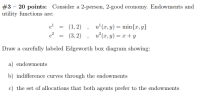 #3-20 points: Consider a 2-person, 2-good economy. Endowments and utility functions are: e(3,2 ( y)y Draw a carefully labeled Edgeworth box diagram showing: a) endowments b) indifference curves through the endowments c) the set of allocations that both agents prefer to the endowments
3. This question is adapted from our textbook. Anne and Bill live in an island economy...
 3. This question is adapted from our textbook. Anne and Bill live in an island economy and consume only two goods. Let x? = (x1, xi) denote the consumption bundle for i = A, B. Their endowments are wa = (WA,WA) = (2,5) and wb = (wp,w?) = (10, a). Both have identical Cobb-Douglas utility functions ui(x) = xix, for i = A, B. Normalizing the price of good 2 to be p2 = 1, we just write pı =...
 3. 120) Consider an Edgeworth box ecomomy where preferences and endowmente are given by (a) [5] Find all the Pareto optimal allocations. (b) Using the normalization, P2 = 1, find the Walrasian equilibrium. (c) [5] Carefully state the first welfare theorem and verify that it holds (d) [5] Suppose the endowments had instead been e (18,15) and- (2,5). Find the Walrasian equilibrium. 4. 20 Answer the following urm astrategy that is a best response versus
 omy where preferences and endowments 2. /20) Consider an Edgeworth box econ are given by d(z, zl) = (zl): (x), ei = (6,6) (a) 4 Carefully state the theorem regarding thé 'existence of a Walrasian equilibrium that was given in the lectures. (b) [6) Using the normalization p2 - 1, find the Walrasian equilibrium. (c) 4] Carefully state the Walras' Law and verify that it holds. (d) [6] Can the allocation ((5,23.4), (5, 2.6)) be supported as an equi- librium...
 3. [20] Consider an Edgeworth box economy are given by (a) [5) Find all the Pareto optimal allocations. sing the normalization, P2 = 1, find the Walrasian equilibrium. ully state the first welfare theorem and verify that it holds. dowments had instead been ē1 = (18,15) and (d) [5] Suppose the en = (2,5). Find the Walrasian equilibrium. 4. [20] Answer the following. (a) [4] Explain the difference between a strategy that is a best response versus a strategy that...
 2. (20) Consider an Edgeworth box economy where the preferences and endow- ments are u" (1, 3) = In:} +2 in x and e' = (0,6) w?(21,2)= x + (23) and e? = (10,4). (a) [4] State the definition of a Pareto optimal allocation. (b) [6] Find all the interior Pareto optimal allocations, using ah, as the pa rameter (that is, express the PO allocations in terms of 2). In this part, you are not required to find the range...
 1. Consider the following exchange economy. There are two goods (1 and 2) and two consumers (A and B). Preferences and endowments are as follows: uA (イ·攻)-玲攻 TA _ (0,2) 2(4,0) (a) Draw an Edgeworth Box diagram to depict this economy. Your diagram should be clearly labelled, and should include the autar kic allocation as well as a couple of indifference curves for each consumer. (Indifference curves for A do not need to be precisely accurate but those for B...
 Need help with Edgeworth Box exercise
Two agents have identical quasilinear preferences U(x, y)-u(x) +y, where u(x) =|x-1 + 1 , x > 1 Agent I's endowment is (3/2, 1/2) and agent 2's endowment is (1/2, 3/2). Normalize so that the price of good 2 is 1. There is a Walrasian Equilibrium at which the price of good 1 is greater than 1/2. Draw an Edgeworth Box for this economy. Draw and label the following elements: (I) The Walrasian Equilibrium...
Need help with Edgeworth Box exercise
Two agents have identical quasilinear preferences U(x, y)-u(x) +y, where u(x) =|x-1 + 1 , x > 1 Agent I's endowment is (3/2, 1/2) and agent 2's endowment is (1/2, 3/2). Normalize so that the price of good 2 is 1. There is a Walrasian Equilibrium at which the price of good 1 is greater than 1/2. Draw an Edgeworth Box for this economy. Draw and label the following elements: (I) The Walrasian Equilibrium...
 #3-20 points: Consider a 2-person, 2-good economy. Endowments and utility functions are: e(3,2 ( y)y Draw a carefully labeled Edgeworth box diagram showing: a) endowments b) indifference curves through the endowments c) the set of allocations that both agents prefer to the endowments
 3. This question is adapted from our textbook. Anne and Bill live in an island economy and consume only two goods. Let x? = (x1, xi) denote the consumption bundle for i = A, B. Their endowments are wa = (WA,WA) = (2,5) and wb = (wp,w?) = (10, a). Both have identical Cobb-Douglas utility functions ui(x) = xix, for i = A, B. Normalizing the price of good 2 to be p2 = 1, we just write pı =...
Most questions answered within 3 hours.
-
Where is the error in this code sequence?
String s1 = "Hello";
String s2 = "ello";...
asked 10 months ago -
Financial data for Joel de Paris, Inc., for last year
follow:
Joel de Paris, Inc.
Balance...
asked 10 months ago -
Consider this reaction:
Al2(SO4)3 (aq)+ BaCl3
(aq) Al2Cl6 (aq)- +
3BaSO4(s) . What is the...
asked 10 months ago -
Suppose that Savneet is considering increasing her
recent random sample from 20 car rentals to 40...
asked 10 months ago -
Trucks arrive at an unloading terminal at an average rate of 120
per hour.
Trucks arrive...
asked 10 months ago -
Why are methanol and ethanol completely soluble in water while
octanol is not very little soluble....
asked 10 months ago -
A facilities manager at a university reads in a research report
that the mean amount of...
asked 10 months ago -
When the CuSO4 is rehydrated by adding water to the anhydrous
compound, is this an endothermic...
asked 10 months ago -
A ray of sunlight is passing from diamond into crown glass; the
angle of incidence is...
asked 10 months ago -
A block of mass 0.249 kg is placed on top of a light, vertical
spring of...
asked 10 months ago -
how do the kidneys compensate in the presences of acidosis
a) trigger hyperventilate
b) reserve acid...
asked 10 months ago -
Question 501 pts
The rental rate of capital to the firm increases. Which of the
following...
asked 10 months ago