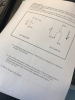
1. A. An oil drop has a mass m. The drop is falling at a terminal...
1. A. An oil drop has a mass m. The drop is falling at a terminal speed vfall. Draw a free body diagram for the drop. Write the Newton’s Second law equation for the drop. Find the expression for the value of k in terms of the mass of the drop (m), the terminal speed (vfall), and g.
B. The oil drop from C has a charge +q. It is now in a
uniform electric field that points upward with strength E.
The electric force is strong enough that the drop slowly moves
upward. Because of air drag, the drop moves with a constant speed
(vup). (Remember, the drag force points opposite to the
direction of the velocity.) Because the air and the oil drop are
the same as in C, the value of the air drag constant (k)
is the same. Draw a free body diagram for the oil drop when it is
moving up at its new terminal speed. Write a Newton’s Second Law
equation for this situation. Substitute your previous expression
for k into this equation and solve for the charge
(q) on the drop. The expression should include m,
vfall, vup, E (the electric field
strength), and g.
Homework Answers


Add Answer to:
1. A. An oil drop has a mass m. The drop is falling at
a terminal...
for the Millikan Oil drop experiment with the elect r thee o ano drop with charge...
 for the Millikan Oil drop experiment with the elect r thee o ano drop with charge q falls dowctrih with charge q falls down thros br where b is the moving oil drop 2 Miken Ol Drep speed of s For simplicity we assume the drag force is |DI constant associated with the viscous liquid and v is the speed of qE 9 moilg D2 (a) Field Off (b) Field On 20. Assuming the drag constant is b the mass...
. Terminal velocity - free fall. Estimate (order of magnitude) the terminal speed vT of a...
. Terminal velocity - free fall. Estimate (order of magnitude) the terminal speed vT of a typical human in free fall. Draw a free body diagram for the person falling at terminal velocity. Use the FBD, Newton’s second law, and the formula for air resistance (drag force) mentioned in class FD = 1/2 D ρ A v2 to find an expression for vT . Explain/justify any assumptions that you make (e.g., for quantities like the cross-sectional area A or the...
In an oil-drop experiment a negatively charged oil drop has a mass of 3.0 x 10⁻¹⁵...
In an oil-drop experiment a negatively charged oil drop has a mass of 3.0 x 10⁻¹⁵ kg and is held at rest between two parallel plates separated by a distance of 2.0 cm. The potential difference between the plates is 460 V. a) On the diagram below, show all the applied forces on the drop. Do not include the buoyant force of the air on the oil drop. b) What is the strength of the electric field between the plates?...
Oil Drop 11. Robert Millikan received a Nobel Prize for determining the charge on the electron....
 Oil Drop 11. Robert Millikan received a Nobel Prize for determining the charge on the electron. To do this, he set up a of oil between potential difference between two horizontal parallel metal plates. He then sprayed drops the plates and adjusted the potential difference until drops of a certain size between the plates, as shown above. Suppose that when the potential difference adjusted until the electric field is 10,000 N/C downward, a certain drop with a mass of remains...
1. An oil drop with a mass of 2.45 g is suspended between two Problem 01...
 1. An oil drop with a mass of 2.45 g is suspended between two Problem 01 oppositely-charged plates that are 10.00 cm apart and have a potential-- difference of 6000 V as shown in the diagram to the right. a.) Show the direction of the electric field on the diagram. b.) What is the magnitude of the electric field? c.) What is the force due to gravity acting on the oil drop? d.) What is the charge on the oil...
in this lab we will drop a steel ball P steel=8000 kg/m^3, r ball=2.18x10^-3) through the...
in this lab we will drop a steel ball P steel=8000 kg/m^3, r ball=2.18x10^-3) through the air (nair=1.8x10^-5 Pas, P air= 1.29kg/m^3) and through a viscous soap solution (n soap ~ 9.0 Pa s) you will measure this number in lab, but use this number for prelab.( P soap = 1000kg/m^3) 1Pa= 1N/m 1. (a) assuming that the ball falling through the soap solution experiences visocus drag, find the terminal speed of the ball, the speed at which the weight...
A negatively charged oil drop whose mass is 10-15 kg and whose charge is -6.4 10-19...
 A negatively charged oil drop whose mass is 10-15 kg and
whose charge is -6.4 10-19 Coulombs remains stationary under the
influence of the Earth’s gravitational field and a uniform external
electric field made by two oppositely-charged parallel plates (see
diagram below). Ignore the influence of Earth’s electric field on
the oil drop.
Determine the magnitude and direction of the net
electric field created by the plates (not the electric field of the
oil drop !). Explain completely how you...
A negatively charged oil drop whose mass is 10-15 kg and
whose charge is -6.4 10-19 Coulombs remains stationary under the
influence of the Earth’s gravitational field and a uniform external
electric field made by two oppositely-charged parallel plates (see
diagram below). Ignore the influence of Earth’s electric field on
the oil drop.
Determine the magnitude and direction of the net
electric field created by the plates (not the electric field of the
oil drop !). Explain completely how you...
0.01 m 5. In an oil-drop experiment, two parallel conducting plates are connected to a power...
 0.01 m 5. In an oil-drop experiment, two parallel conducting plates are connected to a power supply with a constant voltage of 100 V. The separation between the plates is 0.01 m. A 4.8x10⁻⁶ kg oil drop is suspended in the region between the plates. Use g = 10 m/s. a. What is the direction of the electric field between the plates? b. What is the magnitude of the electric field between the plates? c. What is the sign and...
10. The mass-detecting part of a mass spectrometer is described below. Devise a mathematical expression for...
 10. The mass-detecting part of a mass spectrometer is described
below. Devise a mathematical expression for the ion’s mass based on
its speed, the strength of the magnetic field, and the radius of
the circle that it makes in that field.
a. Draw a force diagram for the ion at any point in its motion
on your whiteboard.
b. Represent the process mathematically by applying Newton’s
second law for circular motion.
c. Solve for the mass of the ion.
Top...
10. The mass-detecting part of a mass spectrometer is described
below. Devise a mathematical expression for the ion’s mass based on
its speed, the strength of the magnetic field, and the radius of
the circle that it makes in that field.
a. Draw a force diagram for the ion at any point in its motion
on your whiteboard.
b. Represent the process mathematically by applying Newton’s
second law for circular motion.
c. Solve for the mass of the ion.
Top...
Please provide a detailed solution to problem 3-11. Thank you! he ozontal direct l fatheelical, giving...
 Please provide a detailed solution to problem 3-11. Thank
you!
he ozontal direct l fatheelical, giving charged droplets cceieration The result is that the droplet falls in a straight line that makes an angle θ with the vertical Show that where v; is the terminal speed along the angled path. 3-11. A charged oil droplet falls 5.0 mm in 20.0 s at terminal speed in the absence of an electric field. The specific gravity of air is I The viscosity...
Please provide a detailed solution to problem 3-11. Thank
you!
he ozontal direct l fatheelical, giving charged droplets cceieration The result is that the droplet falls in a straight line that makes an angle θ with the vertical Show that where v; is the terminal speed along the angled path. 3-11. A charged oil droplet falls 5.0 mm in 20.0 s at terminal speed in the absence of an electric field. The specific gravity of air is I The viscosity...
 for the Millikan Oil drop experiment with the elect r thee o ano drop with charge q falls dowctrih with charge q falls down thros br where b is the moving oil drop 2 Miken Ol Drep speed of s For simplicity we assume the drag force is |DI constant associated with the viscous liquid and v is the speed of qE 9 moilg D2 (a) Field Off (b) Field On 20. Assuming the drag constant is b the mass...
 Oil Drop 11. Robert Millikan received a Nobel Prize for determining the charge on the electron. To do this, he set up a of oil between potential difference between two horizontal parallel metal plates. He then sprayed drops the plates and adjusted the potential difference until drops of a certain size between the plates, as shown above. Suppose that when the potential difference adjusted until the electric field is 10,000 N/C downward, a certain drop with a mass of remains...
 1. An oil drop with a mass of 2.45 g is suspended between two Problem 01 oppositely-charged plates that are 10.00 cm apart and have a potential-- difference of 6000 V as shown in the diagram to the right. a.) Show the direction of the electric field on the diagram. b.) What is the magnitude of the electric field? c.) What is the force due to gravity acting on the oil drop? d.) What is the charge on the oil...
 A negatively charged oil drop whose mass is 10-15 kg and
whose charge is -6.4 10-19 Coulombs remains stationary under the
influence of the Earth’s gravitational field and a uniform external
electric field made by two oppositely-charged parallel plates (see
diagram below). Ignore the influence of Earth’s electric field on
the oil drop.
Determine the magnitude and direction of the net
electric field created by the plates (not the electric field of the
oil drop !). Explain completely how you...
A negatively charged oil drop whose mass is 10-15 kg and
whose charge is -6.4 10-19 Coulombs remains stationary under the
influence of the Earth’s gravitational field and a uniform external
electric field made by two oppositely-charged parallel plates (see
diagram below). Ignore the influence of Earth’s electric field on
the oil drop.
Determine the magnitude and direction of the net
electric field created by the plates (not the electric field of the
oil drop !). Explain completely how you...
 0.01 m 5. In an oil-drop experiment, two parallel conducting plates are connected to a power supply with a constant voltage of 100 V. The separation between the plates is 0.01 m. A 4.8x10⁻⁶ kg oil drop is suspended in the region between the plates. Use g = 10 m/s. a. What is the direction of the electric field between the plates? b. What is the magnitude of the electric field between the plates? c. What is the sign and...
 10. The mass-detecting part of a mass spectrometer is described
below. Devise a mathematical expression for the ion’s mass based on
its speed, the strength of the magnetic field, and the radius of
the circle that it makes in that field.
a. Draw a force diagram for the ion at any point in its motion
on your whiteboard.
b. Represent the process mathematically by applying Newton’s
second law for circular motion.
c. Solve for the mass of the ion.
Top...
10. The mass-detecting part of a mass spectrometer is described
below. Devise a mathematical expression for the ion’s mass based on
its speed, the strength of the magnetic field, and the radius of
the circle that it makes in that field.
a. Draw a force diagram for the ion at any point in its motion
on your whiteboard.
b. Represent the process mathematically by applying Newton’s
second law for circular motion.
c. Solve for the mass of the ion.
Top...
 Please provide a detailed solution to problem 3-11. Thank
you!
he ozontal direct l fatheelical, giving charged droplets cceieration The result is that the droplet falls in a straight line that makes an angle θ with the vertical Show that where v; is the terminal speed along the angled path. 3-11. A charged oil droplet falls 5.0 mm in 20.0 s at terminal speed in the absence of an electric field. The specific gravity of air is I The viscosity...
Please provide a detailed solution to problem 3-11. Thank
you!
he ozontal direct l fatheelical, giving charged droplets cceieration The result is that the droplet falls in a straight line that makes an angle θ with the vertical Show that where v; is the terminal speed along the angled path. 3-11. A charged oil droplet falls 5.0 mm in 20.0 s at terminal speed in the absence of an electric field. The specific gravity of air is I The viscosity...
Most questions answered within 3 hours.
-
Where is the error in this code sequence?
String s1 = "Hello";
String s2 = "ello";...
asked 10 months ago -
Financial data for Joel de Paris, Inc., for last year
follow:
Joel de Paris, Inc.
Balance...
asked 10 months ago -
Consider this reaction:
Al2(SO4)3 (aq)+ BaCl3
(aq) Al2Cl6 (aq)- +
3BaSO4(s) . What is the...
asked 10 months ago -
Suppose that Savneet is considering increasing her
recent random sample from 20 car rentals to 40...
asked 10 months ago -
Trucks arrive at an unloading terminal at an average rate of 120
per hour.
Trucks arrive...
asked 10 months ago -
Why are methanol and ethanol completely soluble in water while
octanol is not very little soluble....
asked 10 months ago -
A facilities manager at a university reads in a research report
that the mean amount of...
asked 10 months ago -
When the CuSO4 is rehydrated by adding water to the anhydrous
compound, is this an endothermic...
asked 10 months ago -
A ray of sunlight is passing from diamond into crown glass; the
angle of incidence is...
asked 10 months ago -
A block of mass 0.249 kg is placed on top of a light, vertical
spring of...
asked 10 months ago -
how do the kidneys compensate in the presences of acidosis
a) trigger hyperventilate
b) reserve acid...
asked 10 months ago -
Question 501 pts
The rental rate of capital to the firm increases. Which of the
following...
asked 10 months ago