

Homework Answers
Add Answer to:
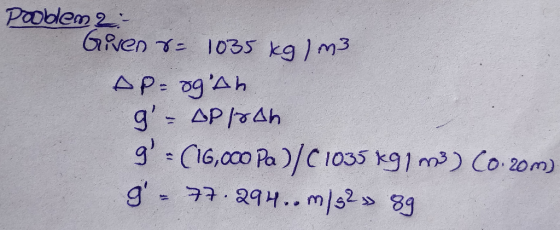
Problem 2 When the human body is accelerated vertically, blood pressure in the brain will drop....
Neglecting the pressure drop due to resistance, calculate the blood pressure, in pascals, in an artery...
Neglecting the pressure drop due to resistance, calculate the blood pressure, in pascals, in an artery in the brain 30 cm above the heart. The pressure at the heart is 120 mm Hg. The density of blood is 1.05 g/cm3 and the density of mercury is 13600 kg/m3. Do not type in units.
QUESTION 11 Neglecting the pressure drop due to resistance, calculate the blood pressure, in pascals, in...
 QUESTION 11 Neglecting the pressure drop due to resistance, calculate the blood pressure, in pascals, in an artery in the brain 30 cm above the heart. The pressure at the heart is 120 mm Hg. The density of blood is 1.05 g/cm2 and the density of mercury is 13600 kg/m3. Do not type in units.
Neglecting the pressure drop due to resistance, calculate the blood pressure, in pascals, in an artery...
 Neglecting the pressure drop due to resistance, calculate the blood pressure, in pascals, in an artery in the brain 30 cm above the heart. The pressure at the heart is 120 mm Hg. The density of blood is 1.05 g/cm2 and the density of mercury is 13600 kg/m2. Do not type in units. Two different manometers are used to read a pressure. One uses water of density 1.0 g/cm3 and reads "150 cm water". The other one uses an unknown...
If you are lying down and stand up quickly, you can get dizzy or feel faint....
If you are lying down and stand up quickly, you can get dizzy or feel faint. This is because the blood vessels don't have time to expand to compensate for the blood pressure drop. If your brain is 0.4 m higher than your heart when you are standing, how much lower is your blood pressure at your brain than it is at your heart? The density of blood plasma is about 1025 kg/m3 and suppose your maximum (systolic) pressure of...
Determine whether the kinetic-energy term is significant for measurement of pressure in the human descending aorta....
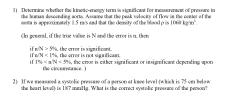 Determine whether the kinetic-energy term is significant for measurement of pressure in the human descending aorta. Assume that the peak velocity of flow in the center of the aorta is approximately 1.5 m/s and that the density of the blood p is 1060 kg/m 1) (In general, if the true value is N and the error is n, then if n/N > 5%, the error is significant if n/N < 1%, the error is not significant, if 1% < nN...
The blood pressure at your heart is approximately 100 mm of Hg. As blood is pumped...
The blood pressure at your heart is approximately 100 mm of Hg. As blood is pumped from the left ventricle of your heart, it flows through the aorta, a single large blood vessel with a diameter of about 2.5 cm. The speed of blood flow in the aorta is about 60 cm/s. Any change in pressure as blood flows in the aorta is due to the change in height: the vessel is large enough that viscous drag is not a...
a)Mention two mechanisms the human body can use to raise a drop in blood pressure due to a hemorrhage. b) Can the transport through the capillaries in the right foot be affected by an edema? Explain....
a)Mention two mechanisms the human body can use to raise a drop in blood pressure due to a hemorrhage. b) Can the transport through the capillaries in the right foot be affected by an edema? Explain. c) Mention the respiratory and urinary adjustments to acidosis and alkalosis.
The human brain and spinal cord are immersed in the cerebrospinal fluid. The fluid is normally...
 The human brain and spinal cord are immersed in the
cerebrospinal fluid. The fluid is normally continuous between the
cranial and spinal cavities and exerts a pressure of 100 to 200 mm
of H2O above the prevailing atmospheric pressure. In
medical work, pressures are often measured in units of mm of
H2O because body fluids, including the cerebrospinal
fluid, typically have nearly the same density as water. The
pressure of the cerebrospinal fluid can be measured by means of a...
The human brain and spinal cord are immersed in the
cerebrospinal fluid. The fluid is normally continuous between the
cranial and spinal cavities and exerts a pressure of 100 to 200 mm
of H2O above the prevailing atmospheric pressure. In
medical work, pressures are often measured in units of mm of
H2O because body fluids, including the cerebrospinal
fluid, typically have nearly the same density as water. The
pressure of the cerebrospinal fluid can be measured by means of a...
answer this question BLOOD AND FLUID QUESTION 1 (0A patient's blood pressure taken at the arm...
 answer this question
BLOOD AND FLUID QUESTION 1 (0A patient's blood pressure taken at the arm is 120 mmHg systolic and 70 mmHg diastolic. What would you expect the blood pressure (systolic and diastolic pressures) to be at the top of the head given that this point is 40 cm above the measurement point? Remember blood pressure is a gauge pressure and that 1 kPa = 7.5 mmHg. (The density of blood is about 1060 kg/m.) Choose one: a. 89...
answer this question
BLOOD AND FLUID QUESTION 1 (0A patient's blood pressure taken at the arm is 120 mmHg systolic and 70 mmHg diastolic. What would you expect the blood pressure (systolic and diastolic pressures) to be at the top of the head given that this point is 40 cm above the measurement point? Remember blood pressure is a gauge pressure and that 1 kPa = 7.5 mmHg. (The density of blood is about 1060 kg/m.) Choose one: a. 89...
HW 12 96-9.9. Phys 213 Gene HW 1296-99. Phys 213 Gent X G difference between blood...
 HW 12 96-9.9. Phys 213 Gene HW 1296-99. Phys 213 Gent X G difference between blood press * 2 > In Depth Reports - High blood p webassign.net/web/Student/Assignment Responses/submit?dep 226043858tags-autosave x + 1. -1 points SerCP119.7.P.046. Water is pumped through a pipe of diameter 14.5 cm from the Colorado River up to Grand Canyon Vitage on them of the canyon. There is (a) At what minimum pressure must the water be pumped to arrive at the village (The density of...
 QUESTION 11 Neglecting the pressure drop due to resistance, calculate the blood pressure, in pascals, in an artery in the brain 30 cm above the heart. The pressure at the heart is 120 mm Hg. The density of blood is 1.05 g/cm2 and the density of mercury is 13600 kg/m3. Do not type in units.
 Neglecting the pressure drop due to resistance, calculate the blood pressure, in pascals, in an artery in the brain 30 cm above the heart. The pressure at the heart is 120 mm Hg. The density of blood is 1.05 g/cm2 and the density of mercury is 13600 kg/m2. Do not type in units. Two different manometers are used to read a pressure. One uses water of density 1.0 g/cm3 and reads "150 cm water". The other one uses an unknown...
 Determine whether the kinetic-energy term is significant for measurement of pressure in the human descending aorta. Assume that the peak velocity of flow in the center of the aorta is approximately 1.5 m/s and that the density of the blood p is 1060 kg/m 1) (In general, if the true value is N and the error is n, then if n/N > 5%, the error is significant if n/N < 1%, the error is not significant, if 1% < nN...
 The human brain and spinal cord are immersed in the
cerebrospinal fluid. The fluid is normally continuous between the
cranial and spinal cavities and exerts a pressure of 100 to 200 mm
of H2O above the prevailing atmospheric pressure. In
medical work, pressures are often measured in units of mm of
H2O because body fluids, including the cerebrospinal
fluid, typically have nearly the same density as water. The
pressure of the cerebrospinal fluid can be measured by means of a...
The human brain and spinal cord are immersed in the
cerebrospinal fluid. The fluid is normally continuous between the
cranial and spinal cavities and exerts a pressure of 100 to 200 mm
of H2O above the prevailing atmospheric pressure. In
medical work, pressures are often measured in units of mm of
H2O because body fluids, including the cerebrospinal
fluid, typically have nearly the same density as water. The
pressure of the cerebrospinal fluid can be measured by means of a...
 answer this question
BLOOD AND FLUID QUESTION 1 (0A patient's blood pressure taken at the arm is 120 mmHg systolic and 70 mmHg diastolic. What would you expect the blood pressure (systolic and diastolic pressures) to be at the top of the head given that this point is 40 cm above the measurement point? Remember blood pressure is a gauge pressure and that 1 kPa = 7.5 mmHg. (The density of blood is about 1060 kg/m.) Choose one: a. 89...
answer this question
BLOOD AND FLUID QUESTION 1 (0A patient's blood pressure taken at the arm is 120 mmHg systolic and 70 mmHg diastolic. What would you expect the blood pressure (systolic and diastolic pressures) to be at the top of the head given that this point is 40 cm above the measurement point? Remember blood pressure is a gauge pressure and that 1 kPa = 7.5 mmHg. (The density of blood is about 1060 kg/m.) Choose one: a. 89...
 HW 12 96-9.9. Phys 213 Gene HW 1296-99. Phys 213 Gent X G difference between blood press * 2 > In Depth Reports - High blood p webassign.net/web/Student/Assignment Responses/submit?dep 226043858tags-autosave x + 1. -1 points SerCP119.7.P.046. Water is pumped through a pipe of diameter 14.5 cm from the Colorado River up to Grand Canyon Vitage on them of the canyon. There is (a) At what minimum pressure must the water be pumped to arrive at the village (The density of...
Most questions answered within 3 hours.
-
Where is the error in this code sequence?
String s1 = "Hello";
String s2 = "ello";...
asked 10 months ago -
Financial data for Joel de Paris, Inc., for last year
follow:
Joel de Paris, Inc.
Balance...
asked 10 months ago -
Consider this reaction:
Al2(SO4)3 (aq)+ BaCl3
(aq) Al2Cl6 (aq)- +
3BaSO4(s) . What is the...
asked 10 months ago -
Suppose that Savneet is considering increasing her
recent random sample from 20 car rentals to 40...
asked 10 months ago -
Trucks arrive at an unloading terminal at an average rate of 120
per hour.
Trucks arrive...
asked 10 months ago -
Why are methanol and ethanol completely soluble in water while
octanol is not very little soluble....
asked 10 months ago -
A facilities manager at a university reads in a research report
that the mean amount of...
asked 10 months ago -
When the CuSO4 is rehydrated by adding water to the anhydrous
compound, is this an endothermic...
asked 10 months ago -
A ray of sunlight is passing from diamond into crown glass; the
angle of incidence is...
asked 10 months ago -
A block of mass 0.249 kg is placed on top of a light, vertical
spring of...
asked 10 months ago -
how do the kidneys compensate in the presences of acidosis
a) trigger hyperventilate
b) reserve acid...
asked 10 months ago -
Question 501 pts
The rental rate of capital to the firm increases. Which of the
following...
asked 10 months ago