
Homework Answers
Add Answer to:
Shown below is a heating curve generated during an experiment in which 5.0 mol of a...
15. If 5.0 mol of the substance was heated in this experiment, what is the approximate value of the molar hea...
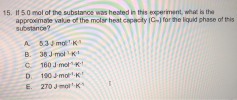 15. If 5.0 mol of the substance was heated in this experiment, what is the approximate value of the molar heat capacity (Cm) for the liquid phase of this substance? A. B. C. D. E. 5.3 J.mol-1.K-1 38 J.mol-1.K-1 160 J.mol-1.K? 190 J.mol-1.K-1 270 J.mol-1-K-1 Shown below is a heating curve generated during an experiment in which 5.0 mo of a substance was heated to around 190°C. 200.0- 160.0 -- 120.0- T(°C) 80.0 - -- 40.0- - 0.00– --- 0.00...
6. Shown below is the heating curve for a substance. The five segments of the heating...
 6. Shown below is the heating curve for a substance. The five segments of the heating curve are labeled A-E 130 100 T (°C) heat added (kJ) I. ndicate the phases of matter present when the substance is at each point (A-E) on the heating curve For this substance, which phase of matter has the largest heat capacity? How can you tell? In what state of matter would this substance exist at room temperature? How can you tell? IV. In...
Select all accurate statements about the heating curve shown for ethanol (C)H,OH). C2H5OH 46.07 g/mol 161...
 Select all accurate statements about the heating curve shown for ethanol (C)H,OH). C2H5OH 46.07 g/mol 161 C AHvap 42.59KJ/mol 78.5 AHfus A 5.021 kJ/mol Boiling Point 78.5°C Heat Added Freezing Point -117.3°C Specific Heat Capacity (c) of liquid 2.42 J/g°C Specific Heat 1.42 J/g°C Capacity (c) of gas Temperature (C) B The portion of the heating curve labeled "A represents the increase in the average kinetic energy of the liquid phase of ethanol. The portion of the heating curve labeled...
Heating Curve for 1 Mole at 1 Atm heating of gas 500 gas 400 heating of...
 Heating Curve for 1 Mole at 1 Atm heating of gas 500 gas 400 heating of lig 300 TK 200 solid I evaporation liquid/ 100+ b L Melning Freezing - Valporization 0 + 100 400 500 200 300 Energy added, kJ Use the heating curve in Model 2 to estimate values for the following parameters of the Assume that the molar mass of the substance is 120 g/mol. a. molar heat of fusion b. molar heat of vaporization c. specific...
Which section of the flowing heating curve of water represents the heat of vaporization? Which section...
 Which section of the flowing heating curve of water represents the heat of vaporization? Which section represents a physical state of liquid? E Temperature (°C) B Heat Added, kJ/mol DE represents the heat of vaporization: CD represents a physical state of liquid OBC represents heat of vaporization; EF represents a physical state of liquid BC represents heat of vaporization: CD represents a physical state of liquid DE represents heat of vaporization: AB represents a physical state of liquid
identifying phase transitions on a heating curve - O GASES, LIQUIDS, AND SOLIDS Identifying phase transitions...
 identifying phase transitions on a heating curve
- O GASES, LIQUIDS, AND SOLIDS Identifying phase transitions on a heating curve A pure solid sample of Substance X is put into an evacuated flask. The flask is heated at a steady rate and the temperature recorded as time passes. Here is a graph of the results: temperature (°C) heat added (kJ/mol Use this graph to answer the following questions: What is the melting point of X? What phase (physical state) of...
identifying phase transitions on a heating curve
- O GASES, LIQUIDS, AND SOLIDS Identifying phase transitions on a heating curve A pure solid sample of Substance X is put into an evacuated flask. The flask is heated at a steady rate and the temperature recorded as time passes. Here is a graph of the results: temperature (°C) heat added (kJ/mol Use this graph to answer the following questions: What is the melting point of X? What phase (physical state) of...
O GASES, LUIDJA Identifying phase transitions on a heating curve A pure v ample of Substance...
 O GASES, LUIDJA Identifying phase transitions on a heating curve A pure v ample of Substance X is put into an evacuated flask. The flask is heated at a ste graph of the results: temperature (°C) heat added (kJ/mol) Use this graph to answer the following questions: What is the melting point of X? Ilc What phase (physical state) of X would you expect to find in the flask after 10 kJ/mol of heat has been added? (check all that...
X is known to exist at 1 atm in the solid, liquid, or vapor phase, depending...
 X is known to exist at 1 atm in the solid, liquid, or vapor phase, depending on the temperature. Additionally, the values of these other properties of Substance X have been determined: boiling point 35. melting point enthalpy of fusion6.00 kJ/mol enthalpy of vaporization 34.00 kJ/mol 46. J-K mol (solid) 73. JK mol (vapor 2.80 g/em (solid) 2.40 g/mL (liquid density heat capacity61.JKmol Ciquid) You may also assume X behaves as an ideal gas in the vapor phase. Suppose a...
2) A person pours 400 g of water at 45°C into an 855-g aluminum container with...
 2) A person pours 400 g of water at 45°C into an 855-g aluminum container with an initial temperature of 10°c. The specific heat of aluminum is 900 J/(kg-K) and that of water is 4190 J/(kg K). What is the final temperature of assuming no heat is exchanged with the surroundings? A) 3 B) 35°C D) 28°C E) 33°C 3) A heat engine with aneffic ency of 300% performs 300 of work. How much heat is discharged to the lower...
Principles of Inorganic Chemistry! Week 5 Effect of Temperature on Solubility of a Salt In this experiment, you w...
 Principles of Inorganic Chemistry! Week 5 Effect of Temperature on Solubility of a Salt In this experiment, you will study the effect of changing temperature on the amount of solute that will dissolve in a given amount of water. Water solubility is an important physical property in chemistry, and is often expressed as the mass of solute that dissolves in 100 g of water at a certain temperature. In this experiment, you will completely dissolve different quantities of potassium nitrate,...
 15. If 5.0 mol of the substance was heated in this experiment, what is the approximate value of the molar heat capacity (Cm) for the liquid phase of this substance? A. B. C. D. E. 5.3 J.mol-1.K-1 38 J.mol-1.K-1 160 J.mol-1.K? 190 J.mol-1.K-1 270 J.mol-1-K-1 Shown below is a heating curve generated during an experiment in which 5.0 mo of a substance was heated to around 190°C. 200.0- 160.0 -- 120.0- T(°C) 80.0 - -- 40.0- - 0.00– --- 0.00...
 6. Shown below is the heating curve for a substance. The five segments of the heating curve are labeled A-E 130 100 T (°C) heat added (kJ) I. ndicate the phases of matter present when the substance is at each point (A-E) on the heating curve For this substance, which phase of matter has the largest heat capacity? How can you tell? In what state of matter would this substance exist at room temperature? How can you tell? IV. In...
 Select all accurate statements about the heating curve shown for ethanol (C)H,OH). C2H5OH 46.07 g/mol 161 C AHvap 42.59KJ/mol 78.5 AHfus A 5.021 kJ/mol Boiling Point 78.5°C Heat Added Freezing Point -117.3°C Specific Heat Capacity (c) of liquid 2.42 J/g°C Specific Heat 1.42 J/g°C Capacity (c) of gas Temperature (C) B The portion of the heating curve labeled "A represents the increase in the average kinetic energy of the liquid phase of ethanol. The portion of the heating curve labeled...
 Heating Curve for 1 Mole at 1 Atm heating of gas 500 gas 400 heating of lig 300 TK 200 solid I evaporation liquid/ 100+ b L Melning Freezing - Valporization 0 + 100 400 500 200 300 Energy added, kJ Use the heating curve in Model 2 to estimate values for the following parameters of the Assume that the molar mass of the substance is 120 g/mol. a. molar heat of fusion b. molar heat of vaporization c. specific...
 Which section of the flowing heating curve of water represents the heat of vaporization? Which section represents a physical state of liquid? E Temperature (°C) B Heat Added, kJ/mol DE represents the heat of vaporization: CD represents a physical state of liquid OBC represents heat of vaporization; EF represents a physical state of liquid BC represents heat of vaporization: CD represents a physical state of liquid DE represents heat of vaporization: AB represents a physical state of liquid
 identifying phase transitions on a heating curve
- O GASES, LIQUIDS, AND SOLIDS Identifying phase transitions on a heating curve A pure solid sample of Substance X is put into an evacuated flask. The flask is heated at a steady rate and the temperature recorded as time passes. Here is a graph of the results: temperature (°C) heat added (kJ/mol Use this graph to answer the following questions: What is the melting point of X? What phase (physical state) of...
identifying phase transitions on a heating curve
- O GASES, LIQUIDS, AND SOLIDS Identifying phase transitions on a heating curve A pure solid sample of Substance X is put into an evacuated flask. The flask is heated at a steady rate and the temperature recorded as time passes. Here is a graph of the results: temperature (°C) heat added (kJ/mol Use this graph to answer the following questions: What is the melting point of X? What phase (physical state) of...
 O GASES, LUIDJA Identifying phase transitions on a heating curve A pure v ample of Substance X is put into an evacuated flask. The flask is heated at a ste graph of the results: temperature (°C) heat added (kJ/mol) Use this graph to answer the following questions: What is the melting point of X? Ilc What phase (physical state) of X would you expect to find in the flask after 10 kJ/mol of heat has been added? (check all that...
 X is known to exist at 1 atm in the solid, liquid, or vapor phase, depending on the temperature. Additionally, the values of these other properties of Substance X have been determined: boiling point 35. melting point enthalpy of fusion6.00 kJ/mol enthalpy of vaporization 34.00 kJ/mol 46. J-K mol (solid) 73. JK mol (vapor 2.80 g/em (solid) 2.40 g/mL (liquid density heat capacity61.JKmol Ciquid) You may also assume X behaves as an ideal gas in the vapor phase. Suppose a...
 2) A person pours 400 g of water at 45°C into an 855-g aluminum container with an initial temperature of 10°c. The specific heat of aluminum is 900 J/(kg-K) and that of water is 4190 J/(kg K). What is the final temperature of assuming no heat is exchanged with the surroundings? A) 3 B) 35°C D) 28°C E) 33°C 3) A heat engine with aneffic ency of 300% performs 300 of work. How much heat is discharged to the lower...
 Principles of Inorganic Chemistry! Week 5 Effect of Temperature on Solubility of a Salt In this experiment, you will study the effect of changing temperature on the amount of solute that will dissolve in a given amount of water. Water solubility is an important physical property in chemistry, and is often expressed as the mass of solute that dissolves in 100 g of water at a certain temperature. In this experiment, you will completely dissolve different quantities of potassium nitrate,...
Most questions answered within 3 hours.
-
Where is the error in this code sequence?
String s1 = "Hello";
String s2 = "ello";...
asked 10 months ago -
Financial data for Joel de Paris, Inc., for last year
follow:
Joel de Paris, Inc.
Balance...
asked 10 months ago -
Consider this reaction:
Al2(SO4)3 (aq)+ BaCl3
(aq) Al2Cl6 (aq)- +
3BaSO4(s) . What is the...
asked 10 months ago -
Suppose that Savneet is considering increasing her
recent random sample from 20 car rentals to 40...
asked 10 months ago -
Trucks arrive at an unloading terminal at an average rate of 120
per hour.
Trucks arrive...
asked 10 months ago -
Why are methanol and ethanol completely soluble in water while
octanol is not very little soluble....
asked 10 months ago -
A facilities manager at a university reads in a research report
that the mean amount of...
asked 10 months ago -
When the CuSO4 is rehydrated by adding water to the anhydrous
compound, is this an endothermic...
asked 10 months ago -
A ray of sunlight is passing from diamond into crown glass; the
angle of incidence is...
asked 10 months ago -
A block of mass 0.249 kg is placed on top of a light, vertical
spring of...
asked 10 months ago -
how do the kidneys compensate in the presences of acidosis
a) trigger hyperventilate
b) reserve acid...
asked 10 months ago -
Question 501 pts
The rental rate of capital to the firm increases. Which of the
following...
asked 10 months ago