

Homework Answers

Add Answer to:
5. A 14 inch (0.356 m) automobile tire on a car traveling at 60 mph has...
Im having trouble with all parts a-e The tire of an accelerating car rotates with an...
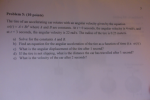 Im having trouble with all parts a-e
The tire of an accelerating car rotates with an angular velocity given by the equation omega(t) = A + Bt^2 where A and B are constants. At t = 0 seconds, the angular velocity is 4 rad/s, and at t = 3 seconds, the angular velocity is 22 rad/s. The radius of the tire is 0.25 meters. Solve for the constants A and B. Find an equation for the angular acceleration of the...
Im having trouble with all parts a-e
The tire of an accelerating car rotates with an angular velocity given by the equation omega(t) = A + Bt^2 where A and B are constants. At t = 0 seconds, the angular velocity is 4 rad/s, and at t = 3 seconds, the angular velocity is 22 rad/s. The radius of the tire is 0.25 meters. Solve for the constants A and B. Find an equation for the angular acceleration of the...
An automobile traveling at 70.0 km/h has tires of 50.0 cm diameter. (a) What is the...
 An automobile traveling at 70.0 km/h has tires of 50.0 cm diameter. (a) What is the angular speed of the tires about their axles? rad/s (b) If the car is brought to a stop uniformly in 40.0 complete turns of the tires (without skidding), what is the magnitude of the angular acceleration of the wheels? rad/s2 (c) How far does the car move during the braking? m
A car initially traveling at 29.8 m/s undergoes a constant negative acceleration of magnitude 1.60 m...
 A car initially traveling at 29.8 m/s undergoes a constant negative acceleration of magnitude 1.60 m after its brakes are applied (a) How many revolutions does each tre male before the comes to a stop, assuming the car does not sad and the tires have made of 0.330 ? (6) What is the angular speed of the wheels when the car has traveled half the total distance? Need Help? The 4 -14 points SerCP8 7.P.012, My Notes Ask Your Teacher...
An automobile traveling at 50 km/h has tires of 75.0 cm diameter. A) What is the...
An automobile traveling at 50 km/h has tires of 75.0 cm diameter. A) What is the angular speed of the tires on the wheels? B) If the car is brought to a stop uniformly in 15 complete turns of the tire (without skidding), what is the magnitude of the angular acceleration of the wheels? C) How far does the car move during the braking?
Problem 1: A wheel starts from rest and rotates with constant angular acceleration and reaches an...
Problem 1: A wheel starts from rest and rotates with constant angular acceleration and reaches an angular velocity of 32.0 rad/s in 4.00 s. (a) What is the magnitude of the angular acceleration of the wheel? (b) Through what angle does the wheel rotate in these 4.00 s? Problem 2: An automobile traveling at 90.0 km/hour, has tires of 75.0 cm diameter. (a) What is the angular velocity of the tires about the axis of rotation? (b) If the car...
A car initially traveling at 33.5 m/s undergoes a constant negative acceleration of magnitude 1.40 m/s...
 A car initially traveling at 33.5 m/s undergoes a constant negative acceleration of magnitude 1.40 m/s after its brakes are applied. (a) How many revolutions does each tire make before the car comes to a stop, assuming the car does not skid and the tires have radil of 0.330 m? (b) What is the angular speed of the wheels when the car has traveled half the total distance? rad/s
A car initially traveling at 25.4 m/s undergoes a constant negative acceleration of magnitude 1.80 m/s2...
A car initially traveling at 25.4 m/s undergoes a constant negative acceleration of magnitude 1.80 m/s2 after its brakes are applied. (a) How many revolutions does each tire make before the car comes to a stop, assuming the car does not skid and the tires have radii of 0.330 m? _______ rev (b) What is the angular speed of the wheels when the car has traveled half the total distance? ________ rad/s
A car initially traveling at 25.7 m/s undergoes a constant negative acceleration of magnitude 1.60 m/s2...
A car initially traveling at 25.7 m/s undergoes a constant negative acceleration of magnitude 1.60 m/s2 after its brakes are applied. (a) How many revolutions does each tire make before the car comes to a stop, assuming the car does not skid and the tires have radii of 0.350 m? rev (b) What is the angular speed of the wheels when the car has traveled half the total distance? rad/s
The car in front of you is driving through downtown Huntington at 35 mph (15.65 m/s)....
The car in front of you is driving through downtown Huntington at 35 mph (15.65 m/s). If the tires have a 17-inch diameter (the radius is 0.216 m), what is the angular velocity of the wheel in rad/s? What is the angular velocity in rpm?
A car initially traveling at 34.3 m/s undergoes a constant negative acceleration of magnitude 1.70 m/s2...
 A car initially traveling at 34.3 m/s undergoes a constant negative acceleration of magnitude 1.70 m/s2 after its brakes are applied. (a) How many revolutions does each tire make before the car comes to a stop, assuming the car does not skid and the tires have radii of 0.330 m? c rev (b) What is the angular speed of the wheels when the car has traveled half the total distance? rad/s
 Im having trouble with all parts a-e
The tire of an accelerating car rotates with an angular velocity given by the equation omega(t) = A + Bt^2 where A and B are constants. At t = 0 seconds, the angular velocity is 4 rad/s, and at t = 3 seconds, the angular velocity is 22 rad/s. The radius of the tire is 0.25 meters. Solve for the constants A and B. Find an equation for the angular acceleration of the...
Im having trouble with all parts a-e
The tire of an accelerating car rotates with an angular velocity given by the equation omega(t) = A + Bt^2 where A and B are constants. At t = 0 seconds, the angular velocity is 4 rad/s, and at t = 3 seconds, the angular velocity is 22 rad/s. The radius of the tire is 0.25 meters. Solve for the constants A and B. Find an equation for the angular acceleration of the...
 An automobile traveling at 70.0 km/h has tires of 50.0 cm diameter. (a) What is the angular speed of the tires about their axles? rad/s (b) If the car is brought to a stop uniformly in 40.0 complete turns of the tires (without skidding), what is the magnitude of the angular acceleration of the wheels? rad/s2 (c) How far does the car move during the braking? m
 A car initially traveling at 29.8 m/s undergoes a constant negative acceleration of magnitude 1.60 m after its brakes are applied (a) How many revolutions does each tre male before the comes to a stop, assuming the car does not sad and the tires have made of 0.330 ? (6) What is the angular speed of the wheels when the car has traveled half the total distance? Need Help? The 4 -14 points SerCP8 7.P.012, My Notes Ask Your Teacher...
 A car initially traveling at 33.5 m/s undergoes a constant negative acceleration of magnitude 1.40 m/s after its brakes are applied. (a) How many revolutions does each tire make before the car comes to a stop, assuming the car does not skid and the tires have radil of 0.330 m? (b) What is the angular speed of the wheels when the car has traveled half the total distance? rad/s
 A car initially traveling at 34.3 m/s undergoes a constant negative acceleration of magnitude 1.70 m/s2 after its brakes are applied. (a) How many revolutions does each tire make before the car comes to a stop, assuming the car does not skid and the tires have radii of 0.330 m? c rev (b) What is the angular speed of the wheels when the car has traveled half the total distance? rad/s
Most questions answered within 3 hours.
-
Where is the error in this code sequence?
String s1 = "Hello";
String s2 = "ello";...
asked 11 months ago -
Financial data for Joel de Paris, Inc., for last year
follow:
Joel de Paris, Inc.
Balance...
asked 11 months ago -
Consider this reaction:
Al2(SO4)3 (aq)+ BaCl3
(aq) Al2Cl6 (aq)- +
3BaSO4(s) . What is the...
asked 11 months ago -
Suppose that Savneet is considering increasing her
recent random sample from 20 car rentals to 40...
asked 11 months ago -
Trucks arrive at an unloading terminal at an average rate of 120
per hour.
Trucks arrive...
asked 11 months ago -
Why are methanol and ethanol completely soluble in water while
octanol is not very little soluble....
asked 11 months ago -
A facilities manager at a university reads in a research report
that the mean amount of...
asked 11 months ago -
When the CuSO4 is rehydrated by adding water to the anhydrous
compound, is this an endothermic...
asked 11 months ago -
A ray of sunlight is passing from diamond into crown glass; the
angle of incidence is...
asked 11 months ago -
A block of mass 0.249 kg is placed on top of a light, vertical
spring of...
asked 11 months ago -
how do the kidneys compensate in the presences of acidosis
a) trigger hyperventilate
b) reserve acid...
asked 11 months ago -
Question 501 pts
The rental rate of capital to the firm increases. Which of the
following...
asked 11 months ago