A mining cart is pulled up a hill at 24 km/h and then pulled back down...
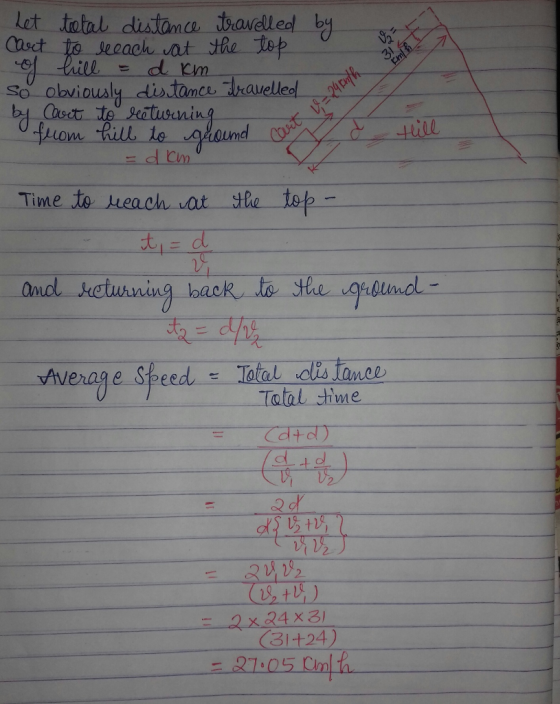
A mining cart is pulled up a hill at 24 km/h and then pulled back down the hill at 31 km/h through its original level. (The time required for the cart's reversal at the top of its climb is negligible.) What is the average speed of the cart for its round trip, from its original level back to its original level?
Homework Answers
Summary of Answer-We will find the average speed by dividing total distance travelled by cart with total time taken by it in this journey.
Add Answer to:
A mining cart is pulled up a hill at 24 km/h and then pulled
back down...
A car travels up a hill at a constant speed of 31 km/h and returns down...
A car travels up a hill at a constant speed of 31 km/h and returns down the hill at a constant speed of 79 km/h. Calculate the average speed for the round trip.
A car travels up a hill at a constant speed of 40 km/h and returns down...
A car travels up a hill at a constant speed of 40 km/h and returns down the hill at a constant speed of 60 km/h. Calculate the average speed for the round trip.
please help with 4(c) 5 6. 4. A car travels up a hill at a constant...
 please help with
4(c)
5
6.
4. A car travels up a hill at a constant speed of 40 km/h and returns down the hill at a constant speed of 60 km/h. (a) The displacement for the round trip is Hint: r ? (b) The average velocity for the round trip is Hint: -=- (c) The average speed for the round trip is Hint: average speedtotal distance km/h Ax kmh Assume the distance for one way is d. , -d...
please help with
4(c)
5
6.
4. A car travels up a hill at a constant speed of 40 km/h and returns down the hill at a constant speed of 60 km/h. (a) The displacement for the round trip is Hint: r ? (b) The average velocity for the round trip is Hint: -=- (c) The average speed for the round trip is Hint: average speedtotal distance km/h Ax kmh Assume the distance for one way is d. , -d...
question 5 Module 2B: Velocity and Acceleration 4. A car travels up a hill at a...
 question 5
Module 2B: Velocity and Acceleration 4. A car travels up a hill at a constant speed of 40 km/h and returns down the hill at a constant speed of 60 km/h. (a) The displacement for the round trip is Hint: Ar ? (b) The average velocity for the round trip is Hint: Ar (c) The average speed for the round trip skm/h km/h At average speed -total distacekm/h total time Assume the distance for one way is d,...
question 5
Module 2B: Velocity and Acceleration 4. A car travels up a hill at a constant speed of 40 km/h and returns down the hill at a constant speed of 60 km/h. (a) The displacement for the round trip is Hint: Ar ? (b) The average velocity for the round trip is Hint: Ar (c) The average speed for the round trip skm/h km/h At average speed -total distacekm/h total time Assume the distance for one way is d,...
A roller coaster reaches the top of the steepest hill with a speed of 6.00 km/h....
A roller coaster reaches the top of the steepest hill with a speed of 6.00 km/h. It then descends the hill, which is at an average angle of 25° and is 60.0 m long. What will its speed be when it reaches the bottom? Assume µk = 0.16.
A roller coaster reaches the top of the steepest hill with a speed of 6.1 km/h...
A roller coaster reaches the top of the steepest hill with a speed of 6.1 km/h . It then descends the hill, which is at an average angle of 41 ∘ and is 37.5 m long. Part A What will its speed be when it reaches the bottom? Assume μk = 0.18.
An 1100 kg car is shifted into neutral and coasts down a 10 meter hill and...
 An 1100 kg car is shifted into neutral and coasts down a 10 meter hill and then back up a 15 meter hill. If you assume that frictional losses are negligible and the car starts out at 60 mph, what will its speed be when it reaches the top of the second hill? Use g 9.8 m/s2, 1 mile 1600 meters, and round answer to 2 significant figures. - Gas station 15 m 10 m
a) How high a hill can a car coast up (engine disengaged) if friction is negligible...
a) How high a hill can a car coast up (engine disengaged) if friction is negligible and its initial speed is 78.0 km/h? m (b) If, in actuality, a 750 kg car with an initial speed of 78.0 km/h is observed to coast up a hill to a height 10.0 m above its starting point, how much thermal energy was generated by friction? J (c) What is the average force of friction if the hill has a slope 2.5° above...
Imagine a cyclist coasting down a 5.0◦ incline at a constant speed of 6.0 km/h because...
Imagine a cyclist coasting down a 5.0◦ incline at a constant speed of 6.0 km/h because of air resistance. If the total mass of the bicycle + cyclist is 50 kg, how much force must be generated to climb back up the incline at the same speed (and same air resistance)?
A car has an initial speed of 118 km/h and climbs up an incline with its...
A car has an initial speed of 118 km/h and climbs up an incline with its engine DISENGAGED (no engine force). DON"T use scientific notation. Angle is 33 degrees. (a) If work done by friction is negligible, How high (the h in the figure) a hill can the car coast up (engine disengaged) before coming to a stop? (b) If, in actuality, a 700-kg car with an initial speed of 118 km/h is observed to coast up a hill to...
 please help with
4(c)
5
6.
4. A car travels up a hill at a constant speed of 40 km/h and returns down the hill at a constant speed of 60 km/h. (a) The displacement for the round trip is Hint: r ? (b) The average velocity for the round trip is Hint: -=- (c) The average speed for the round trip is Hint: average speedtotal distance km/h Ax kmh Assume the distance for one way is d. , -d...
please help with
4(c)
5
6.
4. A car travels up a hill at a constant speed of 40 km/h and returns down the hill at a constant speed of 60 km/h. (a) The displacement for the round trip is Hint: r ? (b) The average velocity for the round trip is Hint: -=- (c) The average speed for the round trip is Hint: average speedtotal distance km/h Ax kmh Assume the distance for one way is d. , -d...
 question 5
Module 2B: Velocity and Acceleration 4. A car travels up a hill at a constant speed of 40 km/h and returns down the hill at a constant speed of 60 km/h. (a) The displacement for the round trip is Hint: Ar ? (b) The average velocity for the round trip is Hint: Ar (c) The average speed for the round trip skm/h km/h At average speed -total distacekm/h total time Assume the distance for one way is d,...
question 5
Module 2B: Velocity and Acceleration 4. A car travels up a hill at a constant speed of 40 km/h and returns down the hill at a constant speed of 60 km/h. (a) The displacement for the round trip is Hint: Ar ? (b) The average velocity for the round trip is Hint: Ar (c) The average speed for the round trip skm/h km/h At average speed -total distacekm/h total time Assume the distance for one way is d,...
 An 1100 kg car is shifted into neutral and coasts down a 10 meter hill and then back up a 15 meter hill. If you assume that frictional losses are negligible and the car starts out at 60 mph, what will its speed be when it reaches the top of the second hill? Use g 9.8 m/s2, 1 mile 1600 meters, and round answer to 2 significant figures. - Gas station 15 m 10 m
Most questions answered within 3 hours.
-
Where is the error in this code sequence?
String s1 = "Hello";
String s2 = "ello";...
asked 10 months ago -
Financial data for Joel de Paris, Inc., for last year
follow:
Joel de Paris, Inc.
Balance...
asked 10 months ago -
Consider this reaction:
Al2(SO4)3 (aq)+ BaCl3
(aq) Al2Cl6 (aq)- +
3BaSO4(s) . What is the...
asked 10 months ago -
Suppose that Savneet is considering increasing her
recent random sample from 20 car rentals to 40...
asked 10 months ago -
Trucks arrive at an unloading terminal at an average rate of 120
per hour.
Trucks arrive...
asked 10 months ago -
Why are methanol and ethanol completely soluble in water while
octanol is not very little soluble....
asked 10 months ago -
A facilities manager at a university reads in a research report
that the mean amount of...
asked 10 months ago -
When the CuSO4 is rehydrated by adding water to the anhydrous
compound, is this an endothermic...
asked 10 months ago -
A ray of sunlight is passing from diamond into crown glass; the
angle of incidence is...
asked 10 months ago -
A block of mass 0.249 kg is placed on top of a light, vertical
spring of...
asked 10 months ago -
how do the kidneys compensate in the presences of acidosis
a) trigger hyperventilate
b) reserve acid...
asked 10 months ago -
Question 501 pts
The rental rate of capital to the firm increases. Which of the
following...
asked 10 months ago