

Homework Answers
Add Answer to:
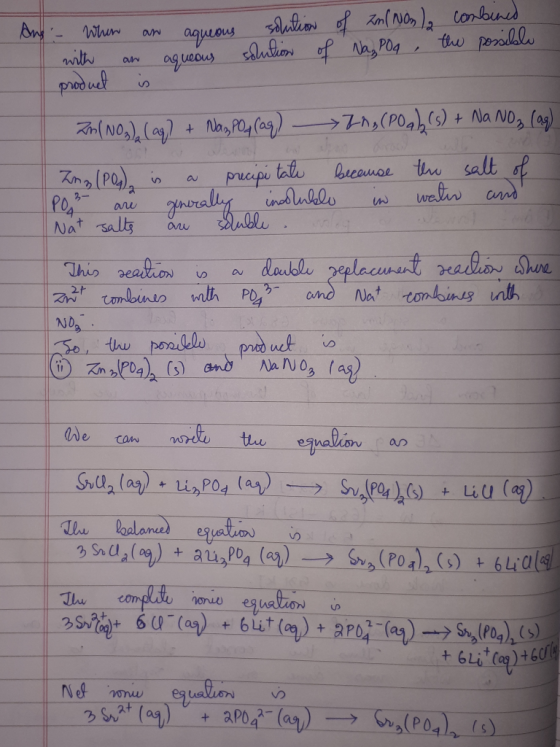
If an aqueous solution of Zn(NO3)2 was combined with an aqueous solution of Na3PO4, the possible...
Question 5 2 pts Consider what would happen if aqueous solutions of strontium chloride and lithium phosphate were...
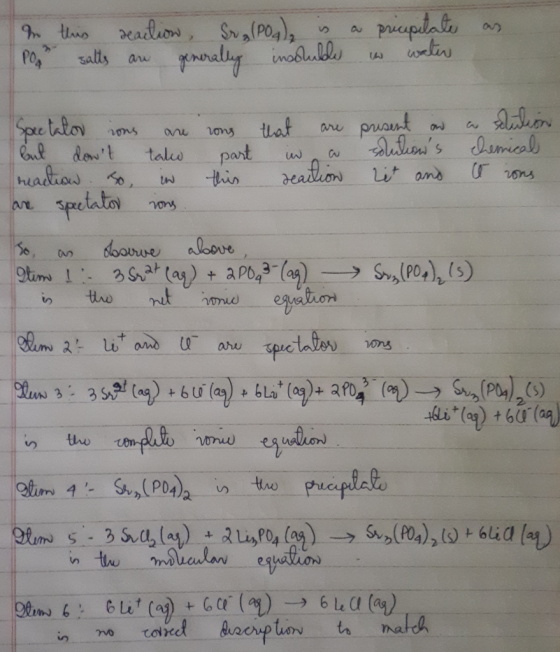
 Question 5 2 pts Consider what would happen if aqueous solutions of strontium chloride and lithium phosphate were combined. Match each of the items below to the correct description of that item in this chemical process. Item 1: 3 Sr2+ (aq) + 2 PO43- (aq) --> Sr3(PO4)2 (s) Item 2: Lit and Cl" Item 3: 3 Sr2+ (aq) + 6 CI" (aq) + 6 LI+ (aq) + 2 PO43- (aq) --> Sr3(PO4)2 (s) +6 Lit (aq) + 6 Cl(aq) Item...
11:08 ..: LTE O < Question 17 of 29 Submit Which one of the following represents...
 11:08 ..: LTE O < Question 17 of 29 Submit Which one of the following represents the net ionic equation for the reaction of Ca(NO3)2 with LizPO ? A) 3 Ca(NO3)2 (aq) + 2 Li3PO4 (aq) → Ca3(PO4)2 (s) + 6 NaNO3 (aq) B) Ca2+ (aq) + PO43- (aq) → Ca3(PO4)2 (s) C) 3 Ca2+ (aq) + 2 PO43- (aq) → Ca3(PO4)2 (s) D) Lit (aq) + NO3- (aq) → LINO3 (s)
25.0 mL of 0.150 M Na3PO4 are combined with 25.0 mL of 0.200 M Sr(NO3)2. Calculate...
25.0 mL of 0.150 M Na3PO4 are combined with 25.0 mL of 0.200 M Sr(NO3)2. Calculate the concentrations of all ionic species (except H+ and OH-) at equilibrium. Ksp( Sr3(PO4)2 ) = 1.0x10^-31. Answer: Na+ = 0.225 M PO4= 0.0084 M Sr= 1.12 x 10^-9 M NO3 = 0.220 M
Write complete ionic and net ionic equations for each reaction. 3 SrCl2(aq) + 2Li3PO4(aq) → Sr3(PO4)2(s)...
Write complete ionic and net ionic equations for each reaction. 3 SrCl2(aq) + 2Li3PO4(aq) → Sr3(PO4)2(s) + 6 LiCl(aq) Complete ionic equation: 3 Sr2+ (aq) + 6 Cl- (aq) + 6 Li+ (aq) + 2 PO43- (aq) → Sr3(PO4)2(s) + 6 Li+ (aq) + 6 Cl- (aq) Net ionic equation: 3 Sr2+ (aq) + 2 PO43- (aq) → Sr3(PO4)2(s) HC2H3O2(aq) + KOH(aq) → H2O(l) + KC2H3O2 (aq) Complete ionic equation: HC2H3O2(aq) + K+(aq) + OH- (aq) → H2O(l)...
2 Na3PO4(aq) + 3 Cu(NO3)2(aq) → Cu3(PO4)2(s) + 6 NaNO3(aq) What mass of Cu3(PO4)2 can be...
2 Na3PO4(aq) + 3 Cu(NO3)2(aq) → Cu3(PO4)2(s) + 6 NaNO3(aq) What mass of Cu3(PO4)2 can be formed when 23.7 mL of a 0.790 M solution of Na3PO4 is mixed with 76.3 mL of a 0.730 M solution of Cu(NO3)2?
When the following chemical reaction is balanced, what is the sum of the coefficients? Zn(C2H302)2 (aq) + Na3PO4 (a...
 When the following chemical reaction is balanced, what is the sum of the coefficients? Zn(C2H302)2 (aq) + Na3PO4 (aq) --> NaC2H302 (aq) + Zn3(PO4)2 (s)
c. (10 pts.) Using the equation: 3 S-Cl2 (aq) + 2 Li3PO4 (aq) → Sr3(PO4)2 (8)...
 c. (10 pts.) Using the equation: 3 S-Cl2 (aq) + 2 Li3PO4 (aq) → Sr3(PO4)2 (8) + 6 LICI (aq) If you are given 5.80 g of SrCl2 and 2.45 g of Li3PO4, which of the two compounds is the limiting reactant, and what is the theoretical yield (in grams)? src S 8762)*1 is 4.524
The following chemical reaction takes place in aqueous solution: Zn(NO3)2(aq)+ 2KOH(aq)->Zn(OH)2(s)+ 2KNO3(aq) Write the net ionic...
The following chemical reaction takes place in aqueous solution: Zn(NO3)2(aq)+ 2KOH(aq)->Zn(OH)2(s)+ 2KNO3(aq) Write the net ionic equation for this reaction.
Na3PO4(aq) + Ca(NO3)2(aq) → NaNO3(aq) + Ca3(PO4)2(s) Determine the amount of NaNO3(aq) formed in the reaction...
Na3PO4(aq) + Ca(NO3)2(aq) → NaNO3(aq) + Ca3(PO4)2(s) Determine the amount of NaNO3(aq) formed in the reaction if 3.30 moles of Ca(NO3)2(aq) reacts with an excess of Na3PO4(aq) and the percent yield of NaNO3(aq) is 71.0%. A. 6.24 moles B. 9.30 moles C. 4.69 moles D. 7.50 moles E. 8.96 moles
Solutions of calcium hydroxide, Ca(OH)2, and sodium phosphate, Na3PO4, are mixed according to the following chemical...
 Solutions of calcium hydroxide, Ca(OH)2, and sodium phosphate, Na3PO4, are mixed according to the following chemical equation. What is the ionic equation for the reaction The molecular equation is: 3Cu(OH)2(aq) + 2Na3PO4(aq) + Caz(PO4)2 (s) + NaOH(aq) 3Ca2+(aq) + 20H(aq) + 6Na*(aq) + PO43- (aq) - 3Ca2+ (aq) + PO43- (aq) + 6NaOH(aq) 3Ca2(aq) + OH2" (aq) + 2Na3aq) + PO43- (aq) - Ca3(PO4)2 (s) + 2Nazt (aq) + OH2" (aq) 3Ca2+ (aq) + 20H(aq) + 6Na*(aq) + PO43-lag) -...
 Question 5 2 pts Consider what would happen if aqueous solutions of strontium chloride and lithium phosphate were combined. Match each of the items below to the correct description of that item in this chemical process. Item 1: 3 Sr2+ (aq) + 2 PO43- (aq) --> Sr3(PO4)2 (s) Item 2: Lit and Cl" Item 3: 3 Sr2+ (aq) + 6 CI" (aq) + 6 LI+ (aq) + 2 PO43- (aq) --> Sr3(PO4)2 (s) +6 Lit (aq) + 6 Cl(aq) Item...
 11:08 ..: LTE O < Question 17 of 29 Submit Which one of the following represents the net ionic equation for the reaction of Ca(NO3)2 with LizPO ? A) 3 Ca(NO3)2 (aq) + 2 Li3PO4 (aq) → Ca3(PO4)2 (s) + 6 NaNO3 (aq) B) Ca2+ (aq) + PO43- (aq) → Ca3(PO4)2 (s) C) 3 Ca2+ (aq) + 2 PO43- (aq) → Ca3(PO4)2 (s) D) Lit (aq) + NO3- (aq) → LINO3 (s)
 When the following chemical reaction is balanced, what is the sum of the coefficients? Zn(C2H302)2 (aq) + Na3PO4 (aq) --> NaC2H302 (aq) + Zn3(PO4)2 (s)
 c. (10 pts.) Using the equation: 3 S-Cl2 (aq) + 2 Li3PO4 (aq) → Sr3(PO4)2 (8) + 6 LICI (aq) If you are given 5.80 g of SrCl2 and 2.45 g of Li3PO4, which of the two compounds is the limiting reactant, and what is the theoretical yield (in grams)? src S 8762)*1 is 4.524
 Solutions of calcium hydroxide, Ca(OH)2, and sodium phosphate, Na3PO4, are mixed according to the following chemical equation. What is the ionic equation for the reaction The molecular equation is: 3Cu(OH)2(aq) + 2Na3PO4(aq) + Caz(PO4)2 (s) + NaOH(aq) 3Ca2+(aq) + 20H(aq) + 6Na*(aq) + PO43- (aq) - 3Ca2+ (aq) + PO43- (aq) + 6NaOH(aq) 3Ca2(aq) + OH2" (aq) + 2Na3aq) + PO43- (aq) - Ca3(PO4)2 (s) + 2Nazt (aq) + OH2" (aq) 3Ca2+ (aq) + 20H(aq) + 6Na*(aq) + PO43-lag) -...
Most questions answered within 3 hours.
-
Where is the error in this code sequence?
String s1 = "Hello";
String s2 = "ello";...
asked 11 months ago -
Financial data for Joel de Paris, Inc., for last year
follow:
Joel de Paris, Inc.
Balance...
asked 11 months ago -
Consider this reaction:
Al2(SO4)3 (aq)+ BaCl3
(aq) Al2Cl6 (aq)- +
3BaSO4(s) . What is the...
asked 11 months ago -
Suppose that Savneet is considering increasing her
recent random sample from 20 car rentals to 40...
asked 11 months ago -
Trucks arrive at an unloading terminal at an average rate of 120
per hour.
Trucks arrive...
asked 11 months ago -
Why are methanol and ethanol completely soluble in water while
octanol is not very little soluble....
asked 11 months ago -
A facilities manager at a university reads in a research report
that the mean amount of...
asked 11 months ago -
When the CuSO4 is rehydrated by adding water to the anhydrous
compound, is this an endothermic...
asked 11 months ago -
A ray of sunlight is passing from diamond into crown glass; the
angle of incidence is...
asked 11 months ago -
A block of mass 0.249 kg is placed on top of a light, vertical
spring of...
asked 11 months ago -
how do the kidneys compensate in the presences of acidosis
a) trigger hyperventilate
b) reserve acid...
asked 11 months ago -
Question 501 pts
The rental rate of capital to the firm increases. Which of the
following...
asked 11 months ago