
Homework Answers
Add Answer to:
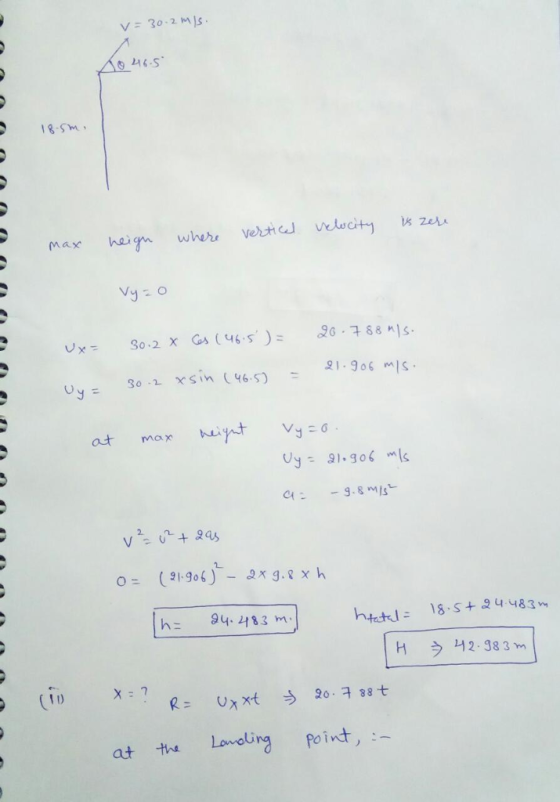
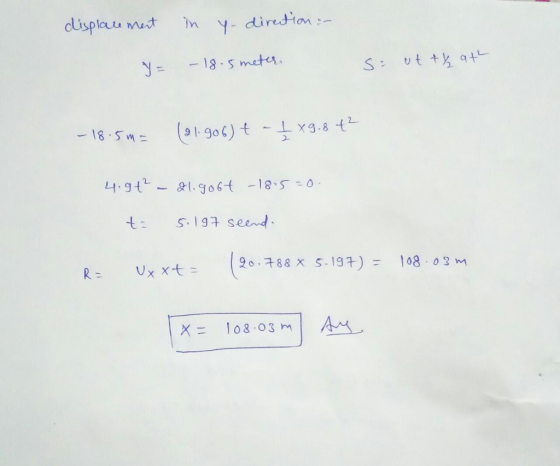
A person on a cliff throws a ball with an initial velocity of 30.2 m/s at...
Maple T.A Rem 34:50-16 A person on a ciffthrows a ball with an initial velocity of...
 Maple T.A Rem 34:50-16 A person on a ciffthrows a ball with an initial velocity of 28 7 m's at an angle of 52 9 above the horizontal fthe intial height of the boll,compared to f impact location ih, Y 212m,what i the maxinmum Max height Number Distance, XNumber Units Next it nssianment Quit & Save Back Question Menu
Ahiker throws a ball at an angle of 21.0" above the horizontal frornョcliff 21 magnitude of...
 Ahiker throws a ball at an angle of 21.0" above the horizontal frornョcliff 21 magnitude of the of the velocity is 15.000 m/s. Find a. The magnitudes of the horizontal and vertical componenis 3. horizontal from a citt 21. m h T m hith The of the velocity, respecty (PSYw) (4) The horizontal distance between the base of the hill and the point where the ball hits the grou (PSYW) (4) b. c. The time it took for the ball...
a person throws a ball upward into the air with an initial velocity of 15 m/s calculate a)how high it goes
a person throws a ball upward into the air with an initial velocity of 15 m/s calculate a)how high it goes? b)how long the ball is in the air before it comes back ? c)how much time it takes for the ball to reach the maximum height?
1. A student standing on the edge of a cliff throws a rock downward at a...
1. A student standing on the edge of a cliff throws a rock downward at a speed of 7.5 m/s at an angle 40° below the horizontal. It takes the rock 2.4 seconds to hit the ground. How far from the base of the cliff will the rock land? a)18 m b)5.7 m c)13.8 m d)11.6 m 2. A person driving through a field has velocity components that are 30 m/s west and 20 m/s south. What is the magnitude...
Problem 2: I throw a ball, mass m-5.0kg, at an initial speed of 3.0m/s, at an...
 Problem 2: I throw a ball, mass m-5.0kg, at an initial speed of 3.0m/s, at an initial height of 1.7m, but at an angle of 37' with respect to the horizontal. It lands on the ground, at a final height of zero. (a) What is the initial velocity? (This is a VECTOR. Define ti as the horizontal, and +j as the vertical.) (b) What is the time when the ball obtains its maximum height? (c) What is the maximum height...
Initial horizontal velocity of ball: 4.85m/s Init vertical velocity of ball: 2.83 m/s Initial angle of...
Initial horizontal velocity of ball: 4.85m/s Init vertical velocity of ball: 2.83 m/s Initial angle of ball: 30.25 degrees What is the total vertical height achieved? What is the total horizontal distance achieved?
Problem 2: I throw a ball, mass m-5.0kg, at an initial speed of 3.0m/s, at an...
 Problem 2: I throw a ball, mass m-5.0kg, at an initial speed of 3.0m/s, at an initial height of 1.7m, but at ar angle of 37" with respect to the horizontal. It lands on the ground, at a final height of zero. (a) What is the initial velocity? (This is a VECTOR. Define ti as the horizontal, and +j as the vertical.) (b) What is the time when the ball obtains its maximum height? (c) What is the maximum height...
A soccer ball is kicked with an initial horizontal velocity of 20 m/s and an initial vertical velocity of 16 m/s
A soccer ball is kicked with an initial horizontal velocity of 20 m/s and an initial vertical velocity of 16 m/s. I've calculated: Initial Speed: 25.61 m/s Angle: 38.66 degrees Maximum Height it reaches: 13.06 m Distance kicked: 65.29m NOW I NEED: What is the speed of the ball 0.7 seconds after it was kicked? How high above the ground is the ball 0.7 seconds after it is kicked? help? please.
A soccer ball is kicked with an initial horizontal velocity of 18 m/s and an initial...
A soccer ball is kicked with an initial horizontal velocity of 18 m/s and an initial vertical velocity of 13 m/s. 1) What is the initial speed of the ball? 2) What is the initial angle ? of the ball with respect to the ground? 3) What is the maximum height the ball goes above the ground? 4) How far from where it was kicked will the ball land? 5) What is the speed of the ball 0.8 seconds after...
A boy throws a ball with an initial velocity of 25 m/s at an angle of...
 A boy throws a ball with an initial velocity of 25 m/s at an angle of 30° above the horizontal. If air resistance is negligible, how high above the projection point is the ball after 2.0 s? How long is it in the air, and how far does it go before hitting the ground? 6.
 Maple T.A Rem 34:50-16 A person on a ciffthrows a ball with an initial velocity of 28 7 m's at an angle of 52 9 above the horizontal fthe intial height of the boll,compared to f impact location ih, Y 212m,what i the maxinmum Max height Number Distance, XNumber Units Next it nssianment Quit & Save Back Question Menu
 Ahiker throws a ball at an angle of 21.0" above the horizontal frornョcliff 21 magnitude of the of the velocity is 15.000 m/s. Find a. The magnitudes of the horizontal and vertical componenis 3. horizontal from a citt 21. m h T m hith The of the velocity, respecty (PSYw) (4) The horizontal distance between the base of the hill and the point where the ball hits the grou (PSYW) (4) b. c. The time it took for the ball...
 Problem 2: I throw a ball, mass m-5.0kg, at an initial speed of 3.0m/s, at an initial height of 1.7m, but at an angle of 37' with respect to the horizontal. It lands on the ground, at a final height of zero. (a) What is the initial velocity? (This is a VECTOR. Define ti as the horizontal, and +j as the vertical.) (b) What is the time when the ball obtains its maximum height? (c) What is the maximum height...
 Problem 2: I throw a ball, mass m-5.0kg, at an initial speed of 3.0m/s, at an initial height of 1.7m, but at ar angle of 37" with respect to the horizontal. It lands on the ground, at a final height of zero. (a) What is the initial velocity? (This is a VECTOR. Define ti as the horizontal, and +j as the vertical.) (b) What is the time when the ball obtains its maximum height? (c) What is the maximum height...
 A boy throws a ball with an initial velocity of 25 m/s at an angle of 30° above the horizontal. If air resistance is negligible, how high above the projection point is the ball after 2.0 s? How long is it in the air, and how far does it go before hitting the ground? 6.
Most questions answered within 3 hours.
-
Where is the error in this code sequence?
String s1 = "Hello";
String s2 = "ello";...
asked 10 months ago -
Financial data for Joel de Paris, Inc., for last year
follow:
Joel de Paris, Inc.
Balance...
asked 10 months ago -
Consider this reaction:
Al2(SO4)3 (aq)+ BaCl3
(aq) Al2Cl6 (aq)- +
3BaSO4(s) . What is the...
asked 10 months ago -
Suppose that Savneet is considering increasing her
recent random sample from 20 car rentals to 40...
asked 10 months ago -
Trucks arrive at an unloading terminal at an average rate of 120
per hour.
Trucks arrive...
asked 10 months ago -
Why are methanol and ethanol completely soluble in water while
octanol is not very little soluble....
asked 10 months ago -
A facilities manager at a university reads in a research report
that the mean amount of...
asked 10 months ago -
When the CuSO4 is rehydrated by adding water to the anhydrous
compound, is this an endothermic...
asked 10 months ago -
A ray of sunlight is passing from diamond into crown glass; the
angle of incidence is...
asked 10 months ago -
A block of mass 0.249 kg is placed on top of a light, vertical
spring of...
asked 10 months ago -
how do the kidneys compensate in the presences of acidosis
a) trigger hyperventilate
b) reserve acid...
asked 10 months ago -
Question 501 pts
The rental rate of capital to the firm increases. Which of the
following...
asked 10 months ago