
Homework Answers
Add Answer to:
Page 6 (5) At 298 K and 1 bar pressure, the density of water is 0.9970...
Page 6 (5) At 298 K and I bar pressure, the density of water is 0.9970...
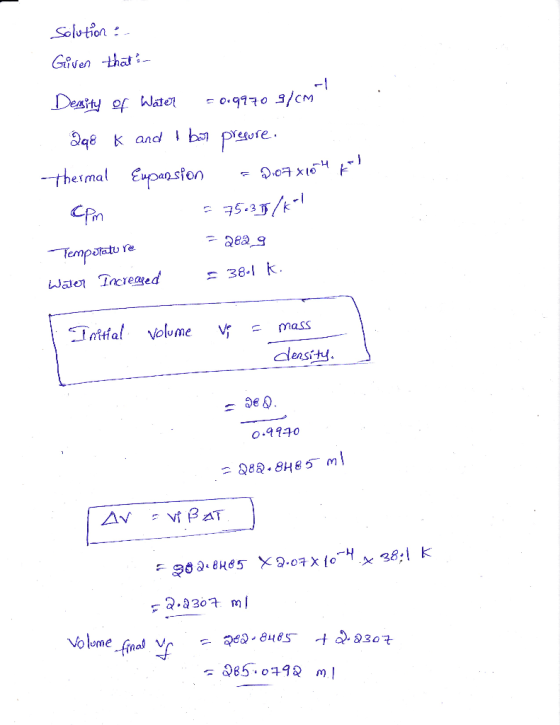
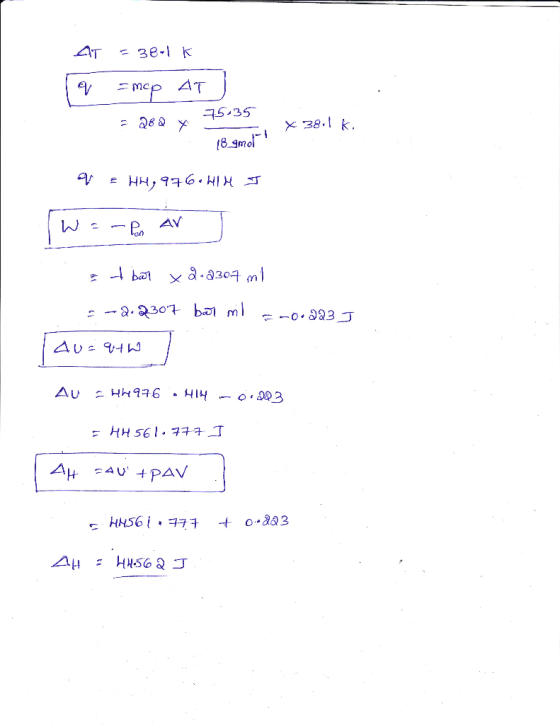
 Page 6 (5) At 298 K and I bar pressure, the density of water is 0.9970 cm the coefficient of thermal expansion is 2.07x10 K and C 75 3 J m ol. If the temperature of 282 g of water is increased by calculate w. 4. AU, AH and AS (20 pts)
Please answer the following question completely and correctly. Please show all work and write neatly. 5. At 298 K and 1...
 Please answer the following question completely and correctly.
Please show all work and write neatly.
5. At 298 K and 1 bar pressure, the density of water is 0.9970 gecm, the coefficient of thermal expansion, is 2.07x10 K, and CP.m = 75.3 J•K-'•mol"!. If the temperature of 282 g of water is increased by 38.1 K, calculate w,q, AU, AH and AS.
Please answer the following question completely and correctly.
Please show all work and write neatly.
5. At 298 K and 1 bar pressure, the density of water is 0.9970 gecm, the coefficient of thermal expansion, is 2.07x10 K, and CP.m = 75.3 J•K-'•mol"!. If the temperature of 282 g of water is increased by 38.1 K, calculate w,q, AU, AH and AS.
At 298 K and 1 bar pressure, the density of water is 0.9970 g⋅cm−3, the coefficient...
At 298 K and 1 bar pressure, the density of water is 0.9970 g⋅cm−3, the coefficient of thermal expansion, is 2.07×10⁻⁴ K−1, and CP,m=75.3 J⋅K−1⋅mol−1. Part A: If the temperature of 336 g of water is increased by 27.9 K, calculate w Part B: If the temperature of 336 g of water is increased by 27.9 K, calculate q. Part C: If the temperature of 336 g of water is increased by 27.9 K, calculate ΔH. Part D: If the...
6. Four (4.00) moles of a perfect gas at 250.0 K and 1.50 bar pressure undergo...
 6. Four (4.00) moles of a perfect gas at 250.0 K and 1.50 bar pressure undergo a reversible isothermal compression until the pressure becomes 3.00 bar. Calculate: q, w, AU, AH and AS.
For a gaseous reaction, standard conditions are 298 K and a partial pressure of 1 bar...
For a gaseous reaction, standard conditions are 298 K and a partial pressure of 1 bar for all species. For the reaction N2(g)+3H2(g)↽−−⇀2NH3(g) the standard change in Gibbs free energy is Δ?∘=−69.0 kJ/mol. What is Δ? for this reaction at 298 K when the partial pressures are ?N2=0.500 bar, ?H2=0.150 bar, and ?NH3=0.750 bar? Show work please!
For a gaseous reaction, standard conditions are 298 K and a partial pressure of 1 bar...
 For a gaseous reaction, standard conditions are 298 K and a partial pressure of 1 bar for all species. For the reaction N2(g) + 3 H2(g) = 2 NH3(g) the standard change in Gibbs free energy is AGⓇ = -72.6 kJ/mol. What is AG for this reaction at 298 K when the partial pressures are PN, = 0.200 bar, Ph, = 0.150 bar, and PnHz = 0.800 bar. kJ AG = mol
1 00 mol of a perfect gas initially at 1 00 atm and 298 K with...
 1 00 mol of a perfect gas initially at 1 00 atm and 298 K with Cpm (7/2) R is put through the following cycle () constant-volume heating to twice its initial temperature (u) reversible, adiabatic expansion back to its onginal temperature () reversible, isothermal compression back to 1 00 atm Calculate q, w, AU, and AH for each of the steps ()-(m) above Hints First calculate AU, then q AH easily follows Remember the meaning of an adiabatic process...
Part A The Henry's law coefficient of 1-butanol at 298 K is 9 26 bar. Calculate...
 Part A The Henry's law coefficient of 1-butanol at 298 K is 9 26 bar. Calculate the vapor pressure (in bar) of 1- butanol over a 0,0240 M aquoou moles of water in L at 298 K olution. There are 55.3 Express your answer to three significant figures and include the appropriate units. PB bar Submit My Answers Give Up de Continue at (b
Question 2 One mole of an ideal gas, initially at 30 C and 1 bar is...
 Question 2 One mole of an ideal gas, initially at 30 C and 1 bar is changed to 130 °C and 10 bar by using two different mechanically reversible processes: 2.1 The gas is first heated at constant pressure until its temperature is 130 °C and then compressed isothermally to 10 bar. 2.2 The gas is first compressed isothermally to 10 bar and then heated at constant pressure to 13°C Calculate Q, W, AU, and AH for each case. Take...
Calculate the work (w) and ΔEo, in kJ, at 298 K and 1 atm pressure, for...
Calculate the work (w) and ΔEo, in kJ, at 298 K and 1 atm pressure, for the combustion of one mole of C3H8 (g). First write and balance the equation. The products will be CO2 (g) and H2O (g). The value of ΔHo for this reaction is -2043.9 kJ/mol. The value for w in kJ = The equation for work is given by: w = -PextΔV. There are 101.3 J/L atm.
 Page 6 (5) At 298 K and I bar pressure, the density of water is 0.9970 cm the coefficient of thermal expansion is 2.07x10 K and C 75 3 J m ol. If the temperature of 282 g of water is increased by calculate w. 4. AU, AH and AS (20 pts)
 Please answer the following question completely and correctly.
Please show all work and write neatly.
5. At 298 K and 1 bar pressure, the density of water is 0.9970 gecm, the coefficient of thermal expansion, is 2.07x10 K, and CP.m = 75.3 J•K-'•mol"!. If the temperature of 282 g of water is increased by 38.1 K, calculate w,q, AU, AH and AS.
Please answer the following question completely and correctly.
Please show all work and write neatly.
5. At 298 K and 1 bar pressure, the density of water is 0.9970 gecm, the coefficient of thermal expansion, is 2.07x10 K, and CP.m = 75.3 J•K-'•mol"!. If the temperature of 282 g of water is increased by 38.1 K, calculate w,q, AU, AH and AS.
 6. Four (4.00) moles of a perfect gas at 250.0 K and 1.50 bar pressure undergo a reversible isothermal compression until the pressure becomes 3.00 bar. Calculate: q, w, AU, AH and AS.
 For a gaseous reaction, standard conditions are 298 K and a partial pressure of 1 bar for all species. For the reaction N2(g) + 3 H2(g) = 2 NH3(g) the standard change in Gibbs free energy is AGⓇ = -72.6 kJ/mol. What is AG for this reaction at 298 K when the partial pressures are PN, = 0.200 bar, Ph, = 0.150 bar, and PnHz = 0.800 bar. kJ AG = mol
 1 00 mol of a perfect gas initially at 1 00 atm and 298 K with Cpm (7/2) R is put through the following cycle () constant-volume heating to twice its initial temperature (u) reversible, adiabatic expansion back to its onginal temperature () reversible, isothermal compression back to 1 00 atm Calculate q, w, AU, and AH for each of the steps ()-(m) above Hints First calculate AU, then q AH easily follows Remember the meaning of an adiabatic process...
 Part A The Henry's law coefficient of 1-butanol at 298 K is 9 26 bar. Calculate the vapor pressure (in bar) of 1- butanol over a 0,0240 M aquoou moles of water in L at 298 K olution. There are 55.3 Express your answer to three significant figures and include the appropriate units. PB bar Submit My Answers Give Up de Continue at (b
 Question 2 One mole of an ideal gas, initially at 30 C and 1 bar is changed to 130 °C and 10 bar by using two different mechanically reversible processes: 2.1 The gas is first heated at constant pressure until its temperature is 130 °C and then compressed isothermally to 10 bar. 2.2 The gas is first compressed isothermally to 10 bar and then heated at constant pressure to 13°C Calculate Q, W, AU, and AH for each case. Take...
Most questions answered within 3 hours.
-
Where is the error in this code sequence?
String s1 = "Hello";
String s2 = "ello";...
asked 11 months ago -
Financial data for Joel de Paris, Inc., for last year
follow:
Joel de Paris, Inc.
Balance...
asked 11 months ago -
Consider this reaction:
Al2(SO4)3 (aq)+ BaCl3
(aq) Al2Cl6 (aq)- +
3BaSO4(s) . What is the...
asked 11 months ago -
Suppose that Savneet is considering increasing her
recent random sample from 20 car rentals to 40...
asked 11 months ago -
Trucks arrive at an unloading terminal at an average rate of 120
per hour.
Trucks arrive...
asked 11 months ago -
Why are methanol and ethanol completely soluble in water while
octanol is not very little soluble....
asked 11 months ago -
A facilities manager at a university reads in a research report
that the mean amount of...
asked 11 months ago -
When the CuSO4 is rehydrated by adding water to the anhydrous
compound, is this an endothermic...
asked 11 months ago -
A ray of sunlight is passing from diamond into crown glass; the
angle of incidence is...
asked 11 months ago -
A block of mass 0.249 kg is placed on top of a light, vertical
spring of...
asked 11 months ago -
how do the kidneys compensate in the presences of acidosis
a) trigger hyperventilate
b) reserve acid...
asked 11 months ago -
Question 501 pts
The rental rate of capital to the firm increases. Which of the
following...
asked 11 months ago