If 1.80 g Zn is allowed to react with 1.56 g of CuSO4 according to equation...
If 1.80 g Zn is allowed to react with 1.56 g of CuSO4 according to equation CuSO4(aq)+Zn(s)→ZnSO4(aq)+Cu(s), how many grams of Zn will remain after the reaction is complete
Homework Answers
Number of moles of Zn = 1.80 g / 65.38 g/mol = 0.0275 mole
Number of moles of CuSO4 = 1.56 g / 159.609 g/mol = 0.00977 mole
From the balanced equation we can say that
1 mole of Zn requires 1 mole of CuSO4 so
0.0275 mole of Zn will require
= 0.0275 mole of Zn *(1 mole of CuSO4 / 1 mole of Zn)
= 0.0275 mole of CuSO4
But we have 0.00977 mole of CuSO4 which is in short so CuSO4 is limiting reactant and Zn is an excess reactant
From the balanced equation we can say that
1 mole of CuSO4 requires 1 mole of Zn so
0.00977 mole of CuSO4 will require
= 0.00977 mole of CuSO4 *(1 mole of Zn / 1 mole of CuSO4)
= 0.00977 mole of Zn
The number of moles of Zn remain after completion of reaction = 0.0275 - 0.00977 = 0.0177 mole
mass of 1 mole of Zn = 65.38 g so
the mass of 0.0177 mole of Zn = 1.16 g
Therefore, the mass of Zn remain after completion of reaction = 1.16 g
Add Answer to:
If 1.80 g Zn is allowed to react with 1.56 g of CuSO4 according
to equation...
What would be the physical state foe ZnSO4 in the following equation? Zn(s) + CuSO4(aq) =...
 What would be the physical state foe ZnSO4 in the following equation? Zn(s) + CuSO4(aq) = ZnSO4(aq) + Cu(s) O A. Solid B. Aqueous OC. Liquid D. Gas E. Plasma QUESTION 24 The following reaction can be classified as a: Zn(s) + H2SO4(aq) = ZnSO4(aq) + H2(g) O A. Combination reaction B. Single-replacement reaction OC. Decomposition reaction D. Double displacement reaction E. Evaporation reaction
If a solution containing 31.34 g of mercury(I) nitrate is allowed to react completely with a...
 If a solution containing 31.34 g of mercury(I) nitrate is allowed to react completely with a solution containing 8.564 g of sodium sulfate according to the equation below. Hg(NO,)2(aq) + Na,SO,(aq)2 NaNO3 (aq) + HgSO (s) How many grams of solid precipitate will be formed? mass: How many grams of the reactant in excess will remain after the reaction? mass: 6о
If a solution containing 19 g of mercury(II) nitrate is allowed to react completely with a...
 If a solution containing 19 g of mercury(II) nitrate is allowed
to react completely with a solution containing 5.102 g of sodium
sulfate according to the equation below:
a) How many grams of solid precipitate will be formed?
b) How many grams of the reactant in excess will remain after
the reaction?
Question 6 of 8 Map General Chemistry 4th Edition this question has been customized by Donna McGregor at City University of New York (CUNY,Lehmar If a solution containing...
If a solution containing 19 g of mercury(II) nitrate is allowed
to react completely with a solution containing 5.102 g of sodium
sulfate according to the equation below:
a) How many grams of solid precipitate will be formed?
b) How many grams of the reactant in excess will remain after
the reaction?
Question 6 of 8 Map General Chemistry 4th Edition this question has been customized by Donna McGregor at City University of New York (CUNY,Lehmar If a solution containing...
The following redox reaction can occur between zinc (Zn) and copper (Cu): Zn(s) + CuSO4(aq) →...
The following redox reaction can occur between zinc (Zn) and copper (Cu): Zn(s) + CuSO4(aq) → ZnSO4(aq) +Cu(s) The transfer of electrons that occurs in this reaction can be exploited to create a battery. A. Write the net ionic equation for this reaction. B. Which atoms or ions are reduced in the reaction? Which are oxidized? C. How many electrons are transferred from each oxidized atom (or ion) to each reduced atom (or ion) in the reaction? D. If 100...
Fill in the Blanks A solution containing 58.0 g of mercury(II) nitrate is allowed to react...
 Fill in the Blanks A solution containing 58.0 g of mercury(II) nitrate is allowed to react completely with a solution containing 16.642 g of sodium sulfate according to the equation below: Hg(NO3)2(aq) + Na2SO4(aq) + 2NaNO3(aq) + HgSO4(s) How many grams of solid precipitate will be formed if the reaction has a 100% yield? Solid precipitate grams How many grams of the excess reagent will remain ilter the Excess reagent remaining grams If the reaction has only an 80% yield,...
Introduction The chemical reactions involved in this experiment are: CuSO4(aq) + Zn(s) → ZnSO4(aq) + Cu(s)...
Introduction The chemical reactions involved in this experiment are: CuSO4(aq) + Zn(s) → ZnSO4(aq) + Cu(s) Zn(s) + H2SO4(aq) → ZnSO4(aq) + H2(g) The copper on the surface quickly reacts with oxygen according to the following reaction: 2Cu(s) + O2(g) → 2CuO(s) Experimental Procedure Dissolve completely about 0.5 to 0.7 g of copper (II) sulphate pentahydrate in about 10 to 20 mL of deionized water. Calculate the amount of zinc powder that must be added to a copper sulfate solution...
If 0.375 g of Zn is placed in a beaker with excess CuSO_4, and allowed to...
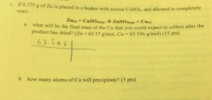 If 0.375 g of Zn is placed in a beaker with excess CuSO_4, and allowed to completely react... Zn_ + CuSO_4(aq) rightarrow ZnSO_2(aq) + Cu what will be the final mass of the Cu that you could expect to collect after the product has dried? (Zn = 65.37 g/mol, Cu = 63.546 g/mol) how many atoms of Cu will precipitate?
on 8 of 9 > If a solution containing 27.79 g of mercury(II) nitrate is allowed...
 on 8 of 9 > If a solution containing 27.79 g of mercury(II) nitrate is allowed to react completely with a solution containing 7.410 g of sodium sulfate according to the equation below. Hg(NO3)2(aq) + Na, SO, (aq) — 2NaNO3(aq) + Hg50 (9) How many grams of solid precipitate will be formed? mass: How many grams of the reactant in excess will remain after the reaction? mass:
1.) If a solution containing 56.59 g56.59 g of mercury(II) nitrate is allowed to react completely...
1.) If a solution containing 56.59 g56.59 g of mercury(II) nitrate is allowed to react completely with a solution containing 17.796 g17.796 g of sodium sulfate according to the equation below. Hg(NO3)2(aq)+Na2SO4(aq)⟶2NaNO3(aq)+HgSO4(s)Hg(NO3)2(aq)+Na2SO4(aq)⟶2NaNO3(aq)+HgSO4(s) How many grams of solid precipitate will be formed? How many grams of the reactant in excess will remain after the reaction? 2.) Each step in the following process has a yield of 60.0%.60.0%. CH4+4Cl2⟶CCl4+4HClCH4+4Cl2⟶CCl4+4HCl CCl4+2HF⟶CCl2F2+2HClCCl4+2HF⟶CCl2F2+2HCl The CCl4CCl4 formed in the first step is used as a reactant...
Zinc reacts with hydrochloric acid according to the reaction equation Zn(s)+2HCl(aq)⟶ZnCl2(aq)+H2(g)Zn(s)+2HCl(aq)⟶ZnCl2(aq)+H2(g) How many milliliters of 2.00...
Zinc reacts with hydrochloric acid according to the reaction equation Zn(s)+2HCl(aq)⟶ZnCl2(aq)+H2(g)Zn(s)+2HCl(aq)⟶ZnCl2(aq)+H2(g) How many milliliters of 2.00 M HCl(aq)2.00 M HCl(aq) are required to react with 8.55 g Zn(s)?
 What would be the physical state foe ZnSO4 in the following equation? Zn(s) + CuSO4(aq) = ZnSO4(aq) + Cu(s) O A. Solid B. Aqueous OC. Liquid D. Gas E. Plasma QUESTION 24 The following reaction can be classified as a: Zn(s) + H2SO4(aq) = ZnSO4(aq) + H2(g) O A. Combination reaction B. Single-replacement reaction OC. Decomposition reaction D. Double displacement reaction E. Evaporation reaction
 If a solution containing 31.34 g of mercury(I) nitrate is allowed to react completely with a solution containing 8.564 g of sodium sulfate according to the equation below. Hg(NO,)2(aq) + Na,SO,(aq)2 NaNO3 (aq) + HgSO (s) How many grams of solid precipitate will be formed? mass: How many grams of the reactant in excess will remain after the reaction? mass: 6о
 If a solution containing 19 g of mercury(II) nitrate is allowed
to react completely with a solution containing 5.102 g of sodium
sulfate according to the equation below:
a) How many grams of solid precipitate will be formed?
b) How many grams of the reactant in excess will remain after
the reaction?
Question 6 of 8 Map General Chemistry 4th Edition this question has been customized by Donna McGregor at City University of New York (CUNY,Lehmar If a solution containing...
If a solution containing 19 g of mercury(II) nitrate is allowed
to react completely with a solution containing 5.102 g of sodium
sulfate according to the equation below:
a) How many grams of solid precipitate will be formed?
b) How many grams of the reactant in excess will remain after
the reaction?
Question 6 of 8 Map General Chemistry 4th Edition this question has been customized by Donna McGregor at City University of New York (CUNY,Lehmar If a solution containing...
 Fill in the Blanks A solution containing 58.0 g of mercury(II) nitrate is allowed to react completely with a solution containing 16.642 g of sodium sulfate according to the equation below: Hg(NO3)2(aq) + Na2SO4(aq) + 2NaNO3(aq) + HgSO4(s) How many grams of solid precipitate will be formed if the reaction has a 100% yield? Solid precipitate grams How many grams of the excess reagent will remain ilter the Excess reagent remaining grams If the reaction has only an 80% yield,...
 If 0.375 g of Zn is placed in a beaker with excess CuSO_4, and allowed to completely react... Zn_ + CuSO_4(aq) rightarrow ZnSO_2(aq) + Cu what will be the final mass of the Cu that you could expect to collect after the product has dried? (Zn = 65.37 g/mol, Cu = 63.546 g/mol) how many atoms of Cu will precipitate?
 on 8 of 9 > If a solution containing 27.79 g of mercury(II) nitrate is allowed to react completely with a solution containing 7.410 g of sodium sulfate according to the equation below. Hg(NO3)2(aq) + Na, SO, (aq) — 2NaNO3(aq) + Hg50 (9) How many grams of solid precipitate will be formed? mass: How many grams of the reactant in excess will remain after the reaction? mass:
Most questions answered within 3 hours.
-
Where is the error in this code sequence?
String s1 = "Hello";
String s2 = "ello";...
asked 10 months ago -
Financial data for Joel de Paris, Inc., for last year
follow:
Joel de Paris, Inc.
Balance...
asked 10 months ago -
Consider this reaction:
Al2(SO4)3 (aq)+ BaCl3
(aq) Al2Cl6 (aq)- +
3BaSO4(s) . What is the...
asked 10 months ago -
Suppose that Savneet is considering increasing her
recent random sample from 20 car rentals to 40...
asked 10 months ago -
Trucks arrive at an unloading terminal at an average rate of 120
per hour.
Trucks arrive...
asked 10 months ago -
Why are methanol and ethanol completely soluble in water while
octanol is not very little soluble....
asked 10 months ago -
A facilities manager at a university reads in a research report
that the mean amount of...
asked 10 months ago -
When the CuSO4 is rehydrated by adding water to the anhydrous
compound, is this an endothermic...
asked 10 months ago -
A ray of sunlight is passing from diamond into crown glass; the
angle of incidence is...
asked 10 months ago -
A block of mass 0.249 kg is placed on top of a light, vertical
spring of...
asked 10 months ago -
how do the kidneys compensate in the presences of acidosis
a) trigger hyperventilate
b) reserve acid...
asked 10 months ago -
Question 501 pts
The rental rate of capital to the firm increases. Which of the
following...
asked 10 months ago