Case Study: Disorders of Blood Flow and Blood Pressure After reading the case study below you...
|
Case Study: Disorders of Blood Flow and Blood Pressure After reading the case study below you will create and post a concept map. Concept mapping is a highly visual process that shows the relationships between ideas. They have proven to have professional, academic and personal applications that allow for brainstorming new ideas, organizing, explaining and sharing information. Be creative in your work. The information included in your map should come from a reliable source and be cited according to APA guidelines. Website references with additional information on this topic are provided in Week 7 Learning Activities. HPI: Mr. H, a 58-year-old bank president of African American descent, is admitted to the hospital with a blood pressure of 210/140. History: He was diagnosed with hypertension 5 years ago, and medications prior to admission included propranolol (Inderal, InnoPran XL) and hydralazine (Apresoline), although he admits that he has not faithfully taken his medications. Assessment: Mr. H is 5'7" tall and weighs 190 pounds. The bank has just undergone a major audit, and several problems were identified. He has been working overtime and eating a lot of "fast foods" to try to keep his energy level up. He reports early morning headaches and excessive fatigue to the point that he just cannot exercise anymore. He smokes one pack of cigarettes a day and has an occasional beer. Family history: His father had a heart attack and died at 58 years of age. He has a brother and sister who both have hypertension. |
Homework Answers
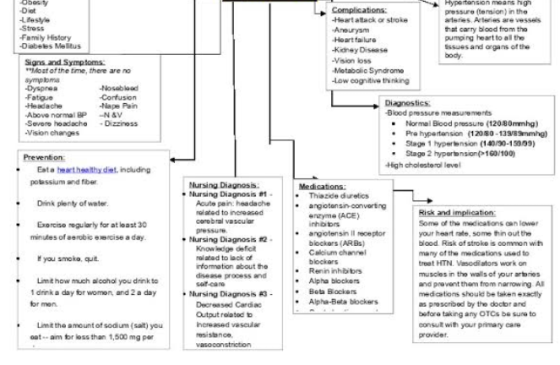
Concept map :-
HYPERTENSION
Add Answer to:
Case Study: Disorders of Blood Flow and Blood
Pressure
After reading the case study below you...
Please send reference APA Please send reference APA WEEK 5 ASSIGNMENT # 2 Case Study, Chapter 18, Disorders o...
 Please send reference APA
WEEK 5 ASSIGNMENT # 2 Case Study, Chapter 18, Disorders of Blood Flow and Blood Pressure Mr. H, a 58-year-old black bank president, is admitted to the hospital with a blood pressure of 210/140. He was diagnosed with hypertension 5 years ago, and medications prior to admission included propranolol and hydralazine, although he admits that he has not faithfully taken his medications. Mr. H is 57" tall and weighs 190 pounds. The...
Please send reference APA
Please send reference APA
WEEK 5 ASSIGNMENT # 2 Case Study, Chapter 18, Disorders of Blood Flow and Blood Pressure Mr. H, a 58-year-old black bank president, is admitted to the hospital with a blood pressure of 210/140. He was diagnosed with hypertension 5 years ago, and medications prior to admission included propranolol and hydralazine, although he admits that he has not faithfully taken his medications. Mr. H is 57" tall and weighs 190 pounds. The...
HYPERTENSION CASE STUDY PN3 LAB Week 4 Scenario You are working in the hospital medical ward...
 HYPERTENSION CASE STUDY PN3 LAB Week 4 Scenario You are working in the hospital medical ward and start your morning assessments Mr HAPPY is a 50-year-old accountant who was admitted 2 days ago to hospital following a blackout whilst watching a football match with his son. His preliminary examination reveals bruising to his left arm and upper thigh for which he has been prescribed paracetamol 1g four times daily and as required ibuprofen 400 mg three times a day His...
Unit 1 Exercise #20 Case Study A Drug Class Names Some of the questions and fill-in-the...
 Unit 1 Exercise #20 Case Study A Drug Class Names Some of the questions and fill-in-the blanks are terms you've already learned, others are from the medication classes listed below. Tetracyclines Sulfonylureas Non-steroidal anti-inflammatory drugs (NSAIDS) Selective serotonin reuptake inhibitors (SSRIS) Thioamines Beta blockers Phenothiazines Diuretics Nitrates ACEIS/ARBS (Angiotensin converting enzyme inhibitors/Angiotensin receptor blockers) Z. C. is 62 years-old and is being evaluated in the emergency room for a possible heart attack. He has a history of hyperthroidism for which...
Patha WEEK 7 ASSIGNMENT # 3 Case Study, Chapter 27, Disorders of the Bladder and Lower...
 Patha WEEK 7 ASSIGNMENT # 3 Case Study, Chapter 27, Disorders of the Bladder and Lower Urinary Tract Mr. T, age 68, presents to the clinic with vague complaints of "just not feeling well." As the nurse questions him, he alludes to the fact that he is having some problems "down there." (Learning Objectives: 3-5) 1. How will the nurse approach this situation to obtain the information needed? Mr. T reports that he has been having difficulty urinating and that...
List subjective observations and objective findings after reading each of the case studies Case Study 1...
 List subjective observations and objective findings after reading each of the case studies Case Study 1 Mrs. Smith is 25 years old and was brought into the emergency Department of College Hospital with complaints of difficulty breathing and chest pain. Her vital temperature of 101 ° F and pulse rate of 90. Respirations are labored 30/min. Blood pressure is 140/80. Her skin is warm and signs show an elevated at diaphoretic. She states, "This condition the past 3 days." has...
CASE STUDY A Nephrosclerosis and Chronic Renal Failure Mr. H., age 68 years, has a long...
 CASE STUDY A Nephrosclerosis and Chronic Renal Failure Mr. H., age 68 years, has a long history of hypertension. He has had more headaches recently, his legs and feet are swollen, and he has noticed that more frequent voiding, both during the day and at night, is necessary. He constantly feels tired and does not feel hungry. Mr. H.s blood pressure is 170/110, his pulse is 94, and he has gained 12 pounds in the last 2 months. Diagnostic test...
Case study: Mr. H., age 68 years, has a long history of hypertension. He has had...
Case study: Mr. H., age 68 years, has a long history of hypertension. He has had more headaches recently, his legs and feet are swollen, and he has noticed that more frequent voiding, both during the day and at night, is necessary. He constantly feels tired and does not feel hungry. Mr. H.'s blood pressure is 170/110, his pulse is 94, and he has gained 12 pounds in the last 2 months. Diagnostic test findings related to the blood and...
Case Study Primary hypertension has been diagnosed in Ms. G., a 47-year-old woman. Blood pressure readings...
 Case Study Primary hypertension has been diagnosed in Ms. G., a 47-year-old woman. Blood pressure readings have been ranging between 158 and 172 mm Hg systolic and 94 and 110 mm Hg diastolic. Average blood pressure over the past month has been 156/96 mm Hg. There is a strong family history of hypertension. Ms. G. is a single parent of two adolescents. She is also trying to keep up with her responsibilities as a full-time assistant professor of education at...
Case Study: Mr. D.W., 84 years old, suffers from high blood pressure, atherosclerosis, and beginning glaucoma. He falls...
Case Study: Mr. D.W., 84 years old, suffers from high blood pressure, atherosclerosis, and beginning glaucoma. He falls at a church function and is taken by ambulance to the emergency room. Unfortunately, his daughter, who usually accompanies him to his primary care clinic, is working. He refuses to have the staff "bother her at the job." Mr. W. cannot tell the emergency room nurse what medications he is taking. He states that he takes a blue pill for his "high...
Concept Model ll: Health/illness UNIT H: ELIMINATION AND DIGESTION Fecal Incontinence Case Study Mrs. L is...
 Concept Model ll: Health/illness UNIT H: ELIMINATION AND DIGESTION Fecal Incontinence Case Study Mrs. L is an 88-year-old Hispanic female who has been in the hospital for 2 weeks. She has dementia and is pleasantly confused. She has developed sepsis (a bacterial Infection in her bloodstream). She is a high fall risk due to her weakness and confusion She has been experiencing fecal incontinence for the last 2 days. 1. What risk factors does Mrs. L have for altered GI...
 Please send reference APA
WEEK 5 ASSIGNMENT # 2 Case Study, Chapter 18, Disorders of Blood Flow and Blood Pressure Mr. H, a 58-year-old black bank president, is admitted to the hospital with a blood pressure of 210/140. He was diagnosed with hypertension 5 years ago, and medications prior to admission included propranolol and hydralazine, although he admits that he has not faithfully taken his medications. Mr. H is 57" tall and weighs 190 pounds. The...
Please send reference APA
Please send reference APA
WEEK 5 ASSIGNMENT # 2 Case Study, Chapter 18, Disorders of Blood Flow and Blood Pressure Mr. H, a 58-year-old black bank president, is admitted to the hospital with a blood pressure of 210/140. He was diagnosed with hypertension 5 years ago, and medications prior to admission included propranolol and hydralazine, although he admits that he has not faithfully taken his medications. Mr. H is 57" tall and weighs 190 pounds. The...
 HYPERTENSION CASE STUDY PN3 LAB Week 4 Scenario You are working in the hospital medical ward and start your morning assessments Mr HAPPY is a 50-year-old accountant who was admitted 2 days ago to hospital following a blackout whilst watching a football match with his son. His preliminary examination reveals bruising to his left arm and upper thigh for which he has been prescribed paracetamol 1g four times daily and as required ibuprofen 400 mg three times a day His...
 Unit 1 Exercise #20 Case Study A Drug Class Names Some of the questions and fill-in-the blanks are terms you've already learned, others are from the medication classes listed below. Tetracyclines Sulfonylureas Non-steroidal anti-inflammatory drugs (NSAIDS) Selective serotonin reuptake inhibitors (SSRIS) Thioamines Beta blockers Phenothiazines Diuretics Nitrates ACEIS/ARBS (Angiotensin converting enzyme inhibitors/Angiotensin receptor blockers) Z. C. is 62 years-old and is being evaluated in the emergency room for a possible heart attack. He has a history of hyperthroidism for which...
 Patha WEEK 7 ASSIGNMENT # 3 Case Study, Chapter 27, Disorders of the Bladder and Lower Urinary Tract Mr. T, age 68, presents to the clinic with vague complaints of "just not feeling well." As the nurse questions him, he alludes to the fact that he is having some problems "down there." (Learning Objectives: 3-5) 1. How will the nurse approach this situation to obtain the information needed? Mr. T reports that he has been having difficulty urinating and that...
 List subjective observations and objective findings after reading each of the case studies Case Study 1 Mrs. Smith is 25 years old and was brought into the emergency Department of College Hospital with complaints of difficulty breathing and chest pain. Her vital temperature of 101 ° F and pulse rate of 90. Respirations are labored 30/min. Blood pressure is 140/80. Her skin is warm and signs show an elevated at diaphoretic. She states, "This condition the past 3 days." has...
 CASE STUDY A Nephrosclerosis and Chronic Renal Failure Mr. H., age 68 years, has a long history of hypertension. He has had more headaches recently, his legs and feet are swollen, and he has noticed that more frequent voiding, both during the day and at night, is necessary. He constantly feels tired and does not feel hungry. Mr. H.s blood pressure is 170/110, his pulse is 94, and he has gained 12 pounds in the last 2 months. Diagnostic test...
 Case Study Primary hypertension has been diagnosed in Ms. G., a 47-year-old woman. Blood pressure readings have been ranging between 158 and 172 mm Hg systolic and 94 and 110 mm Hg diastolic. Average blood pressure over the past month has been 156/96 mm Hg. There is a strong family history of hypertension. Ms. G. is a single parent of two adolescents. She is also trying to keep up with her responsibilities as a full-time assistant professor of education at...
 Concept Model ll: Health/illness UNIT H: ELIMINATION AND DIGESTION Fecal Incontinence Case Study Mrs. L is an 88-year-old Hispanic female who has been in the hospital for 2 weeks. She has dementia and is pleasantly confused. She has developed sepsis (a bacterial Infection in her bloodstream). She is a high fall risk due to her weakness and confusion She has been experiencing fecal incontinence for the last 2 days. 1. What risk factors does Mrs. L have for altered GI...
Most questions answered within 3 hours.
-
Where is the error in this code sequence?
String s1 = "Hello";
String s2 = "ello";...
asked 11 months ago -
Financial data for Joel de Paris, Inc., for last year
follow:
Joel de Paris, Inc.
Balance...
asked 11 months ago -
Consider this reaction:
Al2(SO4)3 (aq)+ BaCl3
(aq) Al2Cl6 (aq)- +
3BaSO4(s) . What is the...
asked 11 months ago -
Suppose that Savneet is considering increasing her
recent random sample from 20 car rentals to 40...
asked 11 months ago -
Trucks arrive at an unloading terminal at an average rate of 120
per hour.
Trucks arrive...
asked 11 months ago -
Why are methanol and ethanol completely soluble in water while
octanol is not very little soluble....
asked 11 months ago -
A facilities manager at a university reads in a research report
that the mean amount of...
asked 11 months ago -
When the CuSO4 is rehydrated by adding water to the anhydrous
compound, is this an endothermic...
asked 11 months ago -
A ray of sunlight is passing from diamond into crown glass; the
angle of incidence is...
asked 11 months ago -
A block of mass 0.249 kg is placed on top of a light, vertical
spring of...
asked 11 months ago -
how do the kidneys compensate in the presences of acidosis
a) trigger hyperventilate
b) reserve acid...
asked 11 months ago -
Question 501 pts
The rental rate of capital to the firm increases. Which of the
following...
asked 11 months ago