
Homework Answers
Decision 1:
Interest rate 3% annually
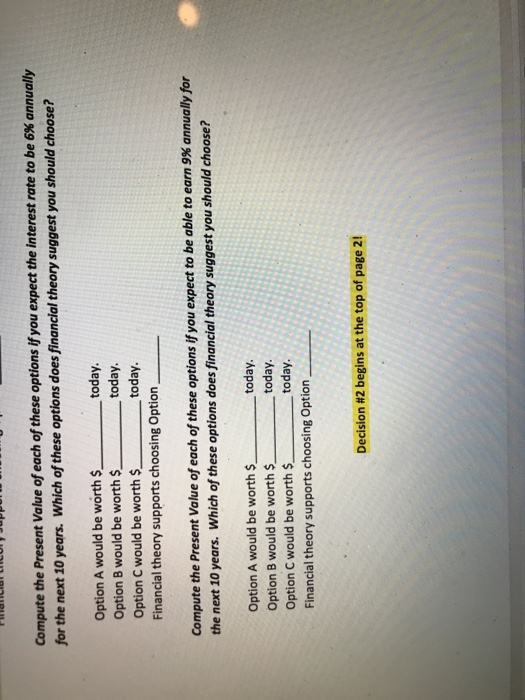
i) Option A would be worth $ 10000 today
ii) Option B would be worth = 1400/(1.03) + 1500*(1-(1/(1.03)^9))/0.03)*(1/1.03)
= $ 12698.22 today
If $1500 were paid for 10 years, then it would be worth = 1500*(1-(1/(1.03)^10))/0.03)
= $ 12795.3 today
iii) Option C would be worth = 18000/(1/1.03^10)
= $ 13393.69 today
Financial theory supports choosing Option C
Interest rate 6% annually
i) Option A would be worth $ 10000 today
ii) Option B would be worth = 1400/(1.06) + 1500*(1-(1/(1.06)^9))/0.06)*(1/1.06)
= $ 10945.80 today
If $1500 were paid for 10 years, then it would be worth = 1500*(1-(1/(1.06)^10))/0.06)
= $ 11040.15 today
iii) Option C would be worth = 18000/(1/1.06^10)
= $ 10051.02 today
Financial theory supports choosing Option B
Interest rate 9% annually
i) Option A would be worth $ 10000 today
ii) Option B would be worth = 1400/(1.09) + 1500*(1-(1/(1.09)^9))/0.09)*(1/1.09)
= $ 9534.68 today
If $1500 were paid for 10 years, then it would be worth = 1500*(1-(1/(1.09)^10))/0.09)
= $ 9626.55 today
iii) Option C would be worth = 18000/(1/1.09^10)
= $ 7603.38 today
Financial theory supports choosing Option B
Decision 2
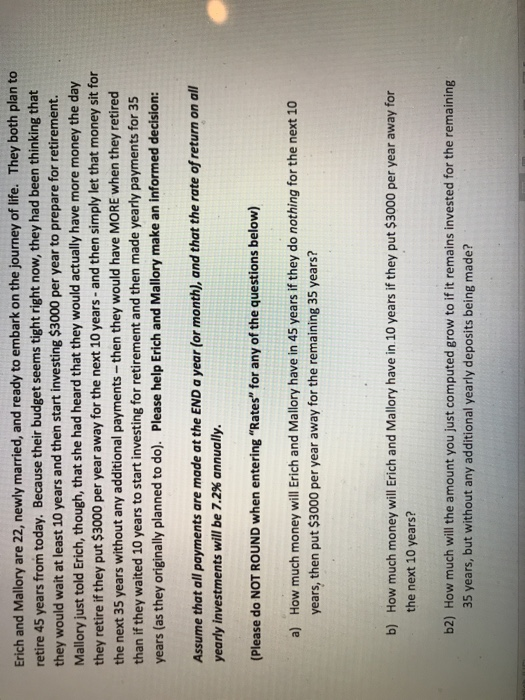
Interest rate is 7.2 % annually
a) The total worth after 35 years = 3000 * ((1.072)^35 - 1)/0.072
= $ 433237.79
b) If they put $ 3000 for the next 10 years, they would have = 3000* ((1.072)^10 - 1)/0.072
= $ 41842.97
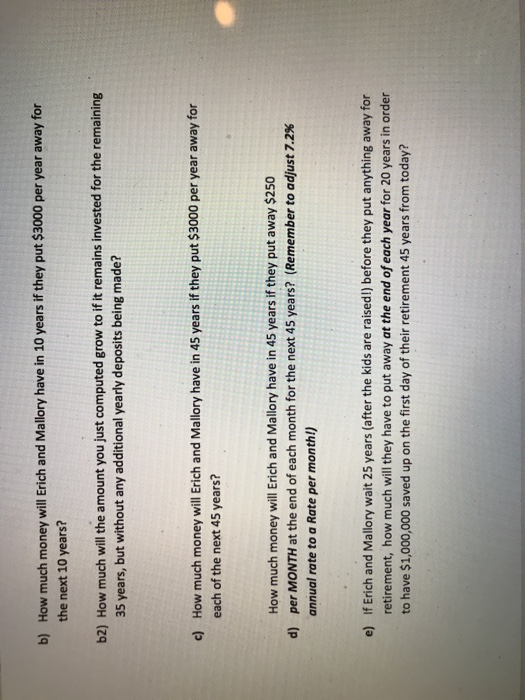
b2) With no additional investments, $ 41842.97 would grow to = 41842.97*(1.072^35)
= $ 476913.95 after 35 years
c)If they put $3000 for the next 45 years, it would accumulate to = 3000 * ((1.072)^45 - 1)/0.072
= $ 910151.74
d) Coverting 7.2 % annually to per month rate
1.072 = (1+(i/12))^12
i = 0.00581 % per month
If they put $250 per month, after 45 years it will accumulate to = 250 * ((1.00581)^(45*12) - 1)/0.00581
= $ 939569.98
e) If they have save $ 1000000 for the first day of reitrement, the amount to be saved per year for 20 years is $ 23865.21.
1000000 = X * ((1.072^20)-1)/0.072
X = $ 23865.21
Add Answer to:
zoom in and it's clear. Thanks !
yes
i believe $1400 first payment and than $1500...
Decision #1: Which set of Cash Flows is worth more now? Assume that your grandmother wants...
Decision #1: Which set of Cash Flows is worth more now? Assume that your grandmother wants to give you generous gift. She wants you to choose which one of the following sets of cash flows you would like to receive: Option A: Receive a one-time gift of $ 10,000 today. Option B: Receive a $1400 gift each year for the next 10 years. The first $1400 would be received 1 year from today. Option C: Receive a one-time gift of...
Decision #1: Which set of Cash Flows is worth more now? Assume that your grandmother wants...
 Decision #1: Which set of Cash Flows is worth more now? Assume that your grandmother wants to give you generous gift. She wants you to choose which one of the following sets of cash flows you would like to receive: Option A: Receive a one-time gift of $10,000 today. Option B: Receive a $1400 gift each year for the next 10 years. The first $1400 would be received 1 year from today. Option C: Receive a one-time gift of $17,000...
BUSI 320 Comprehensive Problem 3 FALL 2020 Use what you have learned about the time value...
BUSI 320 Comprehensive Problem 3 FALL 2020 Use what you have learned about the time value of money to analyze each of the following decisions: Decision #1: Which set of Cash Flows is worth more now? Assume that your grandmother wants to give you generous gift. She wants you to choose which one of the following sets of cash flows you would like to receive: Option A: Receive a one-time gift of $ 10,000 today. Option B: Receive a...
Use what you have learned about the time value of money to analyze each of the...
Use what you have learned about the time value of money to analyze each of the following decisions: Decision #1: Which set of Cash Flows is worth more now? Assume that your grandmother wants to give you generous gift. She wants you to choose which one of the following sets of cash flows you would like to receive: Option A: Receive a one-time gift of $10,000 today. Option B: Receive a $1600 gift each year for the next 10 years....
BUSI 320 Comprehensive Problem 3 Spring 2020 Use what you have learned about the time value...
BUSI 320 Comprehensive Problem 3 Spring 2020 Use what you have learned about the time value of money to analyze each of the following decisions: Decision #1: Which set of Cash Flows is worth more now? Assume that your grandmother wants to give you generous gift. She wants you to choose which one of the following sets of cash flows you would like to receive: Option A: Receive a one-time gift of $10,000 today. Option B: Receive a $1600...
Decision #2: Planning for Retirement Erich and Mallory are 22, newly married, and ready to embark...
Decision #2: Planning for Retirement Erich and Mallory are 22, newly married, and ready to embark on the journey of life. They both plan to retire 45 years from today. Because their budget seems tight right now, they had been thinking that they would wait at least 10 years and then start investing $3000 per year to prepare for retirement. Mallory just told Erich, though, that she had heard that they would actually have more money the day they retire...
Which set of Cash Flows is worth more now? Assume that your grandmother wants to give...
Which set of Cash Flows is worth more now? Assume that your grandmother wants to give you generous gift. She wants you to choose which one of the following sets of cash flows you would like to receive: Option A: Receive a one-time gift of $10,000 today. Option B: Receive a $1600 gift each year for the next 10 years. The first $1600 would be received 1 year from today. Option C: Receive a one-time gift of $20,000 10 years...
Decision #1: Which set of Cash Flows is worth more now? Assume that your grandmother wants...
Decision #1: Which set of Cash Flows is worth more now? Assume that your grandmother wants to give you generous gift. She wants you to choose which one of the following sets of cash flows you would like to receive: Option A: Receive a one-time gift of $ 10,000 today. Option B: Receive a $1500 gift each year for the next 10 years. The first $1400 would be received 1 year from today. Option C: Receive a...
Use what you have learned about the time value of money to analyze each of the...
Use what you have learned about the time value of money to analyze each of the following decisions: (PLEASE SHOW WORK) Decision #1: Which set of Cash Flows is worth more now? Assume that your grandmother wants to give you generous gift. She wants you to choose which one of the following sets of cash flows you would like to receive: Option A: Receive a one-time gift of $10,000 today. Option B: Receive a $1600 gift each year for the...
Assume that your grandmother wants to give you generous gift. She wants you to choose which one of the following sets of cash flows you would like to receive:
Decision #1: Which set of Cash Flows is worth more now? Assume that your grandmother wants to give you generous gift. She wants you to choose which one of the following sets of cash flows you would like to receive: Option A: Receive a one-time gift of $ 10,000 today. Option B: Receive a $1400 gift each year for the next 10 years. The first $1400 would be received 1 year from today. Option C: Receive a one-time gift of $17,000 10...
 Decision #1: Which set of Cash Flows is worth more now? Assume that your grandmother wants to give you generous gift. She wants you to choose which one of the following sets of cash flows you would like to receive: Option A: Receive a one-time gift of $10,000 today. Option B: Receive a $1400 gift each year for the next 10 years. The first $1400 would be received 1 year from today. Option C: Receive a one-time gift of $17,000...
Most questions answered within 3 hours.
-
Where is the error in this code sequence?
String s1 = "Hello";
String s2 = "ello";...
asked 11 months ago -
Financial data for Joel de Paris, Inc., for last year
follow:
Joel de Paris, Inc.
Balance...
asked 11 months ago -
Consider this reaction:
Al2(SO4)3 (aq)+ BaCl3
(aq) Al2Cl6 (aq)- +
3BaSO4(s) . What is the...
asked 11 months ago -
Suppose that Savneet is considering increasing her
recent random sample from 20 car rentals to 40...
asked 11 months ago -
Trucks arrive at an unloading terminal at an average rate of 120
per hour.
Trucks arrive...
asked 11 months ago -
Why are methanol and ethanol completely soluble in water while
octanol is not very little soluble....
asked 11 months ago -
A facilities manager at a university reads in a research report
that the mean amount of...
asked 11 months ago -
When the CuSO4 is rehydrated by adding water to the anhydrous
compound, is this an endothermic...
asked 11 months ago -
A ray of sunlight is passing from diamond into crown glass; the
angle of incidence is...
asked 11 months ago -
A block of mass 0.249 kg is placed on top of a light, vertical
spring of...
asked 11 months ago -
how do the kidneys compensate in the presences of acidosis
a) trigger hyperventilate
b) reserve acid...
asked 11 months ago -
Question 501 pts
The rental rate of capital to the firm increases. Which of the
following...
asked 11 months ago