With regard to the simple deposit multitplier model, if borrowers keep higher portions of their loans...
With regard to the simple deposit multitplier model, if borrowers keep higher portions of their loans as cash instead of deposits, then this will
Group of answer choices
increase the multiplier effect
decrease the multiplier effect
not change the multiplier effect
none of the above
Homework Answers
Answer
The correct answer is (b) decrease the multiplier effect.
Money multiplier(m) = M/H
where M = Money supply = C + D , H = monetary base = C + R, C = cash , D = Deposit, R = Total reserves
Thus m = M/H = (C + D) / (C + R) = (C/D + 1)/(C/D + R/D)
Now Cr = C/D = Cash to deposit ratio, Tr = R/D = Total Reserve to Deposit ratio.Note that Tr = Total Reserve to Deposit ratio is lesser than 1 and greater than 0 because they have to keep some deposited amount as a required reserve and is lesser than 1 because they put some on loan and hence Reserves must be lesser than deposit => 0 < Tr < 1
So, Multiplier(m) = (Cr + 1)/(Cr + Tr) -----------------------(1)
Now if Cr increases and we have to check whether
Using (1) :
As discussed above Tr < 1
Thus, As Cr(Cash to deposit ratio) increases money multiplier(m) will decrease. So, if borrowers keep higher portions of their loans as cash instead of deposits then Cr will increase and hence multiplier will decrease and hence multiplier effect will decrease.
Hence, the correct answer is (b) decrease the multiplier effect.
Add Answer to:
With regard to the simple deposit multitplier model, if
borrowers keep higher portions of their loans...
The Federal Reserve Bank purchases $140,000 in securities and as a result, total amount of loans...
The Federal Reserve Bank purchases $140,000 in securities and as a result, total amount of loans in the economy rises by $1,166,666. Then according to the simple deposit multiplier model, the required reserve ratio is Group of answer choices 10% 12% 16% 19%
Atte 24/7P 2 pts 3243 uctions actions NO Question 24 Using the simple deposit multiplier model,...
 Atte 24/7P 2 pts 3243 uctions actions NO Question 24 Using the simple deposit multiplier model, what is the required reserve ratio if an increase in reserves of $600 increases deposits by $24,000? 3% O • Previous 4.5% 2.5% 3.5% bok
Rate-Sensitive Bank Assets Liabilities $5 Variable-rate Loans Short-term Loans Short-term Securities Reserves Variable-rate CDs Money Market...
 Rate-Sensitive Bank Assets Liabilities $5 Variable-rate Loans Short-term Loans Short-term Securities Reserves Variable-rate CDs Money Market Deposit Accounts Checkable Deposits Savings Deposits Long-term CDs Equity Capital Long-term Loans Long-term Securities 30 30 Referring to the table above, and using basic gap analysis, this bank's "gap" is $ million. (Round your response to the nearest whole number.) Referring to the table above, if interest rates suddenly increase by two percentage points, then the bank's profits change by $ whole number.) (Round...
need an answer to question 5 textbook is macroeconomics 9th edition to keep the money supply...
 need an answer to question 5
textbook is macroeconomics 9th edition
to keep the money supply at its original level, does it culate, in dollars, how much the central bank . Explain how banks create money 5. What are the various ways in which the Federal 6. As a Case Study in the chapter discusses, the Reserve can influence the money supply? money supply fell from 1929 to 1933 because Why might a banking crisis lead to a fall in...
need an answer to question 5
textbook is macroeconomics 9th edition
to keep the money supply at its original level, does it culate, in dollars, how much the central bank . Explain how banks create money 5. What are the various ways in which the Federal 6. As a Case Study in the chapter discusses, the Reserve can influence the money supply? money supply fell from 1929 to 1933 because Why might a banking crisis lead to a fall in...
157 9 Appendix A: A Model of Private Debr Supply of Loans du Puolustablo Demand for...
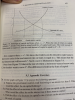 157 9 Appendix A: A Model of Private Debr Supply of Loans du Puolustablo Demand for Loans - Goods WOLISZ 2002 Isqo 5 our silen Goods lent Goods held in capital Figure 7.9. Holdings of capital and loans when x > r. When the rate of return on capital exceeds r. lenders will hold a mixed portfolio of capital and loans. The total amount of loans made is equal to L and the total amount of capital is equal to...
Suppose there is a decrease in interest rates. Using the AD-AS model and starting at a...
Suppose there is a decrease in interest rates. Using the AD-AS model and starting at a long-run equilibrium, what would be the short-run effect? Group of answer choices A . A decrease in Real GDP, a decrease in the GDP Deflator B. No change in Real GDP, an increase in the GDP Deflator C. An increase in Real GDP, an increase in the GDP Deflator D. No change in Real GDP, a decrease in the GDP Deflator
3. If you deposit $400 in a bank account and the reserve ratio is 20 percent....
3. If you deposit $400 in a bank account and the reserve ratio is 20 percent. a. What is the minimum amount of money banks will be required to keep in reserves? How much loans can banks make at most? What is the money multiplier? How much money can be created from $400 of reserves? b. If the fed raises the required reserve ratio to 30 percent. What is the minimum amount of money banks will be required to keep...
Ml equals currency + demand deposits + A)nothing else B)othere checkable deposits. C)traveler's checks + other checkable deposits. D)traveler's checks + other checkable deposits -+ savings de...
 Ml equals currency + demand deposits + A)nothing else B)othere checkable deposits. C)traveler's checks + other checkable deposits. D)traveler's checks + other checkable deposits -+ savings deposits 2. If you deposit $100 of currency into a demand deposit at a bank, this action by itself A)does not change the money supply. B)increases the money supply. C)decreases the money supply. D)has an indeterminate effect on the money supply. 3. The manager of the bank where you work tells you that your...
10. Open-market purchases of government bonds by the Fed will have the tendency to: A) Increase...
 10. Open-market purchases of government bonds by the Fed will have the tendency to: A) Increase interest rates, the money supply, and national income. B) Increase interest rates and the money supply, but decrease national income. C) Increase interest rates, but decrease the money supply and national income. D) Decrease interest rates, but increase the money supply and national income. E) Decrease interest rates, the money supply, and national income. 11. Aggregate demand would tend to be shifted up by...
Unit 5 Assignment Back to Attempts: Keep the Highest: 14 6. The money creation process Suppose...
 Unit 5 Assignment Back to Attempts: Keep the Highest: 14 6. The money creation process Suppose First Main Street Bank, Second Republic Bank, and Third Fidelity Bank all have zero excess reserves. The required reserve ratio is 5% Raphael, a client of First Main Street Bank, deposits $200,000 into his checking account at First Main Street Bank Complete the following table to reflect any changes in First Main Street Bank's T account (before the bank makes any new loans). Liabilities...
 Atte 24/7P 2 pts 3243 uctions actions NO Question 24 Using the simple deposit multiplier model, what is the required reserve ratio if an increase in reserves of $600 increases deposits by $24,000? 3% O • Previous 4.5% 2.5% 3.5% bok
 Rate-Sensitive Bank Assets Liabilities $5 Variable-rate Loans Short-term Loans Short-term Securities Reserves Variable-rate CDs Money Market Deposit Accounts Checkable Deposits Savings Deposits Long-term CDs Equity Capital Long-term Loans Long-term Securities 30 30 Referring to the table above, and using basic gap analysis, this bank's "gap" is $ million. (Round your response to the nearest whole number.) Referring to the table above, if interest rates suddenly increase by two percentage points, then the bank's profits change by $ whole number.) (Round...
 need an answer to question 5
textbook is macroeconomics 9th edition
to keep the money supply at its original level, does it culate, in dollars, how much the central bank . Explain how banks create money 5. What are the various ways in which the Federal 6. As a Case Study in the chapter discusses, the Reserve can influence the money supply? money supply fell from 1929 to 1933 because Why might a banking crisis lead to a fall in...
need an answer to question 5
textbook is macroeconomics 9th edition
to keep the money supply at its original level, does it culate, in dollars, how much the central bank . Explain how banks create money 5. What are the various ways in which the Federal 6. As a Case Study in the chapter discusses, the Reserve can influence the money supply? money supply fell from 1929 to 1933 because Why might a banking crisis lead to a fall in...
 157 9 Appendix A: A Model of Private Debr Supply of Loans du Puolustablo Demand for Loans - Goods WOLISZ 2002 Isqo 5 our silen Goods lent Goods held in capital Figure 7.9. Holdings of capital and loans when x > r. When the rate of return on capital exceeds r. lenders will hold a mixed portfolio of capital and loans. The total amount of loans made is equal to L and the total amount of capital is equal to...
 Ml equals currency + demand deposits + A)nothing else B)othere checkable deposits. C)traveler's checks + other checkable deposits. D)traveler's checks + other checkable deposits -+ savings deposits 2. If you deposit $100 of currency into a demand deposit at a bank, this action by itself A)does not change the money supply. B)increases the money supply. C)decreases the money supply. D)has an indeterminate effect on the money supply. 3. The manager of the bank where you work tells you that your...
 10. Open-market purchases of government bonds by the Fed will have the tendency to: A) Increase interest rates, the money supply, and national income. B) Increase interest rates and the money supply, but decrease national income. C) Increase interest rates, but decrease the money supply and national income. D) Decrease interest rates, but increase the money supply and national income. E) Decrease interest rates, the money supply, and national income. 11. Aggregate demand would tend to be shifted up by...
 Unit 5 Assignment Back to Attempts: Keep the Highest: 14 6. The money creation process Suppose First Main Street Bank, Second Republic Bank, and Third Fidelity Bank all have zero excess reserves. The required reserve ratio is 5% Raphael, a client of First Main Street Bank, deposits $200,000 into his checking account at First Main Street Bank Complete the following table to reflect any changes in First Main Street Bank's T account (before the bank makes any new loans). Liabilities...
Most questions answered within 3 hours.
-
Where is the error in this code sequence?
String s1 = "Hello";
String s2 = "ello";...
asked 10 months ago -
Financial data for Joel de Paris, Inc., for last year
follow:
Joel de Paris, Inc.
Balance...
asked 10 months ago -
Consider this reaction:
Al2(SO4)3 (aq)+ BaCl3
(aq) Al2Cl6 (aq)- +
3BaSO4(s) . What is the...
asked 10 months ago -
Suppose that Savneet is considering increasing her
recent random sample from 20 car rentals to 40...
asked 10 months ago -
Trucks arrive at an unloading terminal at an average rate of 120
per hour.
Trucks arrive...
asked 10 months ago -
Why are methanol and ethanol completely soluble in water while
octanol is not very little soluble....
asked 10 months ago -
A facilities manager at a university reads in a research report
that the mean amount of...
asked 10 months ago -
When the CuSO4 is rehydrated by adding water to the anhydrous
compound, is this an endothermic...
asked 10 months ago -
A ray of sunlight is passing from diamond into crown glass; the
angle of incidence is...
asked 10 months ago -
A block of mass 0.249 kg is placed on top of a light, vertical
spring of...
asked 10 months ago -
how do the kidneys compensate in the presences of acidosis
a) trigger hyperventilate
b) reserve acid...
asked 10 months ago -
Question 501 pts
The rental rate of capital to the firm increases. Which of the
following...
asked 10 months ago