You have a planning horizon of H = 3 years and wish to immunize your investment...
You have a planning horizon of H = 3 years and wish to immunize your investment for that horizon. You attempt to do so by buying a perpetual bond that pays $62 annually and has a YTM of 18% p.a. You will reinvest the coupons throughout this 3-year period and, additionally, you will sell the bond at the end of that 3-year period. Find the total cash flow you will have 3 years from now if interest rates remain unchanged throughout your planning horizon.
Homework Answers
Future Value of annuity = A* ((1+rate)^n-1)/rate
Cash flow after 3 years = 62*((1+18%)^3-1)/18%
=62*3.5724
=$221.49
Add Answer to:
You have a planning horizon of H = 3 years and wish to immunize
your investment...
You have a planning horizon of H = 6 years and wish to immunize your investment...
You have a planning horizon of H = 6 years and wish to immunize your investment for that horizon. You attempt to do so by buying a perpetual bond that pays $59 annually and has a YTM of 17% p.a. You will reinvest the coupons throughout this 6-year period and, additionally, you will sell the bond at the end of that 6-year period. Find the total cash flow you will have 6 years from now if interest rates remain unchanged...
You have a planning horizon of 8 years and wish to immunize your investment over that...
You have a planning horizon of 8 years and wish to immunize your investment over that horizon. To do so, you have two financial instruments available: A and B. Instrument A has a duration of 2 years, and instrument B has a duration of 13 years. Find the proportion of your money that you need to invest in instrument A in order to achieve your immunization goal.
#5. Suppose that we invest in a bond with a 3-year horizon. We consider purchasing a...
#5. Suppose that we invest in a bond with a 3-year horizon. We consider purchasing a bond with the face value of $1,000, the maturity of 20 years, and the coupon rate of 8%. The bond pays the coupons semi-annually. The price of the bond is $907.99 and the YTM is 9%. We expect that we can reinvest the coupon payments at an annual rate of 6%. At the end of the horizon, the 17-year bond will be selling to...
Suppose that an investor with a 3-year investment horizon is considering buying an 8-year 6% coupon...
Suppose that an investor with a 3-year investment horizon is considering buying an 8-year 6% coupon bond selling at par (semi-annual coupon payments). The investor expects that she can reinvest the coupin payments at an annual interest rate of 7% and that at the end of the investment horizon all bonds will be selling to offer a YTM of 9%. What is the (annualized) expected holding period return for this bond?
Question #7: Holding Period Return (20 Points) Assume that you have a one-year investment horizon and...
 Question #7: Holding Period Return (20 Points) Assume that you have a one-year investment horizon and are trying to choose among two bonds. Both have the same default risk and mature in 6 years. The first is a zero-coupon bond that pays $1000 at maturity. The second is a $1000 par value coupon bond that has a coupon rate of 6% and makes an annual coupon payment. (a) If the YTM is equal to 3.6% what is the current prices...
Two years ago you have purchased a bond with $1000 par, semi-annual coupons with a coupon...
Two years ago you have purchased a bond with $1000 par, semi-annual coupons with a coupon rate of 8% and maturity of 20 years for $ 1,200. Calculate your holding period return for this bond over the last two years, if you were able to reinvest coupons at 11% and the current YTM is 7%!
2-assume you have a one year investment horizon and purchase a semiannual coupon bond today that...
2-assume you have a one year investment horizon and purchase a semiannual coupon bond today that pays 9% coupon anually, had a bar of 1000 matures in 20 years and 10% ytm. If you owned the bond for exactly one year( exactly 19 of maturity left ) and the bond is currently yelding 8% to maturity . What is the rate of return?
You are planning to buy a corporate bond with a 7-year maturity that pays 7% coupon...
You are planning to buy a corporate bond with a 7-year maturity that pays 7% coupon interest. The bond is priced at $108,500 per $100,000 par value. You expect to sell the bond in 2 years when a similar-risk 5-year bond is priced to yield 7.2% annually to maturity. Assuming that you can reinvest all cash flows at an 8% annual rate (4% semiannually), calculate your expected total return over the two-year holding period.
You have a 7 year investment horizon and are considering one of three bonds to purchase....
You have a 7 year investment horizon and are considering one of three bonds to purchase. Bond A has a 5 year duration and a 7 YTM. Bond B has a 15 YTM and 10 year duration. Bond C has a 7 year TYM and 5 year duration. Describe the conditions in which you would choose to purchase each bond.
Coupon is paid semi-annually and your investment horizon is 1.5 years. A) What is the modified...
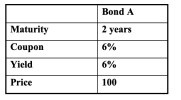 Coupon is paid semi-annually and your
investment horizon is 1.5 years. A) What is the modified duration
of this bond? B) What is the convexity of this bond? C) If the
yield after 6 months is expected to fall to 5.5% and then to 4.5%
from the beginning of year 2, what would be your holding period
return, price appreciation/depreciation, re-investment income and
coupon income from this bond?
Bond A Maturity Coupon Yield 2 years 6% 6% Price 100
Coupon is paid semi-annually and your
investment horizon is 1.5 years. A) What is the modified duration
of this bond? B) What is the convexity of this bond? C) If the
yield after 6 months is expected to fall to 5.5% and then to 4.5%
from the beginning of year 2, what would be your holding period
return, price appreciation/depreciation, re-investment income and
coupon income from this bond?
Bond A Maturity Coupon Yield 2 years 6% 6% Price 100
 Question #7: Holding Period Return (20 Points) Assume that you have a one-year investment horizon and are trying to choose among two bonds. Both have the same default risk and mature in 6 years. The first is a zero-coupon bond that pays $1000 at maturity. The second is a $1000 par value coupon bond that has a coupon rate of 6% and makes an annual coupon payment. (a) If the YTM is equal to 3.6% what is the current prices...
 Coupon is paid semi-annually and your
investment horizon is 1.5 years. A) What is the modified duration
of this bond? B) What is the convexity of this bond? C) If the
yield after 6 months is expected to fall to 5.5% and then to 4.5%
from the beginning of year 2, what would be your holding period
return, price appreciation/depreciation, re-investment income and
coupon income from this bond?
Bond A Maturity Coupon Yield 2 years 6% 6% Price 100
Coupon is paid semi-annually and your
investment horizon is 1.5 years. A) What is the modified duration
of this bond? B) What is the convexity of this bond? C) If the
yield after 6 months is expected to fall to 5.5% and then to 4.5%
from the beginning of year 2, what would be your holding period
return, price appreciation/depreciation, re-investment income and
coupon income from this bond?
Bond A Maturity Coupon Yield 2 years 6% 6% Price 100
Most questions answered within 3 hours.
-
Where is the error in this code sequence?
String s1 = "Hello";
String s2 = "ello";...
asked 11 months ago -
Financial data for Joel de Paris, Inc., for last year
follow:
Joel de Paris, Inc.
Balance...
asked 11 months ago -
Consider this reaction:
Al2(SO4)3 (aq)+ BaCl3
(aq) Al2Cl6 (aq)- +
3BaSO4(s) . What is the...
asked 11 months ago -
Suppose that Savneet is considering increasing her
recent random sample from 20 car rentals to 40...
asked 11 months ago -
Trucks arrive at an unloading terminal at an average rate of 120
per hour.
Trucks arrive...
asked 11 months ago -
Why are methanol and ethanol completely soluble in water while
octanol is not very little soluble....
asked 11 months ago -
A facilities manager at a university reads in a research report
that the mean amount of...
asked 11 months ago -
When the CuSO4 is rehydrated by adding water to the anhydrous
compound, is this an endothermic...
asked 11 months ago -
A ray of sunlight is passing from diamond into crown glass; the
angle of incidence is...
asked 11 months ago -
A block of mass 0.249 kg is placed on top of a light, vertical
spring of...
asked 11 months ago -
how do the kidneys compensate in the presences of acidosis
a) trigger hyperventilate
b) reserve acid...
asked 11 months ago -
Question 501 pts
The rental rate of capital to the firm increases. Which of the
following...
asked 11 months ago