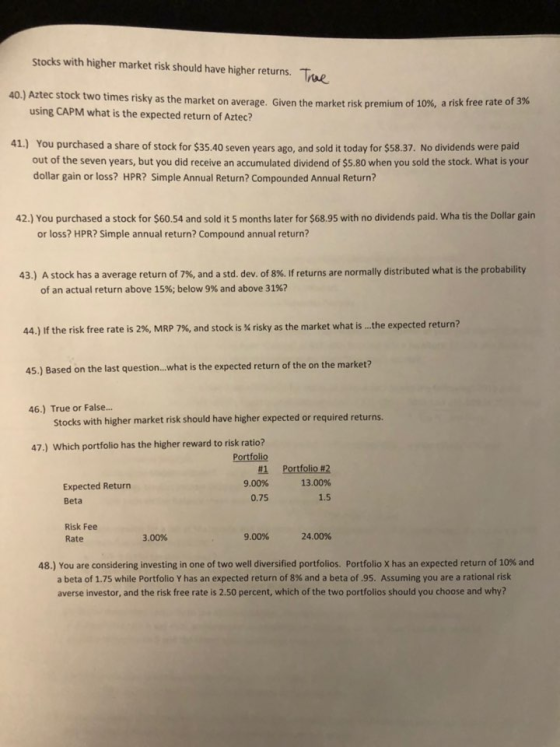
can I please have answer with solutions? thank you!
Homework Answers
44) Using CAPM, Expected Return = Rf + beta x MRP = 2% + 3/4 x 7% = 7.25%
45) Market Returns = MRP + Rf = 7% + 2% = 9%
46) True.
47) Portfolio 1. Reward to Risk = Returns / Beta is higher for Portfolio 1.
48) Portfolio Y as its risk (beta) is lower.
Add Answer to:
can I please have answer with solutions? thank you!
Stocks with higher market risk should have...
1a) You purchased a share of stock for $35.40 seven years ago and just sold it...
1a) You purchased a share of stock for $35.40 seven years ago and just sold it today for $58.37. No dividends were paid out over the seven years but you did receive an accumulated dividend of $5.80 when you sold the stock. What is your (a) Dollar gain or loss; (b) HPR; (c) Simple annual return; and (d) Compound annual return? 1b) You bought a stock for $60.54 and sold it 5 months later for $68.95 with no dividends paid....
od The capital asset pricing model (CAPM) explains how risk should be considered when stocks and...
 od The capital asset pricing model (CAPM) explains how risk should be considered when stocks and other assets are held -Select- The CAPM states that any stock's required rate of return is -Select the risk-free rate of return plus a risk premium that reflects only the risk remaining -Select- diversification. Most individuals hold stocks in portfolios. The risk of a stock held in a portfolio is typically -Select the stock's risk when it is held alone. Therefore, the risk and...
PLEASE EXPLAIN WHY ANSWER IS TRUE OR FALSE: "Risk aversion" implies that investors require higher expected...
PLEASE EXPLAIN WHY ANSWER IS TRUE OR FALSE: "Risk aversion" implies that investors require higher expected returns on riskier than on less risky securities. a. True b. False When adding a randomly chosen new stock to an existing portfolio, the higher (or more positive) the degree of correlation between the new stock and stocks already in the portfolio, the less the additional stock will reduce the portfolio's risk. a. True b. False An individual stock's diversifiable risk, which is measured...
2. Consider a market with only two risky stocks, A and B, and one risk-free asset....
 2. Consider a market with only two risky stocks, A and B, and one risk-free asset. We have the following information about the stocks. Stock A Stock B Number of shares in the market 600 400 Price per share $2.00 $2.50 Expected rate of return 20% Standard dev.of return 12% Furthermore, the correlation coefficient between the returns of stocks A and B is PABWe assume that the returns are annual, and that the assumptions of CAPM hold. (a) (4 points)...
tHANK YOU 18. You are comparing stock A to stock B. stocks should you prefer and...
 tHANK YOU
18. You are comparing stock A to stock B. stocks should you prefer and why? ven the following information, which one of these two REXEL UNIVERSITY- State of Rate of Return if Probability of Economy State of Economy StoskA Stok A. Stock A; because it has B, C. Stock Stock A; because it has higher expected an expected return of 7% and appears to be more risky expected return and appears to be less risky than stock B...
tHANK YOU
18. You are comparing stock A to stock B. stocks should you prefer and why? ven the following information, which one of these two REXEL UNIVERSITY- State of Rate of Return if Probability of Economy State of Economy StoskA Stok A. Stock A; because it has B, C. Stock Stock A; because it has higher expected an expected return of 7% and appears to be more risky expected return and appears to be less risky than stock B...
QUESTION 17 You own a portfolio equally invested in a risk-free asset and two stocks. One of the stocks has a beta...
 QUESTION 17 You own a portfolio equally invested in a risk-free asset and two stocks. One of the stocks has a beta of 126 and the total portfolio is equally as risky as the market. Required: What must the beta be for the other stock in your portfolio? (Round your answer to 2 decimal places leg.32.16).) Beta: QUESTION 18 A stock has a beta of o92, the expected return on the market is 103 percent, and the risk-free rate is...
Stocks A and B have the following probability distributions of expected future returns: Probability A B...
Stocks A and B have the following probability distributions of expected future returns: Probability A B 0.1 (13 %) (22 %) 0.2 6 0 0.5 16 21 0.1 23 27 0.1 39 45 Calculate the expected rate of return, , for Stock B ( = 14.10%.) Do not round intermediate calculations. Round your answer to two decimal places. % Calculate the standard deviation of expected returns, σA, for Stock A (σB = 17.44%.) Do not round intermediate calculations. Round your...
2. 3: Risk and Rates of Return: Risk in Portfolio Context Risk and Rates of Return:...
 2. 3: Risk and Rates of Return: Risk in Portfolio Context Risk
and Rates of Return: Risk in Portfolio Context The capital asset
pricing model (CAPM) explains how risk should be considered when
stocks and other assets are held . The CAPM states that any stock's
required rate of return is the risk-free rate of return plus a risk
premium that reflects only the risk remaining diversification. Most
individuals hold stocks in portfolios. The risk of a stock held in...
2. 3: Risk and Rates of Return: Risk in Portfolio Context Risk
and Rates of Return: Risk in Portfolio Context The capital asset
pricing model (CAPM) explains how risk should be considered when
stocks and other assets are held . The CAPM states that any stock's
required rate of return is the risk-free rate of return plus a risk
premium that reflects only the risk remaining diversification. Most
individuals hold stocks in portfolios. The risk of a stock held in...
(2*5) Consider a market with many risky assets and a risk-free security. Asset’s returns are not...
(2*5) Consider a market with many risky assets and a risk-free security. Asset’s returns are not perfectly correlated. All the CAPM assumptions hold and the market is in equilibrium. The risk-free rate is 5%, the expected return on the market is 15%. Mr. T and Mrs. R are two investors with mean-variance utility functions and different risk-aversion coefficients. They both invest into efficient portfolios composed of the market portfolio and the risk-free security. Mr. T’s portfolio has an expected return...
QUESTION 17 You own a portfolio equally invested in a risk-free asset and two stocks. One...
 QUESTION 17 You own a portfolio equally invested in a risk-free asset and two stocks. One of the stocks has a beta of 126 and the total portfolio is equally as risky as the market. Required: What must the beta be for the other stock in your portfolio? (Round your answer to 2 decimal places (e.g. 32.16).) Beta: QUESTION 18 A stock has a beta of 4.80 percent 92, the expected return on the market is 10.3 percent, and the...
 od The capital asset pricing model (CAPM) explains how risk should be considered when stocks and other assets are held -Select- The CAPM states that any stock's required rate of return is -Select the risk-free rate of return plus a risk premium that reflects only the risk remaining -Select- diversification. Most individuals hold stocks in portfolios. The risk of a stock held in a portfolio is typically -Select the stock's risk when it is held alone. Therefore, the risk and...
 2. Consider a market with only two risky stocks, A and B, and one risk-free asset. We have the following information about the stocks. Stock A Stock B Number of shares in the market 600 400 Price per share $2.00 $2.50 Expected rate of return 20% Standard dev.of return 12% Furthermore, the correlation coefficient between the returns of stocks A and B is PABWe assume that the returns are annual, and that the assumptions of CAPM hold. (a) (4 points)...
 tHANK YOU
18. You are comparing stock A to stock B. stocks should you prefer and why? ven the following information, which one of these two REXEL UNIVERSITY- State of Rate of Return if Probability of Economy State of Economy StoskA Stok A. Stock A; because it has B, C. Stock Stock A; because it has higher expected an expected return of 7% and appears to be more risky expected return and appears to be less risky than stock B...
tHANK YOU
18. You are comparing stock A to stock B. stocks should you prefer and why? ven the following information, which one of these two REXEL UNIVERSITY- State of Rate of Return if Probability of Economy State of Economy StoskA Stok A. Stock A; because it has B, C. Stock Stock A; because it has higher expected an expected return of 7% and appears to be more risky expected return and appears to be less risky than stock B...
 QUESTION 17 You own a portfolio equally invested in a risk-free asset and two stocks. One of the stocks has a beta of 126 and the total portfolio is equally as risky as the market. Required: What must the beta be for the other stock in your portfolio? (Round your answer to 2 decimal places leg.32.16).) Beta: QUESTION 18 A stock has a beta of o92, the expected return on the market is 103 percent, and the risk-free rate is...
 2. 3: Risk and Rates of Return: Risk in Portfolio Context Risk
and Rates of Return: Risk in Portfolio Context The capital asset
pricing model (CAPM) explains how risk should be considered when
stocks and other assets are held . The CAPM states that any stock's
required rate of return is the risk-free rate of return plus a risk
premium that reflects only the risk remaining diversification. Most
individuals hold stocks in portfolios. The risk of a stock held in...
2. 3: Risk and Rates of Return: Risk in Portfolio Context Risk
and Rates of Return: Risk in Portfolio Context The capital asset
pricing model (CAPM) explains how risk should be considered when
stocks and other assets are held . The CAPM states that any stock's
required rate of return is the risk-free rate of return plus a risk
premium that reflects only the risk remaining diversification. Most
individuals hold stocks in portfolios. The risk of a stock held in...
 QUESTION 17 You own a portfolio equally invested in a risk-free asset and two stocks. One of the stocks has a beta of 126 and the total portfolio is equally as risky as the market. Required: What must the beta be for the other stock in your portfolio? (Round your answer to 2 decimal places (e.g. 32.16).) Beta: QUESTION 18 A stock has a beta of 4.80 percent 92, the expected return on the market is 10.3 percent, and the...
Most questions answered within 3 hours.
-
Where is the error in this code sequence?
String s1 = "Hello";
String s2 = "ello";...
asked 10 months ago -
Financial data for Joel de Paris, Inc., for last year
follow:
Joel de Paris, Inc.
Balance...
asked 10 months ago -
Consider this reaction:
Al2(SO4)3 (aq)+ BaCl3
(aq) Al2Cl6 (aq)- +
3BaSO4(s) . What is the...
asked 10 months ago -
Suppose that Savneet is considering increasing her
recent random sample from 20 car rentals to 40...
asked 10 months ago -
Trucks arrive at an unloading terminal at an average rate of 120
per hour.
Trucks arrive...
asked 10 months ago -
Why are methanol and ethanol completely soluble in water while
octanol is not very little soluble....
asked 10 months ago -
A facilities manager at a university reads in a research report
that the mean amount of...
asked 10 months ago -
When the CuSO4 is rehydrated by adding water to the anhydrous
compound, is this an endothermic...
asked 10 months ago -
A ray of sunlight is passing from diamond into crown glass; the
angle of incidence is...
asked 10 months ago -
A block of mass 0.249 kg is placed on top of a light, vertical
spring of...
asked 10 months ago -
how do the kidneys compensate in the presences of acidosis
a) trigger hyperventilate
b) reserve acid...
asked 10 months ago -
Question 501 pts
The rental rate of capital to the firm increases. Which of the
following...
asked 10 months ago