I need help with problems with 5 and 6. I'm not sure how to do them....
I need help with problems with 5 and 6. I'm not sure how to do them. Thanks!
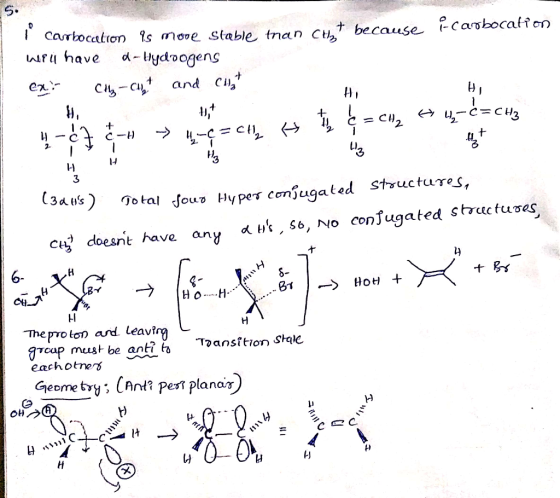
5. the stability of carbocations is generally explained by a concept known as hyperconjugation. Use this concept to explain why a primary (1°) carbocation is more stable than a methyl (CH3+) carbocation. You must use a simple and concise drawing to show your point.
6. Using frontier orbital theory, explain why an E2 reaction must have the beta-hydrogen and the leaving group anti-periplanar to each other.
Homework Answers
Add Answer to:
I need help with problems with 5 and 6. I'm not sure
how to do them....
5) The stability of carbocations is generally explained by a concept known as hyperconjugation. Use this...
 5) The stability of carbocations is generally explained by a concept known as hyperconjugation. Use this concept to explain why a primary (1) carbocation is more stable than a methyl (CH3) carbocation. You must use a simple drawing and concise explanation to illustrate your point.
6) Using frontier orbital theory, explain why an E2 reaction must have the B-hydrogen and the...
 6) Using frontier orbital theory, explain why an E2 reaction must have the B-hydrogen and the leaving group anti-periplanar to each other.
6) Using frontier orbital theory, explain why an E2 reaction must have the B-hydrogen and the...
 6) Using frontier orbital theory, explain why an E2 reaction must have the B-hydrogen and the leaving group anti-periplanar to each other.
no explanation needed, just letters that correspond with right answers. thanks! Name Exam 2: Chapters 4-7...
 no
explanation needed, just letters that correspond with right
answers. thanks!
Name Exam 2: Chapters 4-7 Please put all of your answers on the scantron sheet. This exam paper must be returned with the scar For questions that list only 1,2,3,4, use the letters a,b.c.d respectively on the Scantron 1. What is the approximate value of the H-C-H bonds angle in ethylene? a. 90° b. 109 c. 120 d. 180 2. What type of molecular orbital is formed by the...
no
explanation needed, just letters that correspond with right
answers. thanks!
Name Exam 2: Chapters 4-7 Please put all of your answers on the scantron sheet. This exam paper must be returned with the scar For questions that list only 1,2,3,4, use the letters a,b.c.d respectively on the Scantron 1. What is the approximate value of the H-C-H bonds angle in ethylene? a. 90° b. 109 c. 120 d. 180 2. What type of molecular orbital is formed by the...
need help with 1-21 1) Label the steps below as "slow" and "fast". HCH 013 10...
 need help with 1-21
1) Label the steps below as "slow" and "fast". HCH 013 10 = H. C + + H-LG H-LG 2) Why are they slow/fast? Explain using chemical terms. Stereochemistry of the Sn1 reaction 3) What type of intermediate does the Sn1 reaction proceed through? 4) What is the geometry of the carbon that the nucleophile coordinates to in the 2 step? 5) From how many directions would it be reasonable for the nucleophile to approach the...
need help with 1-21
1) Label the steps below as "slow" and "fast". HCH 013 10 = H. C + + H-LG H-LG 2) Why are they slow/fast? Explain using chemical terms. Stereochemistry of the Sn1 reaction 3) What type of intermediate does the Sn1 reaction proceed through? 4) What is the geometry of the carbon that the nucleophile coordinates to in the 2 step? 5) From how many directions would it be reasonable for the nucleophile to approach the...
i'm workimg on a careplan and i need help. i don't know what this Roy adaption...
 i'm
workimg on a careplan and i need help. i don't know what this Roy
adaption model is. can someone please help me?
HELENE FULD COLLEGE OF NURSING CRITERIA FOR EVALUATION OF NURSING CARE PLAN NUR 221 ASSESSMENT Pole poids Actual points d at of 1. Cabe 2. Uspor include e pay and environmental tervisection, auto plation, and person D hes 3. a t in prima including wojective and objective data history, cum DIAGNOSIS Posle points Actual points Criteria Incorporate...
i'm
workimg on a careplan and i need help. i don't know what this Roy
adaption model is. can someone please help me?
HELENE FULD COLLEGE OF NURSING CRITERIA FOR EVALUATION OF NURSING CARE PLAN NUR 221 ASSESSMENT Pole poids Actual points d at of 1. Cabe 2. Uspor include e pay and environmental tervisection, auto plation, and person D hes 3. a t in prima including wojective and objective data history, cum DIAGNOSIS Posle points Actual points Criteria Incorporate...
Chapter 11: 1. What is a prime rule in naming alkenes? a. Find the longest carbon...
Chapter 11: 1. What is a prime rule in naming alkenes? a. Find the longest carbon chain. b.Find the longest carbon chain containing the alkene. c. Find whether the alkene has a cis- or trans- configuration. d.Find how far the alkene functionality is from either end. 2. What is the IUPAC name of the following alkene? a. cis-5-methyl-2-heptene b. trans-2-ethyl-4-hexene c. trans-5-methyl-2-heptene d. trans-3-methyl-5-heptene 3. What is the hybridization, geometry, and bond angle of the carbon marked by an asterisk?...
 5) The stability of carbocations is generally explained by a concept known as hyperconjugation. Use this concept to explain why a primary (1) carbocation is more stable than a methyl (CH3) carbocation. You must use a simple drawing and concise explanation to illustrate your point.
 6) Using frontier orbital theory, explain why an E2 reaction must have the B-hydrogen and the leaving group anti-periplanar to each other.
 6) Using frontier orbital theory, explain why an E2 reaction must have the B-hydrogen and the leaving group anti-periplanar to each other.
 no
explanation needed, just letters that correspond with right
answers. thanks!
Name Exam 2: Chapters 4-7 Please put all of your answers on the scantron sheet. This exam paper must be returned with the scar For questions that list only 1,2,3,4, use the letters a,b.c.d respectively on the Scantron 1. What is the approximate value of the H-C-H bonds angle in ethylene? a. 90° b. 109 c. 120 d. 180 2. What type of molecular orbital is formed by the...
no
explanation needed, just letters that correspond with right
answers. thanks!
Name Exam 2: Chapters 4-7 Please put all of your answers on the scantron sheet. This exam paper must be returned with the scar For questions that list only 1,2,3,4, use the letters a,b.c.d respectively on the Scantron 1. What is the approximate value of the H-C-H bonds angle in ethylene? a. 90° b. 109 c. 120 d. 180 2. What type of molecular orbital is formed by the...
 need help with 1-21
1) Label the steps below as "slow" and "fast". HCH 013 10 = H. C + + H-LG H-LG 2) Why are they slow/fast? Explain using chemical terms. Stereochemistry of the Sn1 reaction 3) What type of intermediate does the Sn1 reaction proceed through? 4) What is the geometry of the carbon that the nucleophile coordinates to in the 2 step? 5) From how many directions would it be reasonable for the nucleophile to approach the...
need help with 1-21
1) Label the steps below as "slow" and "fast". HCH 013 10 = H. C + + H-LG H-LG 2) Why are they slow/fast? Explain using chemical terms. Stereochemistry of the Sn1 reaction 3) What type of intermediate does the Sn1 reaction proceed through? 4) What is the geometry of the carbon that the nucleophile coordinates to in the 2 step? 5) From how many directions would it be reasonable for the nucleophile to approach the...
 i'm
workimg on a careplan and i need help. i don't know what this Roy
adaption model is. can someone please help me?
HELENE FULD COLLEGE OF NURSING CRITERIA FOR EVALUATION OF NURSING CARE PLAN NUR 221 ASSESSMENT Pole poids Actual points d at of 1. Cabe 2. Uspor include e pay and environmental tervisection, auto plation, and person D hes 3. a t in prima including wojective and objective data history, cum DIAGNOSIS Posle points Actual points Criteria Incorporate...
i'm
workimg on a careplan and i need help. i don't know what this Roy
adaption model is. can someone please help me?
HELENE FULD COLLEGE OF NURSING CRITERIA FOR EVALUATION OF NURSING CARE PLAN NUR 221 ASSESSMENT Pole poids Actual points d at of 1. Cabe 2. Uspor include e pay and environmental tervisection, auto plation, and person D hes 3. a t in prima including wojective and objective data history, cum DIAGNOSIS Posle points Actual points Criteria Incorporate...
Most questions answered within 3 hours.
-
Where is the error in this code sequence?
String s1 = "Hello";
String s2 = "ello";...
asked 10 months ago -
Financial data for Joel de Paris, Inc., for last year
follow:
Joel de Paris, Inc.
Balance...
asked 10 months ago -
Consider this reaction:
Al2(SO4)3 (aq)+ BaCl3
(aq) Al2Cl6 (aq)- +
3BaSO4(s) . What is the...
asked 10 months ago -
Suppose that Savneet is considering increasing her
recent random sample from 20 car rentals to 40...
asked 10 months ago -
Trucks arrive at an unloading terminal at an average rate of 120
per hour.
Trucks arrive...
asked 10 months ago -
Why are methanol and ethanol completely soluble in water while
octanol is not very little soluble....
asked 10 months ago -
A facilities manager at a university reads in a research report
that the mean amount of...
asked 10 months ago -
When the CuSO4 is rehydrated by adding water to the anhydrous
compound, is this an endothermic...
asked 10 months ago -
A ray of sunlight is passing from diamond into crown glass; the
angle of incidence is...
asked 10 months ago -
A block of mass 0.249 kg is placed on top of a light, vertical
spring of...
asked 10 months ago -
how do the kidneys compensate in the presences of acidosis
a) trigger hyperventilate
b) reserve acid...
asked 10 months ago -
Question 501 pts
The rental rate of capital to the firm increases. Which of the
following...
asked 10 months ago