
Homework Answers
(1) Reagent - H2O , H+ (lewis acid as catalyst)
this reaction is called hydration of alkenes
The mechanism of hydration involves electrophlic addition of the proton to the double bond to form a carbocation intermediate. Addition of water in the second step results in formation of an oxonium ion, which, upon deprotonation, gives the alcohol.
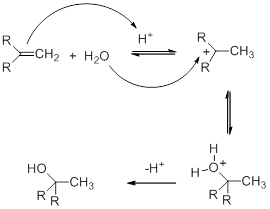
when the carbocation is formed, rearrangement is possible. In the given problem, rearrangement occurs from 20 to 30 carbocation so -OH group is substituted at benzene ring.
(2) Reagent - (i) BH3 ,THF (ii) H2O2 , OH-
This reaction is called hydroboration–oxidation reaction

The hydroxyl group attaching to the less-substituted carbon. The reaction thus provides a complementry product to the above reaction. In your problem -OH gets attached to 1 degree carbon instead of 3 degree.
Add Answer to:
7. Identify the reagent(s) that you would need to accomplish the following transformations. -O
7. Identify the reagent(s) that you would need to accomplish the following transformations. - O ♡...
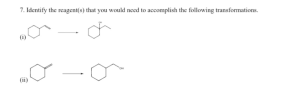 7. Identify the reagent(s) that you would need to accomplish the following transformations. - O ♡ - a
Question 23 Identify the reagents that you would need to accomplish each of the following transformations....
 Question 23 Identify the reagents that you would need to accomplish each of the following transformations. 12.24a a ai 1) Na2Cr2O7, H2S07, H2O 2) xs EtMgBr 3) H2O 1) EtMgBr 2) H20 3) Na Cry07, H2SO4 H20 1) EtMgBr 2) H20 1) MeMgBr 2) H2O 3) Na2Cr2Oy, H2SO4, H2O
What product would you except from the following reaction? Identify the reagent that can be used...
 What product would you except from the following reaction? Identify the reagent that can be used to accomplish the following transformation. How would you accomplish the following transformations?
With explanation please! 3. (30 pts) Identify the reagents you would use to accomplish each of...
 With explanation please!
3. (30 pts) Identify the reagents you would use to accomplish each of the following transformations. Place the reagent(s) over (or beside) each reaction arrow. HO HBr
With explanation please!
3. (30 pts) Identify the reagents you would use to accomplish each of the following transformations. Place the reagent(s) over (or beside) each reaction arrow. HO HBr
5. Identify the reagents you would use to accomplish each of the following transformations: Dy اه...
 5. Identify the reagents you would use to accomplish each of the following transformations: Dy اه (4) مل ، () 0H (4) H
5. Identify the reagents you would use to accomplish each of the following transformations: PH (4)...
 5. Identify the reagents you would use to accomplish each of the following transformations: PH (4) ОН (ъ) H ОН ( ) он
5. Identify the reagents you would use to accomplish each of the following transformations: D (9)...
 5. Identify the reagents you would use to accomplish each of the following transformations: D (9) OH (b) CH (C) DH (d) OH
5. Identify the reagents you would use to accomplish each of the following transformations: DH OH...
 5. Identify the reagents you would use to accomplish each of the following transformations: DH OH (b) > А OH (d) OH 6. Consider the structures of 2-nitrophenol and 3-nitrophenol. These compounds have very different pk, values. Predict which one has the lower pK, and explain why
6. Predict the major products for the ozonolysis reactions shown below.. 1.O 2. Н,О, Н,О, 1....
 6. Predict the major products for the ozonolysis reactions shown below.. 1.O 2. Н,О, Н,О, 1. O 2. DMS 7. Identify the reagent(s) that you would need to accomplish the following transformations. гон (ii)
Identify the reagents necessary to accomplish each of the following transformations. CH CH CH O N...
 Identify the reagents necessary to accomplish each of the following transformations. CH CH CH O N CH H,N Choose the correct reagents from the following list: Cl2, AICI Zn, HCI CH3CH2CocI AlCl3 Fuming H2SO4 9 HNO3, H2SO4 excess NBS, heat CH3CI, AICl3 Zn(Hg), HCI, heat
 7. Identify the reagent(s) that you would need to accomplish the following transformations. - O ♡ - a
 Question 23 Identify the reagents that you would need to accomplish each of the following transformations. 12.24a a ai 1) Na2Cr2O7, H2S07, H2O 2) xs EtMgBr 3) H2O 1) EtMgBr 2) H20 3) Na Cry07, H2SO4 H20 1) EtMgBr 2) H20 1) MeMgBr 2) H2O 3) Na2Cr2Oy, H2SO4, H2O
 What product would you except from the following reaction? Identify the reagent that can be used to accomplish the following transformation. How would you accomplish the following transformations?
 With explanation please!
3. (30 pts) Identify the reagents you would use to accomplish each of the following transformations. Place the reagent(s) over (or beside) each reaction arrow. HO HBr
With explanation please!
3. (30 pts) Identify the reagents you would use to accomplish each of the following transformations. Place the reagent(s) over (or beside) each reaction arrow. HO HBr
 5. Identify the reagents you would use to accomplish each of the following transformations: Dy اه (4) مل ، () 0H (4) H
 5. Identify the reagents you would use to accomplish each of the following transformations: PH (4) ОН (ъ) H ОН ( ) он
 5. Identify the reagents you would use to accomplish each of the following transformations: D (9) OH (b) CH (C) DH (d) OH
 5. Identify the reagents you would use to accomplish each of the following transformations: DH OH (b) > А OH (d) OH 6. Consider the structures of 2-nitrophenol and 3-nitrophenol. These compounds have very different pk, values. Predict which one has the lower pK, and explain why
 6. Predict the major products for the ozonolysis reactions shown below.. 1.O 2. Н,О, Н,О, 1. O 2. DMS 7. Identify the reagent(s) that you would need to accomplish the following transformations. гон (ii)
 Identify the reagents necessary to accomplish each of the following transformations. CH CH CH O N CH H,N Choose the correct reagents from the following list: Cl2, AICI Zn, HCI CH3CH2CocI AlCl3 Fuming H2SO4 9 HNO3, H2SO4 excess NBS, heat CH3CI, AICl3 Zn(Hg), HCI, heat
Most questions answered within 3 hours.
-
Where is the error in this code sequence?
String s1 = "Hello";
String s2 = "ello";...
asked 10 months ago -
Financial data for Joel de Paris, Inc., for last year
follow:
Joel de Paris, Inc.
Balance...
asked 10 months ago -
Consider this reaction:
Al2(SO4)3 (aq)+ BaCl3
(aq) Al2Cl6 (aq)- +
3BaSO4(s) . What is the...
asked 10 months ago -
Suppose that Savneet is considering increasing her
recent random sample from 20 car rentals to 40...
asked 10 months ago -
Trucks arrive at an unloading terminal at an average rate of 120
per hour.
Trucks arrive...
asked 10 months ago -
Why are methanol and ethanol completely soluble in water while
octanol is not very little soluble....
asked 10 months ago -
A facilities manager at a university reads in a research report
that the mean amount of...
asked 10 months ago -
When the CuSO4 is rehydrated by adding water to the anhydrous
compound, is this an endothermic...
asked 10 months ago -
A ray of sunlight is passing from diamond into crown glass; the
angle of incidence is...
asked 10 months ago -
A block of mass 0.249 kg is placed on top of a light, vertical
spring of...
asked 10 months ago -
how do the kidneys compensate in the presences of acidosis
a) trigger hyperventilate
b) reserve acid...
asked 10 months ago -
Question 501 pts
The rental rate of capital to the firm increases. Which of the
following...
asked 10 months ago