
Homework Answers
Add Answer to:
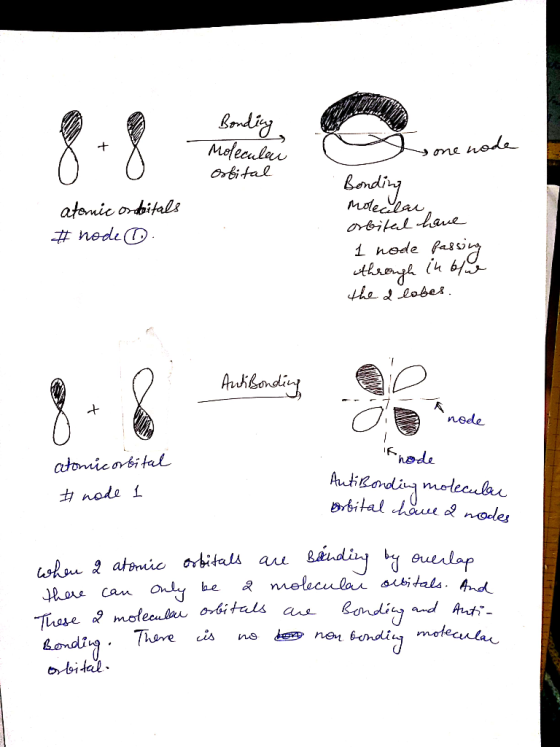
Consider two 2p orbitals, one on each of two different atoms, that are oriented side-to-side as...
Consider two 2p orbitals, one on each of two different atoms, oriented side-to-side, as in the...
 Consider two 2p orbitals, one on each of two different atoms, oriented side-to-side, as in the figure. Imagine bringing these nuclei together so that overlap occurs as shown in the figure. This overlap results in a system of molecular orbitals. (Scroll down to answer part "c)".) a) Below, construct an orbital interaction diagram for molecular orbital formation by dragging the images triat represent various orbital types (e.g., atomic, bonding, antibonding) into the relevant boxes. b) Identify the number of nodes in each...
Molecular orbitals extending over more than two atoms provide an explanation for ionic bonding paramagnetism coordinate...
 Molecular orbitals extending over more than two atoms provide an explanation for ionic bonding paramagnetism coordinate covalent bonding. resonance. Which of the following is not a valence bond concept? Atomic orbitals on two atoms may overlap to form antibonding orbitals. A pair of electrons in a bond is shared by both atoms. Lone pair electrons are in atomic orbitals or in hybrid atomic orbitals The greater the overlap between the orbitals on two atoms, the stronger the bond.
2. Use the group orbitals of CH3 and CH2 to create a Qualitative Molecular Orbital Theory...
2. Use the group orbitals of CH3 and CH2 to create a Qualitative Molecular Orbital Theory diagram of the bonding in CH3NH2 (14 electrons) Draw a separate picture attempting to illustrate what the molecular orbital will look like A few points to help you in making this diagram: • Better overlap (as in head-on versus side-by-side) leads to greater stabilization of bonding orbital • If bonding interaction is highly stabilized, the anti-bonding interaction is even more destabilized • The 2p...
1. Consider the interaction between the 2s orbital of one atom, and the 2p, orbital of...
 1. Consider the interaction between the 2s orbital of one atom, and the 2p, orbital of another: + 2s 2PZ The radial wavefunctions of each of these orbitals when they are far apart are shown approximately below. The phases have been chosen so that they will constructively overlap when they get closer. a) Label the positive and negative parts of these wave functions on the diagram above. b) Draw the sum of these wavefunctions on the diagram above. c) Now...
Question 4 Determine if each of the statements is True or False about bonding molecular orbitals...
 Question 4 Determine if each of the statements is True or False about bonding molecular orbitals and antibonding molecular orbitals. 1) Every electron that enters a bonding molecular orbital has lower energy and stabilizes the molecule. Select 2) Bonding molecular orbitals are formed by the overlap of two out-of-phase atomic orbitals. [Select] 3) An antibonding molecular orbital has a lower electron density in the internuclear region than that of the atomic orbitals. [ Select] 4) Two atomic orbitals are combined...
Using Molecular Orbital Model, sketch (or describe) the interaction of two 2p orbitals. Be sure to...
Using Molecular Orbital Model, sketch (or describe) the interaction of two 2p orbitals. Be sure to consider the orientation of the atomic orbitals.
Question #4 & #5? 3) Using Early and Late Molecular Orbitals, draw the two M.O. diagrams...
 Question #4 & #5?
3) Using Early and Late Molecular Orbitals, draw the two M.O. diagrams for NO , determine which is most stable; calculate and state bond order of each, state diamagnetic or paramagnetioc d if paramagnetic and by how many electrons. an 4) If four hydrogens, each with its 1s orbital, and two carbons, each with its one 2s and three 2p orbitals, form a molecule, then how many molecular orbitals will there be? How many bonding orbitals,...
Question #4 & #5?
3) Using Early and Late Molecular Orbitals, draw the two M.O. diagrams for NO , determine which is most stable; calculate and state bond order of each, state diamagnetic or paramagnetioc d if paramagnetic and by how many electrons. an 4) If four hydrogens, each with its 1s orbital, and two carbons, each with its one 2s and three 2p orbitals, form a molecule, then how many molecular orbitals will there be? How many bonding orbitals,...
Figure 6.11 shows the atomic s and p orbitals in a chain of atoms and how...
 Figure 6.11 shows the atomic s and p orbitals in a chain
of atoms and how these are combined to form the bonding and
antibonding
states. For the s band, the bonding state is formed with the atomic
wave
functions on all sites combined in phase, corresponding to a wave
vector
k = 0, and the antibonding state is associated with a sign change
of the wave
function on every other site, corresponding to a wave vector at the
Brillouin...
Figure 6.11 shows the atomic s and p orbitals in a chain
of atoms and how these are combined to form the bonding and
antibonding
states. For the s band, the bonding state is formed with the atomic
wave
functions on all sites combined in phase, corresponding to a wave
vector
k = 0, and the antibonding state is associated with a sign change
of the wave
function on every other site, corresponding to a wave vector at the
Brillouin...
2-0. If the orbitals of two atoms overlap and interact with constructive interference, the resulting increase...
 2-0. If the orbitals of two atoms overlap and interact with constructive interference, the resulting increase in wave density results in an): a. bonding molecular orbital b. antibonding molecular orbital c. free radical formation d. cation formation Q-7. "Doping" pure silicon with gallium results in a(n) material. a. p-type b. n-type C. S-type d. d-type Q-8. You are likely to observe H-bonding in which of the following molecules? a. NaF b. C2H4F2 C. Na20 d. HF electrons than the host...
Interaction of the following two atomic orbitals results in what kind of molecular orbital, in the...
 Interaction of the following two atomic orbitals results in what kind of molecular orbital, in the orientation shown? + s bonding molecular orbital Op bonding molecular orbital Op* antibonding molecular orbital Which of the following is the correct structure for the compound (S)-3-methylheptane. B. D. A A OB Oc OD What is the degree of substitution of the following alkene? Monosubstituted Disubstituted Trisubstituted Tetrasubstituted Which of the following is a gauche conformer? Н. н Н Hн H Н. Н FH...
 Molecular orbitals extending over more than two atoms provide an explanation for ionic bonding paramagnetism coordinate covalent bonding. resonance. Which of the following is not a valence bond concept? Atomic orbitals on two atoms may overlap to form antibonding orbitals. A pair of electrons in a bond is shared by both atoms. Lone pair electrons are in atomic orbitals or in hybrid atomic orbitals The greater the overlap between the orbitals on two atoms, the stronger the bond.
 1. Consider the interaction between the 2s orbital of one atom, and the 2p, orbital of another: + 2s 2PZ The radial wavefunctions of each of these orbitals when they are far apart are shown approximately below. The phases have been chosen so that they will constructively overlap when they get closer. a) Label the positive and negative parts of these wave functions on the diagram above. b) Draw the sum of these wavefunctions on the diagram above. c) Now...
 Question 4 Determine if each of the statements is True or False about bonding molecular orbitals and antibonding molecular orbitals. 1) Every electron that enters a bonding molecular orbital has lower energy and stabilizes the molecule. Select 2) Bonding molecular orbitals are formed by the overlap of two out-of-phase atomic orbitals. [Select] 3) An antibonding molecular orbital has a lower electron density in the internuclear region than that of the atomic orbitals. [ Select] 4) Two atomic orbitals are combined...
 Question #4 & #5?
3) Using Early and Late Molecular Orbitals, draw the two M.O. diagrams for NO , determine which is most stable; calculate and state bond order of each, state diamagnetic or paramagnetioc d if paramagnetic and by how many electrons. an 4) If four hydrogens, each with its 1s orbital, and two carbons, each with its one 2s and three 2p orbitals, form a molecule, then how many molecular orbitals will there be? How many bonding orbitals,...
Question #4 & #5?
3) Using Early and Late Molecular Orbitals, draw the two M.O. diagrams for NO , determine which is most stable; calculate and state bond order of each, state diamagnetic or paramagnetioc d if paramagnetic and by how many electrons. an 4) If four hydrogens, each with its 1s orbital, and two carbons, each with its one 2s and three 2p orbitals, form a molecule, then how many molecular orbitals will there be? How many bonding orbitals,...
 Figure 6.11 shows the atomic s and p orbitals in a chain
of atoms and how these are combined to form the bonding and
antibonding
states. For the s band, the bonding state is formed with the atomic
wave
functions on all sites combined in phase, corresponding to a wave
vector
k = 0, and the antibonding state is associated with a sign change
of the wave
function on every other site, corresponding to a wave vector at the
Brillouin...
Figure 6.11 shows the atomic s and p orbitals in a chain
of atoms and how these are combined to form the bonding and
antibonding
states. For the s band, the bonding state is formed with the atomic
wave
functions on all sites combined in phase, corresponding to a wave
vector
k = 0, and the antibonding state is associated with a sign change
of the wave
function on every other site, corresponding to a wave vector at the
Brillouin...
 2-0. If the orbitals of two atoms overlap and interact with constructive interference, the resulting increase in wave density results in an): a. bonding molecular orbital b. antibonding molecular orbital c. free radical formation d. cation formation Q-7. "Doping" pure silicon with gallium results in a(n) material. a. p-type b. n-type C. S-type d. d-type Q-8. You are likely to observe H-bonding in which of the following molecules? a. NaF b. C2H4F2 C. Na20 d. HF electrons than the host...
 Interaction of the following two atomic orbitals results in what kind of molecular orbital, in the orientation shown? + s bonding molecular orbital Op bonding molecular orbital Op* antibonding molecular orbital Which of the following is the correct structure for the compound (S)-3-methylheptane. B. D. A A OB Oc OD What is the degree of substitution of the following alkene? Monosubstituted Disubstituted Trisubstituted Tetrasubstituted Which of the following is a gauche conformer? Н. н Н Hн H Н. Н FH...
Most questions answered within 3 hours.
-
Where is the error in this code sequence?
String s1 = "Hello";
String s2 = "ello";...
asked 10 months ago -
Financial data for Joel de Paris, Inc., for last year
follow:
Joel de Paris, Inc.
Balance...
asked 10 months ago -
Consider this reaction:
Al2(SO4)3 (aq)+ BaCl3
(aq) Al2Cl6 (aq)- +
3BaSO4(s) . What is the...
asked 10 months ago -
Suppose that Savneet is considering increasing her
recent random sample from 20 car rentals to 40...
asked 10 months ago -
Trucks arrive at an unloading terminal at an average rate of 120
per hour.
Trucks arrive...
asked 10 months ago -
Why are methanol and ethanol completely soluble in water while
octanol is not very little soluble....
asked 10 months ago -
A facilities manager at a university reads in a research report
that the mean amount of...
asked 10 months ago -
When the CuSO4 is rehydrated by adding water to the anhydrous
compound, is this an endothermic...
asked 10 months ago -
A ray of sunlight is passing from diamond into crown glass; the
angle of incidence is...
asked 10 months ago -
A block of mass 0.249 kg is placed on top of a light, vertical
spring of...
asked 10 months ago -
how do the kidneys compensate in the presences of acidosis
a) trigger hyperventilate
b) reserve acid...
asked 10 months ago -
Question 501 pts
The rental rate of capital to the firm increases. Which of the
following...
asked 10 months ago