7. Discuss the Gravity model, focussing on the predictions it makes for the pattern of trade.
Homework Answers
The Trade Gravity Model is a central model in the international economic arena. It's like the other theories of gravity in the social sciences field. It makes predictions about bilateral trade flows and these predictions are based on the two-unit distance and their respective economic dimensions. Walter Isard used the model for the first time in 1954. For the purposes of trade between several countries, it may be considered a theoretical framework at the basic level.
The Gravity Model of Trade also includes factors like colonial history between the two countries, a number variables that are used for the purpose of accounting at the level of income, which means Gross Domestic Product per capita, tariffs, levels of price, contiguity and relationships in language. The Trade Gravity Model has been used in a wide range of areas such as, for example, international relations. The Gravity Model of Trade was used in the field of international relations to assess the impact of alliances and treaties on trade activities.
The gravity model estimates international trade patterns. While the basic form of the model consists of factors more related to geography and spatiality, the gravity model has also been used to test hypotheses rooted in purer commercial economic theories. One such theory predicts that trade will be based on abundance of relative factors. The Heckscher–Ohlin model is one of the popular relative variable abundance models.
It would be anticipated that those countries with a relative abundance of one factor would produce goods that require a relatively large amount of that factor in their output. While a generally accepted trade theory, most economists at the Chicago School assumed that the Heckscher–Ohlin model alone was enough to explain all trade, although Bertil Ohlin himself argued that the world is actually more complex. Research into real-world trading trends has produced a number of findings that do not fit comparative advantage theories ' expectations.
Add Answer to:
7. Discuss the Gravity model, focussing on the predictions it
makes for the pattern of trade.
QUESTION 7 In the gravity model of trade, if the distance between two countries is very...
 QUESTION 7 In the gravity model of trade, if the distance between two countries is very large, the predicted trade flow should also be large. True or false? True False
characteristic that tends to affect the probability of trade existing 6) According to the gravity model, a characteri b...
 characteristic that tends to affect the probability of trade existing 6) According to the gravity model, a characteri between any two countries is A) their cultural affinity. B) the average weight/value of their traded goods. C) their colonial-historical ties. D) the distance between them. E) the number of different product varieties produ of different product varieties produced by their industries. 7) Why does the gravity model work? A) Large economies became large because they wer B) Large economies have relatively...
Discuss the key predictions and limitations of the Solow Growth Model. Estimating TFP growth rates. This...
Discuss the key predictions and limitations of the Solow Growth Model. Estimating TFP growth rates. This question requires the student to calculate TFP growth rates of various economies and discuss their implications. 750 words
Apply the following models to Germany's actual trade patterns: Gravity Model Hecksher-Ohlin Model Internal Economies of...
Apply the following models to Germany's actual trade patterns: Gravity Model Hecksher-Ohlin Model Internal Economies of Scale Please explain as well as use illustrations to visualize
2. The gravity model offers a logical explanation for the fact that (a) Trade between Asian...
 2. The gravity model offers a logical explanation for the fact that (a) Trade between Asian countries and the US has grown faster than NAFTA trade (b) Trade in services has grown faster than trade in goods (c) Trade in manufactures has grown faster than in agricultural products (d) Intra-European Union trade exceeds international trade by the Europcan Union (c) The US trades more with Western Europe thant does with Canada 3. In general which of the following do NOT...
Matching the concepts with their explanations A model shows that bilateral trade is directly based on...
 Matching the concepts with their explanations A model shows that bilateral trade is directly based on economic sizes but indirectly affected by distance between two countries. A Ricardian Model A model states that international trade is a zero-sum game 2 Adam Smith view of International Trade and a country should maintain a positive trade balance. A trade model states that a country should export the goods for which it has the comparative advantage (lower opportunity cost) Neoclassical Model 3 Also...
02. Critically discuss using examples whether Rigardian's model on international trade is suitable for all the...
 02. Critically discuss using examples whether Rigardian's model on international trade is suitable for all the countries or not.
1. In the case of trade based on external economies of scale, the pattern of trade...
1. In the case of trade based on external economies of scale, the pattern of trade is determined by relative factor abundance. determined by comparative advantage. determined by relative technological differences. determined by history and accident. 2. Dynamic returns to scale refer to average cost falls with current rate of production marginal cost falls with current production average cost falls with cumulative production over time. marginal cost fall with cumulative production over time. 3. In which of the following cases...
00:22 HB $BA (International Economics) The Ricardian Model: Trade Pattern Home has 1,200 units of labor...
 00:22 HB $BA (International Economics) The Ricardian Model: Trade Pattern Home has 1,200 units of labor available. It can produce two goods, apples and bananas. The unit labor requirement in apple production is 3, while in banana production it is 2. Foreign has a labor force of 800. Foreign's unit labor requirement in apple production is 5, while in banana production it is 1. a. What is the opportunity cost of apples in terms of bananas in Home? b. What...
Class Exercise the Gravity Model Use this information to answer the following questions: The GDPs of...
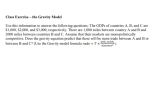 Class Exercise the Gravity Model Use this information to answer the following questions: The GDPs of countries A, B, and C are $1,000, $2,000, and S3,000, respectively. There are 1,000 miles between country A and B and 2000 miles between countries B and C. Assume that their markets are monopolistically competitive. Does the gravity equation predict that there wil be more trade between A and B or between B and C? (Use the Gravity model formula rade Tx nce GDP...
 QUESTION 7 In the gravity model of trade, if the distance between two countries is very large, the predicted trade flow should also be large. True or false? True False
 characteristic that tends to affect the probability of trade existing 6) According to the gravity model, a characteri between any two countries is A) their cultural affinity. B) the average weight/value of their traded goods. C) their colonial-historical ties. D) the distance between them. E) the number of different product varieties produ of different product varieties produced by their industries. 7) Why does the gravity model work? A) Large economies became large because they wer B) Large economies have relatively...
 2. The gravity model offers a logical explanation for the fact that (a) Trade between Asian countries and the US has grown faster than NAFTA trade (b) Trade in services has grown faster than trade in goods (c) Trade in manufactures has grown faster than in agricultural products (d) Intra-European Union trade exceeds international trade by the Europcan Union (c) The US trades more with Western Europe thant does with Canada 3. In general which of the following do NOT...
 Matching the concepts with their explanations A model shows that bilateral trade is directly based on economic sizes but indirectly affected by distance between two countries. A Ricardian Model A model states that international trade is a zero-sum game 2 Adam Smith view of International Trade and a country should maintain a positive trade balance. A trade model states that a country should export the goods for which it has the comparative advantage (lower opportunity cost) Neoclassical Model 3 Also...
 02. Critically discuss using examples whether Rigardian's model on international trade is suitable for all the countries or not.
 00:22 HB $BA (International Economics) The Ricardian Model: Trade Pattern Home has 1,200 units of labor available. It can produce two goods, apples and bananas. The unit labor requirement in apple production is 3, while in banana production it is 2. Foreign has a labor force of 800. Foreign's unit labor requirement in apple production is 5, while in banana production it is 1. a. What is the opportunity cost of apples in terms of bananas in Home? b. What...
 Class Exercise the Gravity Model Use this information to answer the following questions: The GDPs of countries A, B, and C are $1,000, $2,000, and S3,000, respectively. There are 1,000 miles between country A and B and 2000 miles between countries B and C. Assume that their markets are monopolistically competitive. Does the gravity equation predict that there wil be more trade between A and B or between B and C? (Use the Gravity model formula rade Tx nce GDP...
Most questions answered within 3 hours.
-
Where is the error in this code sequence?
String s1 = "Hello";
String s2 = "ello";...
asked 10 months ago -
Financial data for Joel de Paris, Inc., for last year
follow:
Joel de Paris, Inc.
Balance...
asked 10 months ago -
Consider this reaction:
Al2(SO4)3 (aq)+ BaCl3
(aq) Al2Cl6 (aq)- +
3BaSO4(s) . What is the...
asked 10 months ago -
Suppose that Savneet is considering increasing her
recent random sample from 20 car rentals to 40...
asked 10 months ago -
Trucks arrive at an unloading terminal at an average rate of 120
per hour.
Trucks arrive...
asked 10 months ago -
Why are methanol and ethanol completely soluble in water while
octanol is not very little soluble....
asked 10 months ago -
A facilities manager at a university reads in a research report
that the mean amount of...
asked 10 months ago -
When the CuSO4 is rehydrated by adding water to the anhydrous
compound, is this an endothermic...
asked 10 months ago -
A ray of sunlight is passing from diamond into crown glass; the
angle of incidence is...
asked 10 months ago -
A block of mass 0.249 kg is placed on top of a light, vertical
spring of...
asked 10 months ago -
how do the kidneys compensate in the presences of acidosis
a) trigger hyperventilate
b) reserve acid...
asked 10 months ago -
Question 501 pts
The rental rate of capital to the firm increases. Which of the
following...
asked 10 months ago