
Homework Answers
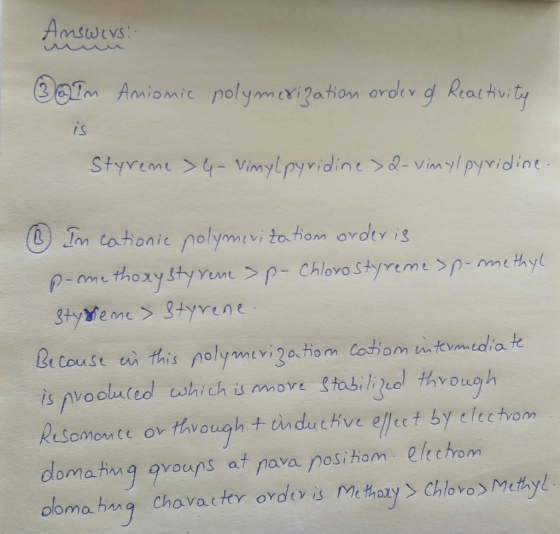
Add Answer to:
3. Predict the order of reactivity (and justify your prediction) of the given monomers. a. Styrene,...
Predict the order of reactivity (and justify your prediction) of the given monomers. a. Styrene, 2-vinylpyridine,...
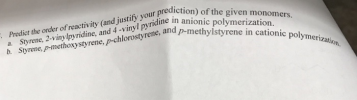 Predict the order of reactivity (and justify your prediction) of the given monomers. a. Styrene, 2-vinylpyridine, and 4-vinyl pyridine in anionic polymerization. and p-methylstyrene in cationic polymerizati Styrene, p-methoxystyrene, p-chlorostyrene, b.
Polymer Chemistry Arrange the following monomers in increasing order of reactivity,toward anionic polymerization and justify your...
 Polymer Chemistry
Arrange the following monomers in increasing order of reactivity,toward anionic polymerization and justify your answer. Arrange the following monomers in increasing order of reactivity toward cationic polymerization and justify your answer.
Polymer Chemistry
Arrange the following monomers in increasing order of reactivity,toward anionic polymerization and justify your answer. Arrange the following monomers in increasing order of reactivity toward cationic polymerization and justify your answer.
anionic polymerization
predict the order of reactivity (and justify your prediction) of the given monomers :styrene,p-methoxy styrene in anionic polymerization
question 4 please! b. BF3 +H20 d. NaNaphthalene e. H2S04 f. n-CaHgLi Consider the following monomers....
 question 4 please!
b. BF3 +H20 d. NaNaphthalene e. H2S04 f. n-CaHgLi Consider the following monomers. Indicate which type or types of addition polymerization (free radical, anionic, or cationic) could be effectively used to polymerize each and briefly explain your answer 4. a. CH2-CHPh b. CH2-C(CH3)2 c. CH2 CHO d. CH2-C(CH3)(COOCH3) e. CH2-CH2 f. CH2-CH(OCH,CHs) 8. CH-CH(CN)
question 4 please!
b. BF3 +H20 d. NaNaphthalene e. H2S04 f. n-CaHgLi Consider the following monomers. Indicate which type or types of addition polymerization (free radical, anionic, or cationic) could be effectively used to polymerize each and briefly explain your answer 4. a. CH2-CHPh b. CH2-C(CH3)2 c. CH2 CHO d. CH2-C(CH3)(COOCH3) e. CH2-CH2 f. CH2-CH(OCH,CHs) 8. CH-CH(CN)
Describe whic (2 pts) 2. Predict the order of reactivity with NaBH. (leas me order of...
 Describe whic (2 pts) 2. Predict the order of reactivity with NaBH. (leas me order of reactivity with NaBH (least reactive to most reactive). Explain(pis) o wo erechile Will fluores Swong elecophile cyclohexanecarbaldehyde benzaldehyde benzophenone 3. Calculate the oxidation state of the carbonyl carbon atom of benzophenone and the hydroxyl carbon atom of benzhydrol. Show all work for full credit. (4 pts) H OH benzophenone +1+0=2 benzhydrol ol10 D 5/2018
1.) What is the order of reactivity of the following reagents under SN1 conditions? Under SN2...
1.) What is the order of reactivity of the following reagents under SN1 conditions? Under SN2 conditions? Draw the structures of each using the bond line method and explain your answers. 1-methyl-1-bromocyclohexane, 1-bromopropane, 2-bromohexane 2.) What is the order of reactivity of the following reagents under SN1 conditions? Under SN2 conditions? Explain your answers. CH3CH=CHBr, CH3CH=CHCH2Br, CH3CH2CH2Br 3.) We did not use crotyl chloride in this experiment. However, based on your knowledge of SN1 and SN2 predict the behavior of...
Select the order that has the following nucleophiles correctly arranged with respect to increasing reactivity tow...
 Select the order that has the following nucleophiles correctly arranged with respect to increasing reactivity tow following substitution reaction Question 4 Nu: Nu Br DMF CHCоо CH3O CHзон 2 3 3 12 2 1 3 1 2 3 1 3 2 2 3 1 3 2 1 B increasing reactivity increasing C increasing reactivity increasing A increasing reactivity increasing D reactivity reactivity reactivity Ов O F Enter Your Answer: A D Choose the major product(s) of the following reaction Question...
Prediction: (b) Predict how many teaspoons of table sugar you will burn exercising your arm to...
 Prediction: (b) Predict how many teaspoons of table sugar you
will burn exercising your arm to exhaustion. Could you explain
prediction (b) in detail?
Inquiry Skills o Questioning Hypothesizing Predicting 4. Lift the dumb one time so th tical distance highest point of the dumbb of the dumbb 4 INVESTIGATION 2.2.1 Energy Consumption During Exercise In this investigation, you will compare your power during aerobic and anaerobic exercise and determine the amount of glucose that you consume. Question How does...
Prediction: (b) Predict how many teaspoons of table sugar you
will burn exercising your arm to exhaustion. Could you explain
prediction (b) in detail?
Inquiry Skills o Questioning Hypothesizing Predicting 4. Lift the dumb one time so th tical distance highest point of the dumbb of the dumbb 4 INVESTIGATION 2.2.1 Energy Consumption During Exercise In this investigation, you will compare your power during aerobic and anaerobic exercise and determine the amount of glucose that you consume. Question How does...
3. Predict and label the major and minor products from the following E2 reaction. Justify your...
 3. Predict and label the major and minor products from the following E2 reaction. Justify your answer with figures which demonstrate the transition state leading to the products obtained (4 points) 4. When the two constitutional isomers, 3,3-dimethyl-1-butene and 2,3-dimethyl-2-butene, are reacted with HCl the same major product is formed. Explain the observation and identify the product. (4 points) Scanned with CamScanner
Question 3: Predict which solutions will have a higher electrical conductivity. Justify your choice for full...
 Question 3: Predict which solutions will have a higher electrical conductivity. Justify your choice for full credit (4 pts) A. 0.200 M NaCl or 0.150 M CaCl2 B. 14.22 g of cobalt(II) nitrate in 57.8 mL of water or 9.528 g of copper (II) chloride in 32.9 mL of water.
 Predict the order of reactivity (and justify your prediction) of the given monomers. a. Styrene, 2-vinylpyridine, and 4-vinyl pyridine in anionic polymerization. and p-methylstyrene in cationic polymerizati Styrene, p-methoxystyrene, p-chlorostyrene, b.
 Polymer Chemistry
Arrange the following monomers in increasing order of reactivity,toward anionic polymerization and justify your answer. Arrange the following monomers in increasing order of reactivity toward cationic polymerization and justify your answer.
Polymer Chemistry
Arrange the following monomers in increasing order of reactivity,toward anionic polymerization and justify your answer. Arrange the following monomers in increasing order of reactivity toward cationic polymerization and justify your answer.
 question 4 please!
b. BF3 +H20 d. NaNaphthalene e. H2S04 f. n-CaHgLi Consider the following monomers. Indicate which type or types of addition polymerization (free radical, anionic, or cationic) could be effectively used to polymerize each and briefly explain your answer 4. a. CH2-CHPh b. CH2-C(CH3)2 c. CH2 CHO d. CH2-C(CH3)(COOCH3) e. CH2-CH2 f. CH2-CH(OCH,CHs) 8. CH-CH(CN)
question 4 please!
b. BF3 +H20 d. NaNaphthalene e. H2S04 f. n-CaHgLi Consider the following monomers. Indicate which type or types of addition polymerization (free radical, anionic, or cationic) could be effectively used to polymerize each and briefly explain your answer 4. a. CH2-CHPh b. CH2-C(CH3)2 c. CH2 CHO d. CH2-C(CH3)(COOCH3) e. CH2-CH2 f. CH2-CH(OCH,CHs) 8. CH-CH(CN)
 Describe whic (2 pts) 2. Predict the order of reactivity with NaBH. (leas me order of reactivity with NaBH (least reactive to most reactive). Explain(pis) o wo erechile Will fluores Swong elecophile cyclohexanecarbaldehyde benzaldehyde benzophenone 3. Calculate the oxidation state of the carbonyl carbon atom of benzophenone and the hydroxyl carbon atom of benzhydrol. Show all work for full credit. (4 pts) H OH benzophenone +1+0=2 benzhydrol ol10 D 5/2018
 Select the order that has the following nucleophiles correctly arranged with respect to increasing reactivity tow following substitution reaction Question 4 Nu: Nu Br DMF CHCоо CH3O CHзон 2 3 3 12 2 1 3 1 2 3 1 3 2 2 3 1 3 2 1 B increasing reactivity increasing C increasing reactivity increasing A increasing reactivity increasing D reactivity reactivity reactivity Ов O F Enter Your Answer: A D Choose the major product(s) of the following reaction Question...
 Prediction: (b) Predict how many teaspoons of table sugar you
will burn exercising your arm to exhaustion. Could you explain
prediction (b) in detail?
Inquiry Skills o Questioning Hypothesizing Predicting 4. Lift the dumb one time so th tical distance highest point of the dumbb of the dumbb 4 INVESTIGATION 2.2.1 Energy Consumption During Exercise In this investigation, you will compare your power during aerobic and anaerobic exercise and determine the amount of glucose that you consume. Question How does...
Prediction: (b) Predict how many teaspoons of table sugar you
will burn exercising your arm to exhaustion. Could you explain
prediction (b) in detail?
Inquiry Skills o Questioning Hypothesizing Predicting 4. Lift the dumb one time so th tical distance highest point of the dumbb of the dumbb 4 INVESTIGATION 2.2.1 Energy Consumption During Exercise In this investigation, you will compare your power during aerobic and anaerobic exercise and determine the amount of glucose that you consume. Question How does...
 3. Predict and label the major and minor products from the following E2 reaction. Justify your answer with figures which demonstrate the transition state leading to the products obtained (4 points) 4. When the two constitutional isomers, 3,3-dimethyl-1-butene and 2,3-dimethyl-2-butene, are reacted with HCl the same major product is formed. Explain the observation and identify the product. (4 points) Scanned with CamScanner
 Question 3: Predict which solutions will have a higher electrical conductivity. Justify your choice for full credit (4 pts) A. 0.200 M NaCl or 0.150 M CaCl2 B. 14.22 g of cobalt(II) nitrate in 57.8 mL of water or 9.528 g of copper (II) chloride in 32.9 mL of water.
Most questions answered within 3 hours.
-
Where is the error in this code sequence?
String s1 = "Hello";
String s2 = "ello";...
asked 10 months ago -
Financial data for Joel de Paris, Inc., for last year
follow:
Joel de Paris, Inc.
Balance...
asked 10 months ago -
Consider this reaction:
Al2(SO4)3 (aq)+ BaCl3
(aq) Al2Cl6 (aq)- +
3BaSO4(s) . What is the...
asked 10 months ago -
Suppose that Savneet is considering increasing her
recent random sample from 20 car rentals to 40...
asked 10 months ago -
Trucks arrive at an unloading terminal at an average rate of 120
per hour.
Trucks arrive...
asked 10 months ago -
Why are methanol and ethanol completely soluble in water while
octanol is not very little soluble....
asked 10 months ago -
A facilities manager at a university reads in a research report
that the mean amount of...
asked 10 months ago -
When the CuSO4 is rehydrated by adding water to the anhydrous
compound, is this an endothermic...
asked 10 months ago -
A ray of sunlight is passing from diamond into crown glass; the
angle of incidence is...
asked 10 months ago -
A block of mass 0.249 kg is placed on top of a light, vertical
spring of...
asked 10 months ago -
how do the kidneys compensate in the presences of acidosis
a) trigger hyperventilate
b) reserve acid...
asked 10 months ago -
Question 501 pts
The rental rate of capital to the firm increases. Which of the
following...
asked 10 months ago