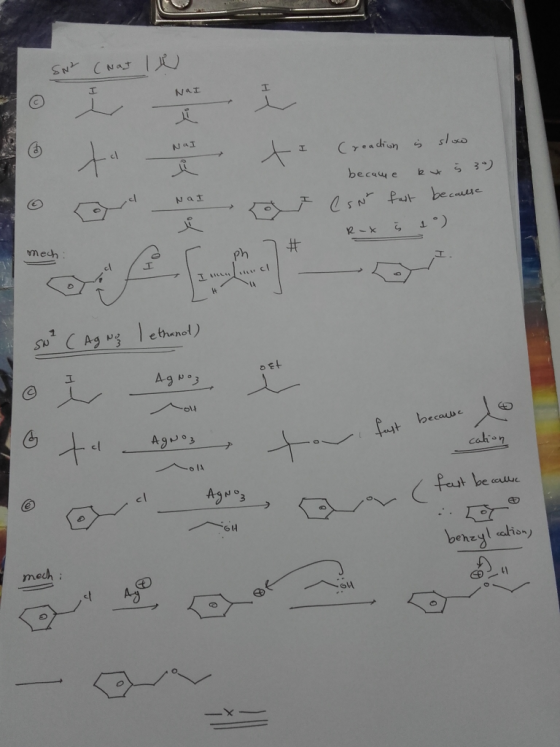
 Write the potential sn2 and sn1 reaction as well as the potential
the sn2 and sn1 mechanism. Then state which reaction(s) will occur
if any, and why?
Write the potential sn2 and sn1 reaction as well as the potential
the sn2 and sn1 mechanism. Then state which reaction(s) will occur
if any, and why?Homework Answers
Add Answer to:
Write the potential sn2 and sn1 reaction as well as the potential
the sn2 and sn1...
Write the potential sn2 and sn1 reaction as well as the potential the sn2 and sn1...
 Write
the potential sn2 and sn1 reaction as well as the potential the sn2
and sn1 mechanism. Then state which reaction(s) will occur if any,
and why?
with NaI/acetone and AgNO3/ethanol
1) t-butyl bromide J) benzyl bromide K) bromobenzene
Write
the potential sn2 and sn1 reaction as well as the potential the sn2
and sn1 mechanism. Then state which reaction(s) will occur if any,
and why?
with NaI/acetone and AgNO3/ethanol
1) t-butyl bromide J) benzyl bromide K) bromobenzene
Write the potential sn2 and sn1 reaction as well as the potential the sn2 and sn1...
 Write
the potential sn2 and sn1 reaction as well as the potential the sn2
and sn1 mechanism. Then state which reaction(s) will occur if any,
and why?
with naI/acetone and with AgNO3/ethanol
F) chlorobenzene G) 1-bromobutane H) 2-bromobutane
Write
the potential sn2 and sn1 reaction as well as the potential the sn2
and sn1 mechanism. Then state which reaction(s) will occur if any,
and why?
with naI/acetone and with AgNO3/ethanol
F) chlorobenzene G) 1-bromobutane H) 2-bromobutane
Draw both the SN1 (AgNO3 in ethanol) and the SN2 (NaI in acetone) mechanisms (include intermediates,...
Draw both the SN1 (AgNO3 in ethanol) and the SN2 (NaI in acetone) mechanisms (include intermediates, arrows etc.) for each of the following alkyl halides. 1) bromocyclohexane, 2) t-butyl chloride, 3) crotyl chloride, 4) benzyl chloride
1. In both the sodium iodide test and the silver nitrate test, why does 2-bromobutane react faster...
 1. In both the sodium iodide
test and the silver nitrate test, why does 2-bromobutane react
faster than 2-chlorobutane?
Bromine is a better leaving group since it is a weaker base than
chlorine is.
2. a. Why does benzyl chloride react under both
SN1 and SN2 conditions?
Benzyl
chloride is a primary alkyl halide, hence reactive under SN2
conditions.
The
primary carbocation formed due to the departure of Cl- is
stabilized by the pi electrons in the benzene ring.
b. Why is...
1. In both the sodium iodide
test and the silver nitrate test, why does 2-bromobutane react
faster than 2-chlorobutane?
Bromine is a better leaving group since it is a weaker base than
chlorine is.
2. a. Why does benzyl chloride react under both
SN1 and SN2 conditions?
Benzyl
chloride is a primary alkyl halide, hence reactive under SN2
conditions.
The
primary carbocation formed due to the departure of Cl- is
stabilized by the pi electrons in the benzene ring.
b. Why is...
Hi, I have a question regarding SN1 and SN2 reactions: Using curved arrow formalism, draw out...
Hi, I have a question regarding SN1 and SN2 reactions: Using curved arrow formalism, draw out the mechanisms for these two reactions: 1. The SN1 reaction between t-bromobutane and 1% ethanol AgNO3 2. The SN2 reaction between 1-chlorohexadecane and 18% NaI in acetone Thanks!
Nucleophilic substitutions, mainly just need the arrangements, and the drawn out reaction equations CHEM 220L Laboratory...
 Nucleophilic substitutions, mainly just need the arrangements,
and the drawn out reaction equations
CHEM 220L Laboratory Manual (S.A. Cummings & J.K. Mahoney) CHEM 220L Data Sheet: Nucleophilic Substitutions (SN1 and SN2) (6 points) Part 1. Enter the results of each test into the table below: Alkyl Halides 10, 2 or 3? SN2 (Nal/acetone) 1-chlorobutane 1-bromobutane 2-chlorobutane 2-bromobutane bromocyclohexane 2-chloro-2-methylpropane (t-butyl chloride) Crotyl chloride Benzyl chloride (a-chlorotoluene) Arrange the alkyl halides in order of reactivity (from most to least reactive) with...
Nucleophilic substitutions, mainly just need the arrangements,
and the drawn out reaction equations
CHEM 220L Laboratory Manual (S.A. Cummings & J.K. Mahoney) CHEM 220L Data Sheet: Nucleophilic Substitutions (SN1 and SN2) (6 points) Part 1. Enter the results of each test into the table below: Alkyl Halides 10, 2 or 3? SN2 (Nal/acetone) 1-chlorobutane 1-bromobutane 2-chlorobutane 2-bromobutane bromocyclohexane 2-chloro-2-methylpropane (t-butyl chloride) Crotyl chloride Benzyl chloride (a-chlorotoluene) Arrange the alkyl halides in order of reactivity (from most to least reactive) with...
For the Reactions that formed precipitates, what are the drawn out reaction equations with stereochemistry if...
 For the Reactions that formed precipitates, what are the drawn
out reaction equations with stereochemistry if applicable?
Part 1. Enter the results of each test into the table below: 1°, 2° or 3°? Alkyl Halides 1-chlorobutane Sn2 (Nal/acetone) Precipitate formed 1-bromobutane Precipitate formed 2-chlorobutane No precipitate formed 2-bromobutane No precipitate formed bromocyclohexane No precipitate formed 2-chloro-2-methylpropane (t-butyl chloride) No precipitate formed Crotyl chloride No precipitate formed Benzyl chloride (a-chlorotoluene) No precipitate formed Arrange the alkyl halides in order of reactivity...
For the Reactions that formed precipitates, what are the drawn
out reaction equations with stereochemistry if applicable?
Part 1. Enter the results of each test into the table below: 1°, 2° or 3°? Alkyl Halides 1-chlorobutane Sn2 (Nal/acetone) Precipitate formed 1-bromobutane Precipitate formed 2-chlorobutane No precipitate formed 2-bromobutane No precipitate formed bromocyclohexane No precipitate formed 2-chloro-2-methylpropane (t-butyl chloride) No precipitate formed Crotyl chloride No precipitate formed Benzyl chloride (a-chlorotoluene) No precipitate formed Arrange the alkyl halides in order of reactivity...
3) Write a complete Sn1 mechanism for the following reaction Also, 4) Write a complete Sn2...
 3) Write a complete Sn1 mechanism for the following
reaction
Also,
4) Write a complete Sn2 mechanism for the following.
Please show transition state and list a good solvent as well.
Thank you!
3. Write a complete Sn1 mechanism for the following reaction. Вт + CH3OH CH₃CH2 CH3 4. Write a complete SN2 mechanism for the following. Show the transition state as well. Also list a good solvent. OTS + NaCN H3C 3. Write a complete sul mechanism for the...
3) Write a complete Sn1 mechanism for the following
reaction
Also,
4) Write a complete Sn2 mechanism for the following.
Please show transition state and list a good solvent as well.
Thank you!
3. Write a complete Sn1 mechanism for the following reaction. Вт + CH3OH CH₃CH2 CH3 4. Write a complete SN2 mechanism for the following. Show the transition state as well. Also list a good solvent. OTS + NaCN H3C 3. Write a complete sul mechanism for the...
What kind of reaction is this? SN1, SN2, E1? Please solve and include a transition state...
 What kind of reaction is this? SN1, SN2, E1? Please solve and
include a transition state if there is one. Thank you!
2. Propose a reasonable mechanism, using curved arrow notation, for the following transformation. Include a structure for any transition state. AgNO3 Eto X Br ethanol
What kind of reaction is this? SN1, SN2, E1? Please solve and
include a transition state if there is one. Thank you!
2. Propose a reasonable mechanism, using curved arrow notation, for the following transformation. Include a structure for any transition state. AgNO3 Eto X Br ethanol
find products for the following interactions and identify the mechanism as sn1, sn2, e1, or e2...
 find products for the following interactions and identify the
mechanism as sn1, sn2, e1, or e2
A) 2-Iodo-2-phenyl butane + water CH3-CHO-Na+ / ethanol B) 2-Chloro-2-methyl propane + СН3 H3C CH C) 1-Chloro pentane + Nal / acetone + Concentrated H.SO. (No Water added) -----> D) 2-phenylbutan-2-ol ОН 10 pts) E) Write a complete mechanism for Reaction D above Be sure to show the intermediate or transition state.
find products for the following interactions and identify the
mechanism as sn1, sn2, e1, or e2
A) 2-Iodo-2-phenyl butane + water CH3-CHO-Na+ / ethanol B) 2-Chloro-2-methyl propane + СН3 H3C CH C) 1-Chloro pentane + Nal / acetone + Concentrated H.SO. (No Water added) -----> D) 2-phenylbutan-2-ol ОН 10 pts) E) Write a complete mechanism for Reaction D above Be sure to show the intermediate or transition state.
 Write
the potential sn2 and sn1 reaction as well as the potential the sn2
and sn1 mechanism. Then state which reaction(s) will occur if any,
and why?
with NaI/acetone and AgNO3/ethanol
1) t-butyl bromide J) benzyl bromide K) bromobenzene
Write
the potential sn2 and sn1 reaction as well as the potential the sn2
and sn1 mechanism. Then state which reaction(s) will occur if any,
and why?
with NaI/acetone and AgNO3/ethanol
1) t-butyl bromide J) benzyl bromide K) bromobenzene
 Write
the potential sn2 and sn1 reaction as well as the potential the sn2
and sn1 mechanism. Then state which reaction(s) will occur if any,
and why?
with naI/acetone and with AgNO3/ethanol
F) chlorobenzene G) 1-bromobutane H) 2-bromobutane
Write
the potential sn2 and sn1 reaction as well as the potential the sn2
and sn1 mechanism. Then state which reaction(s) will occur if any,
and why?
with naI/acetone and with AgNO3/ethanol
F) chlorobenzene G) 1-bromobutane H) 2-bromobutane
 1. In both the sodium iodide
test and the silver nitrate test, why does 2-bromobutane react
faster than 2-chlorobutane?
Bromine is a better leaving group since it is a weaker base than
chlorine is.
2. a. Why does benzyl chloride react under both
SN1 and SN2 conditions?
Benzyl
chloride is a primary alkyl halide, hence reactive under SN2
conditions.
The
primary carbocation formed due to the departure of Cl- is
stabilized by the pi electrons in the benzene ring.
b. Why is...
1. In both the sodium iodide
test and the silver nitrate test, why does 2-bromobutane react
faster than 2-chlorobutane?
Bromine is a better leaving group since it is a weaker base than
chlorine is.
2. a. Why does benzyl chloride react under both
SN1 and SN2 conditions?
Benzyl
chloride is a primary alkyl halide, hence reactive under SN2
conditions.
The
primary carbocation formed due to the departure of Cl- is
stabilized by the pi electrons in the benzene ring.
b. Why is...
 Nucleophilic substitutions, mainly just need the arrangements,
and the drawn out reaction equations
CHEM 220L Laboratory Manual (S.A. Cummings & J.K. Mahoney) CHEM 220L Data Sheet: Nucleophilic Substitutions (SN1 and SN2) (6 points) Part 1. Enter the results of each test into the table below: Alkyl Halides 10, 2 or 3? SN2 (Nal/acetone) 1-chlorobutane 1-bromobutane 2-chlorobutane 2-bromobutane bromocyclohexane 2-chloro-2-methylpropane (t-butyl chloride) Crotyl chloride Benzyl chloride (a-chlorotoluene) Arrange the alkyl halides in order of reactivity (from most to least reactive) with...
Nucleophilic substitutions, mainly just need the arrangements,
and the drawn out reaction equations
CHEM 220L Laboratory Manual (S.A. Cummings & J.K. Mahoney) CHEM 220L Data Sheet: Nucleophilic Substitutions (SN1 and SN2) (6 points) Part 1. Enter the results of each test into the table below: Alkyl Halides 10, 2 or 3? SN2 (Nal/acetone) 1-chlorobutane 1-bromobutane 2-chlorobutane 2-bromobutane bromocyclohexane 2-chloro-2-methylpropane (t-butyl chloride) Crotyl chloride Benzyl chloride (a-chlorotoluene) Arrange the alkyl halides in order of reactivity (from most to least reactive) with...
 For the Reactions that formed precipitates, what are the drawn
out reaction equations with stereochemistry if applicable?
Part 1. Enter the results of each test into the table below: 1°, 2° or 3°? Alkyl Halides 1-chlorobutane Sn2 (Nal/acetone) Precipitate formed 1-bromobutane Precipitate formed 2-chlorobutane No precipitate formed 2-bromobutane No precipitate formed bromocyclohexane No precipitate formed 2-chloro-2-methylpropane (t-butyl chloride) No precipitate formed Crotyl chloride No precipitate formed Benzyl chloride (a-chlorotoluene) No precipitate formed Arrange the alkyl halides in order of reactivity...
For the Reactions that formed precipitates, what are the drawn
out reaction equations with stereochemistry if applicable?
Part 1. Enter the results of each test into the table below: 1°, 2° or 3°? Alkyl Halides 1-chlorobutane Sn2 (Nal/acetone) Precipitate formed 1-bromobutane Precipitate formed 2-chlorobutane No precipitate formed 2-bromobutane No precipitate formed bromocyclohexane No precipitate formed 2-chloro-2-methylpropane (t-butyl chloride) No precipitate formed Crotyl chloride No precipitate formed Benzyl chloride (a-chlorotoluene) No precipitate formed Arrange the alkyl halides in order of reactivity...
 3) Write a complete Sn1 mechanism for the following
reaction
Also,
4) Write a complete Sn2 mechanism for the following.
Please show transition state and list a good solvent as well.
Thank you!
3. Write a complete Sn1 mechanism for the following reaction. Вт + CH3OH CH₃CH2 CH3 4. Write a complete SN2 mechanism for the following. Show the transition state as well. Also list a good solvent. OTS + NaCN H3C 3. Write a complete sul mechanism for the...
3) Write a complete Sn1 mechanism for the following
reaction
Also,
4) Write a complete Sn2 mechanism for the following.
Please show transition state and list a good solvent as well.
Thank you!
3. Write a complete Sn1 mechanism for the following reaction. Вт + CH3OH CH₃CH2 CH3 4. Write a complete SN2 mechanism for the following. Show the transition state as well. Also list a good solvent. OTS + NaCN H3C 3. Write a complete sul mechanism for the...
 What kind of reaction is this? SN1, SN2, E1? Please solve and
include a transition state if there is one. Thank you!
2. Propose a reasonable mechanism, using curved arrow notation, for the following transformation. Include a structure for any transition state. AgNO3 Eto X Br ethanol
What kind of reaction is this? SN1, SN2, E1? Please solve and
include a transition state if there is one. Thank you!
2. Propose a reasonable mechanism, using curved arrow notation, for the following transformation. Include a structure for any transition state. AgNO3 Eto X Br ethanol
 find products for the following interactions and identify the
mechanism as sn1, sn2, e1, or e2
A) 2-Iodo-2-phenyl butane + water CH3-CHO-Na+ / ethanol B) 2-Chloro-2-methyl propane + СН3 H3C CH C) 1-Chloro pentane + Nal / acetone + Concentrated H.SO. (No Water added) -----> D) 2-phenylbutan-2-ol ОН 10 pts) E) Write a complete mechanism for Reaction D above Be sure to show the intermediate or transition state.
find products for the following interactions and identify the
mechanism as sn1, sn2, e1, or e2
A) 2-Iodo-2-phenyl butane + water CH3-CHO-Na+ / ethanol B) 2-Chloro-2-methyl propane + СН3 H3C CH C) 1-Chloro pentane + Nal / acetone + Concentrated H.SO. (No Water added) -----> D) 2-phenylbutan-2-ol ОН 10 pts) E) Write a complete mechanism for Reaction D above Be sure to show the intermediate or transition state.
Most questions answered within 3 hours.
-
Where is the error in this code sequence?
String s1 = "Hello";
String s2 = "ello";...
asked 10 months ago -
Financial data for Joel de Paris, Inc., for last year
follow:
Joel de Paris, Inc.
Balance...
asked 10 months ago -
Consider this reaction:
Al2(SO4)3 (aq)+ BaCl3
(aq) Al2Cl6 (aq)- +
3BaSO4(s) . What is the...
asked 10 months ago -
Suppose that Savneet is considering increasing her
recent random sample from 20 car rentals to 40...
asked 10 months ago -
Trucks arrive at an unloading terminal at an average rate of 120
per hour.
Trucks arrive...
asked 10 months ago -
Why are methanol and ethanol completely soluble in water while
octanol is not very little soluble....
asked 10 months ago -
A facilities manager at a university reads in a research report
that the mean amount of...
asked 10 months ago -
When the CuSO4 is rehydrated by adding water to the anhydrous
compound, is this an endothermic...
asked 10 months ago -
A ray of sunlight is passing from diamond into crown glass; the
angle of incidence is...
asked 10 months ago -
A block of mass 0.249 kg is placed on top of a light, vertical
spring of...
asked 10 months ago -
how do the kidneys compensate in the presences of acidosis
a) trigger hyperventilate
b) reserve acid...
asked 10 months ago -
Question 501 pts
The rental rate of capital to the firm increases. Which of the
following...
asked 10 months ago