
Homework Answers

Add Answer to:
Sample 2 1. Chose the correct answer. How many molecules participate in monomolecular interaction? a) a...
ch 14 answer each of these. answer all 3 please HI HCI reactants Reaction intermediates are...
 ch 14 answer each of these.
answer all 3 please
HI HCI reactants Reaction intermediates are species that are formed in one step of a mechanism and consumed in another step. For example, can act as an intermediate in the following reaction: H2(g) + 2Cl(g) + 2HCl(g) + 12(g). You can often express the concentration of in terms of the concentrations of the of the overall reaction to be consistent with the experimentally observed rate law as the overall reaction...
ch 14 answer each of these.
answer all 3 please
HI HCI reactants Reaction intermediates are species that are formed in one step of a mechanism and consumed in another step. For example, can act as an intermediate in the following reaction: H2(g) + 2Cl(g) + 2HCl(g) + 12(g). You can often express the concentration of in terms of the concentrations of the of the overall reaction to be consistent with the experimentally observed rate law as the overall reaction...
biochemistry if you could please help me answer the following questions! * 1. (5 pts) Which...
 biochemistry
if you could please help me answer the following questions!
* 1. (5 pts) Which of the following is a catalytic mechanism utilize by enzymes? Multiple answers may be correct. Select all that are correct. 1. Acid-base a) acid-base catalysis d. metal-ion catalysis 12. Covalent b covalent catalysis e. transition state binding c. heterogeneou 3. Metalion . Proximin onentation, E 2. 76 pts) What is the "steady-state" assumption in the derivation of the s.clectrosch? Tynsin Michaelis-Menten equation? Sie binding...
biochemistry
if you could please help me answer the following questions!
* 1. (5 pts) Which of the following is a catalytic mechanism utilize by enzymes? Multiple answers may be correct. Select all that are correct. 1. Acid-base a) acid-base catalysis d. metal-ion catalysis 12. Covalent b covalent catalysis e. transition state binding c. heterogeneou 3. Metalion . Proximin onentation, E 2. 76 pts) What is the "steady-state" assumption in the derivation of the s.clectrosch? Tynsin Michaelis-Menten equation? Sie binding...
Choose the correct answer from the list below. is a type of mathematical model that describes...
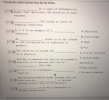 Choose the correct answer from the list below. is a type of mathematical model that describes the kinetics of many enzymes. The study of rates of chemical reactions. A -> P is an example of a reaction. A. Substrate B. first-order At , there is no net change in the concentration of substrate or product. C. Vmax D. k-2 The value Vo is called the of a reaction. E. initial velocity F. second-order - One way to measure the rate...
Which of the following molecules could participate in hydrogen bonding? Question 1 options: A) CH4 B)...
Which of the following molecules could participate in hydrogen bonding? Question 1 options: A) CH4 B) CH3NH2 C) CH2O D) C2H5OH E) HF F) H2O G) CO2 H) HCl I) CH3OCH3 Question 2 (2 points) Question 2 options: For the reaction CH4 + O2 →CO2 + H2OCH4 + O2 →CO2 + H2O what are the coefficients for each reactant or product? a. CH4 b. O2 c. CO2 d. H2O Question 3 (2 points) Question 3 options: For the reaction NaOH + AlCl3...
can someone please walk me through why these are the correct answers for 1, 2, and...
 can someone please walk me
through why these are the correct answers for 1, 2, and 3.
Appreciate it.
5 points each Use the reaction shown below to answer questions 1-3 SO2CH3 methanol NaS Compound Y Compound X 1. What is(are) the major product(s) from the reaction shown above? A) None. There is no reaction B) D) Both B and C 2. How will the rate of the reaction change if Compound Y is exchanged for the species shown below?...
can someone please walk me
through why these are the correct answers for 1, 2, and 3.
Appreciate it.
5 points each Use the reaction shown below to answer questions 1-3 SO2CH3 methanol NaS Compound Y Compound X 1. What is(are) the major product(s) from the reaction shown above? A) None. There is no reaction B) D) Both B and C 2. How will the rate of the reaction change if Compound Y is exchanged for the species shown below?...
Please correct answer each questions before submit.thank you Which of the following molecules are chiral? L...
 Please correct answer each questions before submit.thank
you
Which of the following molecules are chiral? L cis-1 Bromo-1-methylcyclohexane ill trans-1-Bromo 3 methylcyclohexane M.ais-1-Bromo-3-methylcyclohexane C. I, M D. lll, IV 12. What is the major product of this reaction? NaoCH2CH3 (A) CH3 CH2CH3 CH3 CH3 CH3
Please correct answer each questions before submit.thank
you
Which of the following molecules are chiral? L cis-1 Bromo-1-methylcyclohexane ill trans-1-Bromo 3 methylcyclohexane M.ais-1-Bromo-3-methylcyclohexane C. I, M D. lll, IV 12. What is the major product of this reaction? NaoCH2CH3 (A) CH3 CH2CH3 CH3 CH3 CH3
1.. How many different molecules are there with distinct properties with the molecular formula C2H5F? (Hint:...
1.. How many different molecules are there with distinct properties with the molecular formula C2H5F? (Hint: Draw a lewis structure. Consider if the C-C bond can rotate) Group of answer choices A. 1 B. 2 C. 4 D. 3 2.. How many different molecules are there with distinct properties with the molecular formula C2H2F2? (Hint: Draw a lewis structure. Consider if the C-C bond can rotate) Group of answer choices A. 2 B. 3 C. 1 D. 4 3.. Which statement...
Part 2 (1 point) Rate 2 = molecules/(cm3·s) Part 3 Rate 3 = molecules/(cm3·s) Part 4 Rate...
 Part 2 (1 point)
Rate 2 = molecules/(cm3·s)
Part 3
Rate 3 = molecules/(cm3·s)
Part 4
Rate 4 = molecules/(cm3·s)
@ See page 639 02 Question (4 points) Dinitrogen pentoxide (N2O5) decomposes as follows to nitrogen dioxide and nitrogen trioxide: N,93(g) — NO2(g) + NO3(g) Calculate the average rate of the reaction between consecutive measurement times in the following table. Time (s) [N2O5] (molecules/cm3) 0.00 1.505x10¹² 1.55 1.444x10¹² 3.10 1.401x10¹² 4.65 1.370x10¹² 1.349x10¹² 6.20 v 1st attempt Part 1 (1 point)...
Part 2 (1 point)
Rate 2 = molecules/(cm3·s)
Part 3
Rate 3 = molecules/(cm3·s)
Part 4
Rate 4 = molecules/(cm3·s)
@ See page 639 02 Question (4 points) Dinitrogen pentoxide (N2O5) decomposes as follows to nitrogen dioxide and nitrogen trioxide: N,93(g) — NO2(g) + NO3(g) Calculate the average rate of the reaction between consecutive measurement times in the following table. Time (s) [N2O5] (molecules/cm3) 0.00 1.505x10¹² 1.55 1.444x10¹² 3.10 1.401x10¹² 4.65 1.370x10¹² 1.349x10¹² 6.20 v 1st attempt Part 1 (1 point)...
Part 2 Multiple Choice. Select the best answer for each of the questions below: 1. Which...
 Part 2 Multiple Choice. Select the best answer for each of the questions below: 1. Which of these molecules is not an electrophile? a) CH4 b) CH3+ c) H* d) BF3 2. Which of these molecules is not a nucleophile ? a) NH3 b) OH c) CN d) H* 3. Water behaves as: a) a nucleophile b) an electrophile c) both d) neither 4. The SN2 reaction has how many steps? a) 1 b) 2 c) 3 d) 4 5....
1. Consider the three molecules below to answer the following questions. Circle TRUE or FALSE at...
 1. Consider the three molecules below to answer the following questions. Circle TRUE or FALSE at the end of each question (0.5 points each). Molecule A Molecule C Molecule B A. The rate of EAS with Molecule B will be faster than the rate of EAS with Molecule A (assume MAJOR product formation). TRUE or FALSE B. Molecule C will undergo nitration to yield a meta-product that is the MAJOR product. TRUE or FALSE c. The rate of meta-product formation...
 ch 14 answer each of these.
answer all 3 please
HI HCI reactants Reaction intermediates are species that are formed in one step of a mechanism and consumed in another step. For example, can act as an intermediate in the following reaction: H2(g) + 2Cl(g) + 2HCl(g) + 12(g). You can often express the concentration of in terms of the concentrations of the of the overall reaction to be consistent with the experimentally observed rate law as the overall reaction...
ch 14 answer each of these.
answer all 3 please
HI HCI reactants Reaction intermediates are species that are formed in one step of a mechanism and consumed in another step. For example, can act as an intermediate in the following reaction: H2(g) + 2Cl(g) + 2HCl(g) + 12(g). You can often express the concentration of in terms of the concentrations of the of the overall reaction to be consistent with the experimentally observed rate law as the overall reaction...
 biochemistry
if you could please help me answer the following questions!
* 1. (5 pts) Which of the following is a catalytic mechanism utilize by enzymes? Multiple answers may be correct. Select all that are correct. 1. Acid-base a) acid-base catalysis d. metal-ion catalysis 12. Covalent b covalent catalysis e. transition state binding c. heterogeneou 3. Metalion . Proximin onentation, E 2. 76 pts) What is the "steady-state" assumption in the derivation of the s.clectrosch? Tynsin Michaelis-Menten equation? Sie binding...
biochemistry
if you could please help me answer the following questions!
* 1. (5 pts) Which of the following is a catalytic mechanism utilize by enzymes? Multiple answers may be correct. Select all that are correct. 1. Acid-base a) acid-base catalysis d. metal-ion catalysis 12. Covalent b covalent catalysis e. transition state binding c. heterogeneou 3. Metalion . Proximin onentation, E 2. 76 pts) What is the "steady-state" assumption in the derivation of the s.clectrosch? Tynsin Michaelis-Menten equation? Sie binding...
 Choose the correct answer from the list below. is a type of mathematical model that describes the kinetics of many enzymes. The study of rates of chemical reactions. A -> P is an example of a reaction. A. Substrate B. first-order At , there is no net change in the concentration of substrate or product. C. Vmax D. k-2 The value Vo is called the of a reaction. E. initial velocity F. second-order - One way to measure the rate...
 can someone please walk me
through why these are the correct answers for 1, 2, and 3.
Appreciate it.
5 points each Use the reaction shown below to answer questions 1-3 SO2CH3 methanol NaS Compound Y Compound X 1. What is(are) the major product(s) from the reaction shown above? A) None. There is no reaction B) D) Both B and C 2. How will the rate of the reaction change if Compound Y is exchanged for the species shown below?...
can someone please walk me
through why these are the correct answers for 1, 2, and 3.
Appreciate it.
5 points each Use the reaction shown below to answer questions 1-3 SO2CH3 methanol NaS Compound Y Compound X 1. What is(are) the major product(s) from the reaction shown above? A) None. There is no reaction B) D) Both B and C 2. How will the rate of the reaction change if Compound Y is exchanged for the species shown below?...
 Please correct answer each questions before submit.thank
you
Which of the following molecules are chiral? L cis-1 Bromo-1-methylcyclohexane ill trans-1-Bromo 3 methylcyclohexane M.ais-1-Bromo-3-methylcyclohexane C. I, M D. lll, IV 12. What is the major product of this reaction? NaoCH2CH3 (A) CH3 CH2CH3 CH3 CH3 CH3
Please correct answer each questions before submit.thank
you
Which of the following molecules are chiral? L cis-1 Bromo-1-methylcyclohexane ill trans-1-Bromo 3 methylcyclohexane M.ais-1-Bromo-3-methylcyclohexane C. I, M D. lll, IV 12. What is the major product of this reaction? NaoCH2CH3 (A) CH3 CH2CH3 CH3 CH3 CH3
 Part 2 (1 point)
Rate 2 = molecules/(cm3·s)
Part 3
Rate 3 = molecules/(cm3·s)
Part 4
Rate 4 = molecules/(cm3·s)
@ See page 639 02 Question (4 points) Dinitrogen pentoxide (N2O5) decomposes as follows to nitrogen dioxide and nitrogen trioxide: N,93(g) — NO2(g) + NO3(g) Calculate the average rate of the reaction between consecutive measurement times in the following table. Time (s) [N2O5] (molecules/cm3) 0.00 1.505x10¹² 1.55 1.444x10¹² 3.10 1.401x10¹² 4.65 1.370x10¹² 1.349x10¹² 6.20 v 1st attempt Part 1 (1 point)...
Part 2 (1 point)
Rate 2 = molecules/(cm3·s)
Part 3
Rate 3 = molecules/(cm3·s)
Part 4
Rate 4 = molecules/(cm3·s)
@ See page 639 02 Question (4 points) Dinitrogen pentoxide (N2O5) decomposes as follows to nitrogen dioxide and nitrogen trioxide: N,93(g) — NO2(g) + NO3(g) Calculate the average rate of the reaction between consecutive measurement times in the following table. Time (s) [N2O5] (molecules/cm3) 0.00 1.505x10¹² 1.55 1.444x10¹² 3.10 1.401x10¹² 4.65 1.370x10¹² 1.349x10¹² 6.20 v 1st attempt Part 1 (1 point)...
 Part 2 Multiple Choice. Select the best answer for each of the questions below: 1. Which of these molecules is not an electrophile? a) CH4 b) CH3+ c) H* d) BF3 2. Which of these molecules is not a nucleophile ? a) NH3 b) OH c) CN d) H* 3. Water behaves as: a) a nucleophile b) an electrophile c) both d) neither 4. The SN2 reaction has how many steps? a) 1 b) 2 c) 3 d) 4 5....
 1. Consider the three molecules below to answer the following questions. Circle TRUE or FALSE at the end of each question (0.5 points each). Molecule A Molecule C Molecule B A. The rate of EAS with Molecule B will be faster than the rate of EAS with Molecule A (assume MAJOR product formation). TRUE or FALSE B. Molecule C will undergo nitration to yield a meta-product that is the MAJOR product. TRUE or FALSE c. The rate of meta-product formation...
Most questions answered within 3 hours.
-
Where is the error in this code sequence?
String s1 = "Hello";
String s2 = "ello";...
asked 10 months ago -
Financial data for Joel de Paris, Inc., for last year
follow:
Joel de Paris, Inc.
Balance...
asked 10 months ago -
Consider this reaction:
Al2(SO4)3 (aq)+ BaCl3
(aq) Al2Cl6 (aq)- +
3BaSO4(s) . What is the...
asked 10 months ago -
Suppose that Savneet is considering increasing her
recent random sample from 20 car rentals to 40...
asked 10 months ago -
Trucks arrive at an unloading terminal at an average rate of 120
per hour.
Trucks arrive...
asked 10 months ago -
Why are methanol and ethanol completely soluble in water while
octanol is not very little soluble....
asked 10 months ago -
A facilities manager at a university reads in a research report
that the mean amount of...
asked 10 months ago -
When the CuSO4 is rehydrated by adding water to the anhydrous
compound, is this an endothermic...
asked 10 months ago -
A ray of sunlight is passing from diamond into crown glass; the
angle of incidence is...
asked 10 months ago -
A block of mass 0.249 kg is placed on top of a light, vertical
spring of...
asked 10 months ago -
how do the kidneys compensate in the presences of acidosis
a) trigger hyperventilate
b) reserve acid...
asked 10 months ago -
Question 501 pts
The rental rate of capital to the firm increases. Which of the
following...
asked 10 months ago