In broad terms, why is some risk diversifiable? Why are some risks nondiversifiable? Does it follow...
In broad terms, why is some risk diversifiable? Why are some risks nondiversifiable? Does it follow that an investor can control the level of unsystematic risk in a portfolio, but not the level of systematic risk?
Homework Answers
Diversifiable Risk :
Diversifiable risk is the possibility that there will be a change in the price of a security because of the specific characteristics of that security. Diversification of an investor's portfolio can be used to offset and therefore eliminate this type of risk. Diversified risk differs from the risk inherent in the marketplace as a whole.
Non Diversifiable Risk:
Risk which is common to a whole of assets and liabilities.
Being unavoidable and non compensating for exposure to such risks, non-diversifiable risk can be taken as the significant section of an asset's risk attributable to market factors affecting all firms. The Main reasons for this risk type include inflation,International incident etc.Moreover, it cannot be purged through diversification
Some risks are unique to that asset and can be eliminated by investing in different assets. some risks applies to all assets. Systematic risk can be controlled but by a costly effect on estimated returns.
Some of the risk in holding any asset is unique to the asset in question. By investing in a variety of assets, this unsystematic portion of the total risk can be eliminated at little cost. On the Other hand, there are systematic risks that effect all investments. This portion of the total risk of an asset cannot be costlessly eliminated.
Add Answer to:
In broad terms, why is some risk diversifiable? Why are some
risks nondiversifiable? Does it follow...
Question 12 What does the beta measure? systematic risk diversifiable risk. company-specific risk. unsystematic risk.
 Question 12 What does the beta measure? systematic risk diversifiable risk. company-specific risk. unsystematic risk.
18. Identify each of the following risks as either systematic risk or diversifiable risk: a. The...
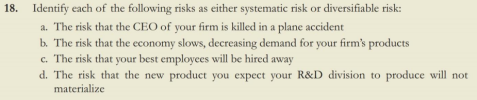 18. Identify each of the following risks as either systematic risk or diversifiable risk: a. The risk that the CEO of your firm is killed in a plane accident b. The risk that the economy slows, decreasing demand for your firm's products c. The risk that your best employees will be hired away d. The risk that the new product you expect your R&D division to produce will not materialize
Total, nondiversifiable, and diversifiable risk David Talbot randomly selected securities from all those listed on the...
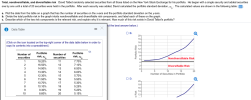 Total, nondiversifiable, and diversifiable risk David Talbot randomly selected securities from all those listed on the New York Stock Exchange for his portfolio. He began with a single security and added securities one by one until a total o 20 securities were held in the portfolio. After each security was added David calculated the portfolio standard deviation, ? The calculated values are shown in the following table: a. Plot the date from the table on a graph that has the...
Explain why the risk premium of a stock does not depend on its diversifiable risk.
Explain why the risk premium of a stock does not depend on its diversifiable risk.
Dropdown options: 1-risk/return 2-equal to/greater or less than 3-self contained/stand-alone 4-variance/standard deviation 5-variance/beta coefficient 6-diversifiable/non-diversiable 7-is/...
 Dropdown options:
1-risk/return
2-equal to/greater or less than
3-self contained/stand-alone
4-variance/standard deviation
5-variance/beta coefficient
6-diversifiable/non-diversiable
7-is/ is not
8-diversifiable/non-diversifiable
9-random/non random
10-decreasing/increasing
11-2000+/500
12-reduces/increases
13-systematic of market/unsystematic or company-specific
14-diversifiable/non diversifiable
1. Basic concepts - Risk and return Professor Isadore (Izzy) Invest-a-Lot retired two years ago from Exceptional College, a small liberal arts college in North Carolina after teaching corporate finance and investment theory for 35 years. Yesterday, Izzy appear on EC LIVE, a television show produced for the students,...
Dropdown options:
1-risk/return
2-equal to/greater or less than
3-self contained/stand-alone
4-variance/standard deviation
5-variance/beta coefficient
6-diversifiable/non-diversiable
7-is/ is not
8-diversifiable/non-diversifiable
9-random/non random
10-decreasing/increasing
11-2000+/500
12-reduces/increases
13-systematic of market/unsystematic or company-specific
14-diversifiable/non diversifiable
1. Basic concepts - Risk and return Professor Isadore (Izzy) Invest-a-Lot retired two years ago from Exceptional College, a small liberal arts college in North Carolina after teaching corporate finance and investment theory for 35 years. Yesterday, Izzy appear on EC LIVE, a television show produced for the students,...
identify each of the following risks as most likely to be systematic risk or diversifiable risk: a. The risk that your main production plant is shut down due to a tornado. b. The risk that the economy slows, decreasing demand for your firm's products.
identify each of the following risks as most likely to be systematic risk or diversifiable risk:a. The risk that your main production plant is shut down due to a tornado. b. The risk that the economy slows, decreasing demand for your firm's products.c. The risk that your best employees will be hired away.d. The risk that the new product you expect your R&D division to produce will not materialize.
what is the correct option? Which of the following does NOT describe the risk that exists...
 what is the correct option?
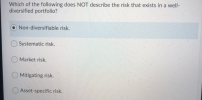
Which of the following does NOT describe the risk that exists in a well- diversified portfolio? Non-diversifiable risk. Systematic risk. Market risk. Mitigating risk. Asset-specific risk.
what is the correct option?
Which of the following does NOT describe the risk that exists in a well- diversified portfolio? Non-diversifiable risk. Systematic risk. Market risk. Mitigating risk. Asset-specific risk.
What is the “boreal forest”, and why does it occur where it does (in broad terms)?
What is the “boreal forest”, and why does it occur where it does (in broad terms)?
The scroll down options are 1. systematic/unsystematic risk 2. systematic/unsystematic risk 3. standard deviation/risk aversion 4....
 The scroll down options are
1. systematic/unsystematic risk
2. systematic/unsystematic risk
3. standard deviation/risk aversion
4. correlation coefficient/diversification
Risk is the potential for an investment to generate more than one return. A security that will produce only one known return is referred to as a risk- free asset, as there is no potential for deviation from the known expected outcome. Investments that have the chance of producing more than one possible outcome are called risky assets. Risk, or potential variability...
The scroll down options are
1. systematic/unsystematic risk
2. systematic/unsystematic risk
3. standard deviation/risk aversion
4. correlation coefficient/diversification
Risk is the potential for an investment to generate more than one return. A security that will produce only one known return is referred to as a risk- free asset, as there is no potential for deviation from the known expected outcome. Investments that have the chance of producing more than one possible outcome are called risky assets. Risk, or potential variability...
1) Explain liquidity risk, default risk, and taxability risk. How does each of these risks affect...
 1) Explain liquidity risk, default risk, and taxability risk. How does each of these risks affect the yield of a bond? 2) Define what is meant by interest rate risk. Assume the manager of a $100 million portfolio of corporate bonds predicts interest rates will rise in the near future. What adjustments should be made to the portfolio assuming the market has not already adjusted for this prediction? 3) Normally, the Treasury yield curve is upward-sloping. Explain the conditions required...
 Question 12 What does the beta measure? systematic risk diversifiable risk. company-specific risk. unsystematic risk.
 18. Identify each of the following risks as either systematic risk or diversifiable risk: a. The risk that the CEO of your firm is killed in a plane accident b. The risk that the economy slows, decreasing demand for your firm's products c. The risk that your best employees will be hired away d. The risk that the new product you expect your R&D division to produce will not materialize
 Total, nondiversifiable, and diversifiable risk David Talbot randomly selected securities from all those listed on the New York Stock Exchange for his portfolio. He began with a single security and added securities one by one until a total o 20 securities were held in the portfolio. After each security was added David calculated the portfolio standard deviation, ? The calculated values are shown in the following table: a. Plot the date from the table on a graph that has the...
 Dropdown options:
1-risk/return
2-equal to/greater or less than
3-self contained/stand-alone
4-variance/standard deviation
5-variance/beta coefficient
6-diversifiable/non-diversiable
7-is/ is not
8-diversifiable/non-diversifiable
9-random/non random
10-decreasing/increasing
11-2000+/500
12-reduces/increases
13-systematic of market/unsystematic or company-specific
14-diversifiable/non diversifiable
1. Basic concepts - Risk and return Professor Isadore (Izzy) Invest-a-Lot retired two years ago from Exceptional College, a small liberal arts college in North Carolina after teaching corporate finance and investment theory for 35 years. Yesterday, Izzy appear on EC LIVE, a television show produced for the students,...
Dropdown options:
1-risk/return
2-equal to/greater or less than
3-self contained/stand-alone
4-variance/standard deviation
5-variance/beta coefficient
6-diversifiable/non-diversiable
7-is/ is not
8-diversifiable/non-diversifiable
9-random/non random
10-decreasing/increasing
11-2000+/500
12-reduces/increases
13-systematic of market/unsystematic or company-specific
14-diversifiable/non diversifiable
1. Basic concepts - Risk and return Professor Isadore (Izzy) Invest-a-Lot retired two years ago from Exceptional College, a small liberal arts college in North Carolina after teaching corporate finance and investment theory for 35 years. Yesterday, Izzy appear on EC LIVE, a television show produced for the students,...
 what is the correct option?
Which of the following does NOT describe the risk that exists in a well- diversified portfolio? Non-diversifiable risk. Systematic risk. Market risk. Mitigating risk. Asset-specific risk.
what is the correct option?
Which of the following does NOT describe the risk that exists in a well- diversified portfolio? Non-diversifiable risk. Systematic risk. Market risk. Mitigating risk. Asset-specific risk.
 The scroll down options are
1. systematic/unsystematic risk
2. systematic/unsystematic risk
3. standard deviation/risk aversion
4. correlation coefficient/diversification
Risk is the potential for an investment to generate more than one return. A security that will produce only one known return is referred to as a risk- free asset, as there is no potential for deviation from the known expected outcome. Investments that have the chance of producing more than one possible outcome are called risky assets. Risk, or potential variability...
The scroll down options are
1. systematic/unsystematic risk
2. systematic/unsystematic risk
3. standard deviation/risk aversion
4. correlation coefficient/diversification
Risk is the potential for an investment to generate more than one return. A security that will produce only one known return is referred to as a risk- free asset, as there is no potential for deviation from the known expected outcome. Investments that have the chance of producing more than one possible outcome are called risky assets. Risk, or potential variability...
 1) Explain liquidity risk, default risk, and taxability risk. How does each of these risks affect the yield of a bond? 2) Define what is meant by interest rate risk. Assume the manager of a $100 million portfolio of corporate bonds predicts interest rates will rise in the near future. What adjustments should be made to the portfolio assuming the market has not already adjusted for this prediction? 3) Normally, the Treasury yield curve is upward-sloping. Explain the conditions required...
Most questions answered within 3 hours.
-
Where is the error in this code sequence?
String s1 = "Hello";
String s2 = "ello";...
asked 10 months ago -
Financial data for Joel de Paris, Inc., for last year
follow:
Joel de Paris, Inc.
Balance...
asked 10 months ago -
Consider this reaction:
Al2(SO4)3 (aq)+ BaCl3
(aq) Al2Cl6 (aq)- +
3BaSO4(s) . What is the...
asked 10 months ago -
Suppose that Savneet is considering increasing her
recent random sample from 20 car rentals to 40...
asked 10 months ago -
Trucks arrive at an unloading terminal at an average rate of 120
per hour.
Trucks arrive...
asked 10 months ago -
Why are methanol and ethanol completely soluble in water while
octanol is not very little soluble....
asked 10 months ago -
A facilities manager at a university reads in a research report
that the mean amount of...
asked 10 months ago -
When the CuSO4 is rehydrated by adding water to the anhydrous
compound, is this an endothermic...
asked 10 months ago -
A ray of sunlight is passing from diamond into crown glass; the
angle of incidence is...
asked 10 months ago -
A block of mass 0.249 kg is placed on top of a light, vertical
spring of...
asked 10 months ago -
how do the kidneys compensate in the presences of acidosis
a) trigger hyperventilate
b) reserve acid...
asked 10 months ago -
Question 501 pts
The rental rate of capital to the firm increases. Which of the
following...
asked 10 months ago