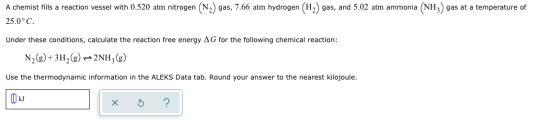
Info from ALEKS data lab:
Gf[N2] = 0 kj/mol
Gf[H2] = 0 kj/mol
Gf[NH3] = -26.50 kj/mol
Homework Answers
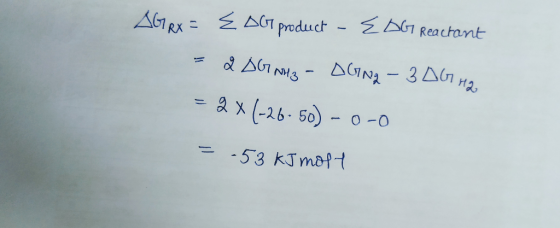
Add Answer to:
Info from ALEKS data lab:
Gf[N2] = 0 kj/mol
Gf[H2] = 0 kj/mol
Gf[NH3] = -26.50...
A chemist fils a reaction vessel with 5.19 atm nitrogen (N2) gas, 7.69 atm oxygen (O2)...
 A chemist fils a reaction vessel with 5.19 atm nitrogen (N2) gas, 7.69 atm oxygen (O2) gas, and 8.05 atm nitrogen monoxide (NO) gas at a temperature of 25.0°C. Under these conditions, calculate the reaction free energy AG for the following chemical reaction: Ng(8)+0,() - 2NO(g) Use the thermodynamic information in the ALEKS Data tab. Round your answer to the nearest kilojoule. x 5 ?
A chemist fills a reaction vessel with 9.20 atm nitrogen monoxide (NO) gas, 9.15 atm chlorine (CI) gas, and 7...
 A chemist fills a reaction vessel with 9.20 atm nitrogen monoxide (NO) gas, 9.15 atm chlorine (CI) gas, and 7.70 atm nitrosyl chloride (NOCI) gas at a temperature of 25.0°C. Under these conditions, calculate the reaction free energy AG for the following chemical reaction: 2NO(g) +CI (8) - 2NOCI (8) Use the thermodynamic information in the ALEKS Data tab. Round your answer to the nearest kilojoule. X 5 ? A chemist fills a reaction vessel with 9.20 atm nitrogen monoxide...
A chemist fills a reaction vessel with 7.72 atm chlorine (C1) gas, 6.29 atm phosphorus (P.)...
 A chemist fills a reaction vessel with 7.72 atm chlorine (C1) gas, 6.29 atm phosphorus (P.) gas, and 6.32 atm phosphorus trichloride (PCI) gas at a temperature of 25.0°C. Under these conditions, calculate the reaction free energy AG for the following chemical reaction: 6C1, () +P,(8) 4PC1,(B) Use the thermodynamic information in the ALEKS Data tab. Round your answer to the nearest kilojoule X 5 ?
5. Given ΔG =-16.5 kJ/mol for the reaction ½ N2 + 3/2 H2 → NH3, find...
 5. Given ΔG =-16.5 kJ/mol for the reaction ½ N2 + 3/2 H2 → NH3, find the equilibrium constant for: (a) the above reaction as written (b) the reaction N2+ 3H2 → 2NH3
The decomposition of ammonia gas is endothermic, AH = 92 kJ/mol. 2 NH3() = N2(g) +...
 The decomposition of ammonia gas is endothermic, AH = 92 kJ/mol. 2 NH3() = N2(g) + 3H2(g) What change to an equilibrium mixture of this reaction will result in the formation of more hydrogen gas? The addition of a catalyst. An decrease in temperature. An increase in volume. A decrease in the concentration of ammonia.
UP AND FREE ENERGY Calculating reaction free energy under nonstandard conditions A chemist fills a reaction...
 UP AND FREE ENERGY Calculating reaction free energy under nonstandard conditions A chemist fills a reaction vessel with 3.78 atm chlorine (C1,) gas, 7.19 atm phosphorus (P) gas, and 9.29 atm phosphorus trichlonde (PC) as a temperature of 25.0°C. Under these conditions, calculate the reaction free energy AG for the following chemical reaction: 6C126)+P4(8) - 4PCI, (8) Use the thermodynamic information in the ALEKS Data tab. Round your answer to the nearest kilojoule. 10W X 5 ?
In the Haber process, ammonia is synthesized from nitrogen and hydrogen: N2(g) + 3H2(g) → 2NH3(g) ΔG° at 298 K for thi...
In the Haber process, ammonia is synthesized from nitrogen and hydrogen: N2(g) + 3H2(g) → 2NH3(g) ΔG° at 298 K for this reaction is -33.3 kJ/mol. The value of ΔG at 298 K for a reaction mixture that consists of 1.9 atm N2, 1.6 atm H2, and 0.65 atm NH3 is ________. -3.86 × 10³ -1.8 -7.25 × 10³ -104.5 -40.5
Consider the Haber synthesis of gaseous NH3 (ΔH∘f = -46.1 kJ/mol; ΔG∘f = -16.5 kJ/mol): N2(g)+3H2(g)→2NH3(g)...
Consider the Haber synthesis of gaseous NH3 (ΔH∘f = -46.1 kJ/mol; ΔG∘f = -16.5 kJ/mol): N2(g)+3H2(g)→2NH3(g) What are the equilibrium constants Kp and Kc for the reaction at 350 K ? You may assume that ΔH∘ and ΔS∘ are independent of temperature.
1. Consider the reaction H2(g) + F2(g) ----->2HF(g) Use the standard thermodynamic data in the tables...
1. Consider the reaction H2(g) + F2(g) ----->2HF(g) Use the standard thermodynamic data in the tables linked above. Calculate delta G for this reaction at 298.15K if the pressure of HF(g) is reduced to 11.42 mm Hg, while the pressures of H2(g) and F2(g) remain at 1 atm. ANSWER: _____ kJ/mol 2. Consider the reaction N2(g) + 3H2(g) ------>2NH3(g) Using the standard thermodynamic data in the tables linked above, calculate delta Grxn for this reaction at 298.15K if the pressure...
A chemist fills a reaction vessel with 0.293 g silver chromate (Ag, Croa) solid, 0.714 M...
 A chemist fills a reaction vessel with 0.293 g silver chromate (Ag, Croa) solid, 0.714 M silver (Ag +) aqueous solution, and 0.805 M chromate (cro?:) aqueous solution at a temperature of 25.0°C. Under these conditions, calculate the reaction free energy AG for the following chemical reaction: 2- Ag, Cro_(s) = 2 Ag+ (aq) + Cro. (aq) Use the thermodynamic information in the ALEKS Data tab. Round your answer to the nearest kilojoule. I kJ Х 5 ?
 A chemist fils a reaction vessel with 5.19 atm nitrogen (N2) gas, 7.69 atm oxygen (O2) gas, and 8.05 atm nitrogen monoxide (NO) gas at a temperature of 25.0°C. Under these conditions, calculate the reaction free energy AG for the following chemical reaction: Ng(8)+0,() - 2NO(g) Use the thermodynamic information in the ALEKS Data tab. Round your answer to the nearest kilojoule. x 5 ?
 A chemist fills a reaction vessel with 9.20 atm nitrogen monoxide (NO) gas, 9.15 atm chlorine (CI) gas, and 7.70 atm nitrosyl chloride (NOCI) gas at a temperature of 25.0°C. Under these conditions, calculate the reaction free energy AG for the following chemical reaction: 2NO(g) +CI (8) - 2NOCI (8) Use the thermodynamic information in the ALEKS Data tab. Round your answer to the nearest kilojoule. X 5 ? A chemist fills a reaction vessel with 9.20 atm nitrogen monoxide...
 A chemist fills a reaction vessel with 7.72 atm chlorine (C1) gas, 6.29 atm phosphorus (P.) gas, and 6.32 atm phosphorus trichloride (PCI) gas at a temperature of 25.0°C. Under these conditions, calculate the reaction free energy AG for the following chemical reaction: 6C1, () +P,(8) 4PC1,(B) Use the thermodynamic information in the ALEKS Data tab. Round your answer to the nearest kilojoule X 5 ?
 5. Given ΔG =-16.5 kJ/mol for the reaction ½ N2 + 3/2 H2 → NH3, find the equilibrium constant for: (a) the above reaction as written (b) the reaction N2+ 3H2 → 2NH3
 The decomposition of ammonia gas is endothermic, AH = 92 kJ/mol. 2 NH3() = N2(g) + 3H2(g) What change to an equilibrium mixture of this reaction will result in the formation of more hydrogen gas? The addition of a catalyst. An decrease in temperature. An increase in volume. A decrease in the concentration of ammonia.
 UP AND FREE ENERGY Calculating reaction free energy under nonstandard conditions A chemist fills a reaction vessel with 3.78 atm chlorine (C1,) gas, 7.19 atm phosphorus (P) gas, and 9.29 atm phosphorus trichlonde (PC) as a temperature of 25.0°C. Under these conditions, calculate the reaction free energy AG for the following chemical reaction: 6C126)+P4(8) - 4PCI, (8) Use the thermodynamic information in the ALEKS Data tab. Round your answer to the nearest kilojoule. 10W X 5 ?
 A chemist fills a reaction vessel with 0.293 g silver chromate (Ag, Croa) solid, 0.714 M silver (Ag +) aqueous solution, and 0.805 M chromate (cro?:) aqueous solution at a temperature of 25.0°C. Under these conditions, calculate the reaction free energy AG for the following chemical reaction: 2- Ag, Cro_(s) = 2 Ag+ (aq) + Cro. (aq) Use the thermodynamic information in the ALEKS Data tab. Round your answer to the nearest kilojoule. I kJ Х 5 ?
Most questions answered within 3 hours.
-
Where is the error in this code sequence?
String s1 = "Hello";
String s2 = "ello";...
asked 10 months ago -
Financial data for Joel de Paris, Inc., for last year
follow:
Joel de Paris, Inc.
Balance...
asked 10 months ago -
Consider this reaction:
Al2(SO4)3 (aq)+ BaCl3
(aq) Al2Cl6 (aq)- +
3BaSO4(s) . What is the...
asked 10 months ago -
Suppose that Savneet is considering increasing her
recent random sample from 20 car rentals to 40...
asked 10 months ago -
Trucks arrive at an unloading terminal at an average rate of 120
per hour.
Trucks arrive...
asked 10 months ago -
Why are methanol and ethanol completely soluble in water while
octanol is not very little soluble....
asked 10 months ago -
A facilities manager at a university reads in a research report
that the mean amount of...
asked 10 months ago -
When the CuSO4 is rehydrated by adding water to the anhydrous
compound, is this an endothermic...
asked 10 months ago -
A ray of sunlight is passing from diamond into crown glass; the
angle of incidence is...
asked 10 months ago -
A block of mass 0.249 kg is placed on top of a light, vertical
spring of...
asked 10 months ago -
how do the kidneys compensate in the presences of acidosis
a) trigger hyperventilate
b) reserve acid...
asked 10 months ago -
Question 501 pts
The rental rate of capital to the firm increases. Which of the
following...
asked 10 months ago