
Homework Answers
Ionizable proton means a molecule furnishing its proton (H+) as a measure of its acidity and the ionizable protons are usually by a polar covalent bond like OH, NH, and SH, etc.
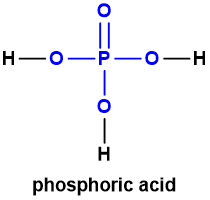
H2SO4 is a diprotic acid as it has two ionizable protons as shown below: while the H3PO4 is a triprotic acid as it can furnish a maximum of three protons as shown.

An object has two million more electrons than protons. What is the net charge of the object?
An object has two million more electrons than protons. What is the net charge of the object?C??the asked answer in Cthanks
10 because it has resonance. 3 b) For the following molecules, two protons are identified. Determine...
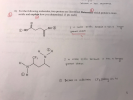 10 because it has resonance. 3 b) For the following molecules, two protons are identified. Determine which proton is more acidic and explain how you determined. (5 pts each) SH acidic because it has a longer 1 HO 2 is more parant chain CF N 2 it has a longer is more acidic because parent chain IZ ☺ Because of induction CF3 puling on N
9. The repulsive force between two protons has a magnitude of 2.00 N. What is the...
 9. The repulsive force between two protons has a magnitude of 2.00 N. What is the distance potnt) between them? 01.07 x 10⁻¹⁴m 01.28 x10-38 m 07.198 10-10 m 02.68 x 10⁴m 10. Two identical point charges in outer space are held apart at a distance D. As soon as the pont charges are released, each begins moving at an acceleration a. If instead they were released at a distance, the acceleration of one charge would be 04a
Which of the protons shown in red is more acidic? Which of the protons shown in...
 Which of the protons shown in red is more acidic?
Which of the protons shown in red is more acidic?
Which of the protons shown in red is more acidic?
In each compound below, two protons are clearly identified. Determine which of the two protons is...
 In each compound below, two protons are clearly identified. Determine which of the two protons is more acidic. он н . NH2 Но (a) (b) (c) SH но (d) (e) (f) H но ОН (h)
At the point of fission, a nucleus of 235U that has 92 protons is divided into...
At the point of fission, a nucleus of 235U that has 92 protons is divided into two smaller spheres, each of which has 46 protons and a radius of 5.74 ✕ 10-15 m. What is the magnitude of the repulsive force pushing these two spheres apart? N
p-Phenylenediamine (C6H8N2) can accept two protons because it has two basic N atoms (Kb1=2.0×10⁻⁸, Kb2=9.3×10⁻¹²). A)...
p-Phenylenediamine (C6H8N2) can accept two protons because it has two basic N atoms (Kb1=2.0×10⁻⁸, Kb2=9.3×10⁻¹²). A) calculate the value of Ka for the conjugate acid C6H8N2H+. B) calculate the value of Ka for the conjugate acid C6H8N2H22+.
Protons carry a charge of +1.6e-19 C. If the repulsive force between two protons in an...
Protons carry a charge of +1.6e-19 C. If the repulsive force between two protons in an atomic nucleus equals 80 N, how far apart are the protons, in picometers (that's trillionths of a meter)? Use "E" notation for your answer.
Protons carry a charge of +1.6e-19 C. If the repulsive force between two protons in an...
Protons carry a charge of +1.6e-19 C. If the repulsive force between two protons in an atomic nucleus equals 106 N, how far apart are the protons, in picometers (that's trillionths of a meter)? Use "E" notation for your answer. Please help
Consider the two protons highlighted in the following compound: Do you expect these protons to be...
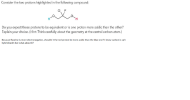 Consider the two protons highlighted in the following compound: Do you expect these protons to be equivalent or is one proton more acidic than the other? Explain your choice. (Hint: Think carefully about the geometry at the central carbon atom.) Because fluorine is more electronegative, shouldn't the red proton be more acidic than the blue one? I know carbon is sp3 hybridizedm but what about it?
 10 because it has resonance. 3 b) For the following molecules, two protons are identified. Determine which proton is more acidic and explain how you determined. (5 pts each) SH acidic because it has a longer 1 HO 2 is more parant chain CF N 2 it has a longer is more acidic because parent chain IZ ☺ Because of induction CF3 puling on N
 9. The repulsive force between two protons has a magnitude of 2.00 N. What is the distance potnt) between them? 01.07 x 10⁻¹⁴m 01.28 x10-38 m 07.198 10-10 m 02.68 x 10⁴m 10. Two identical point charges in outer space are held apart at a distance D. As soon as the pont charges are released, each begins moving at an acceleration a. If instead they were released at a distance, the acceleration of one charge would be 04a
 Which of the protons shown in red is more acidic?
Which of the protons shown in red is more acidic?
Which of the protons shown in red is more acidic?
 In each compound below, two protons are clearly identified. Determine which of the two protons is more acidic. он н . NH2 Но (a) (b) (c) SH но (d) (e) (f) H но ОН (h)
 Consider the two protons highlighted in the following compound: Do you expect these protons to be equivalent or is one proton more acidic than the other? Explain your choice. (Hint: Think carefully about the geometry at the central carbon atom.) Because fluorine is more electronegative, shouldn't the red proton be more acidic than the blue one? I know carbon is sp3 hybridizedm but what about it?
Most questions answered within 3 hours.
-
Where is the error in this code sequence?
String s1 = "Hello";
String s2 = "ello";...
asked 10 months ago -
Financial data for Joel de Paris, Inc., for last year
follow:
Joel de Paris, Inc.
Balance...
asked 10 months ago -
Consider this reaction:
Al2(SO4)3 (aq)+ BaCl3
(aq) Al2Cl6 (aq)- +
3BaSO4(s) . What is the...
asked 10 months ago -
Suppose that Savneet is considering increasing her
recent random sample from 20 car rentals to 40...
asked 10 months ago -
Trucks arrive at an unloading terminal at an average rate of 120
per hour.
Trucks arrive...
asked 10 months ago -
Why are methanol and ethanol completely soluble in water while
octanol is not very little soluble....
asked 10 months ago -
A facilities manager at a university reads in a research report
that the mean amount of...
asked 10 months ago -
When the CuSO4 is rehydrated by adding water to the anhydrous
compound, is this an endothermic...
asked 10 months ago -
A ray of sunlight is passing from diamond into crown glass; the
angle of incidence is...
asked 10 months ago -
A block of mass 0.249 kg is placed on top of a light, vertical
spring of...
asked 10 months ago -
how do the kidneys compensate in the presences of acidosis
a) trigger hyperventilate
b) reserve acid...
asked 10 months ago -
Question 501 pts
The rental rate of capital to the firm increases. Which of the
following...
asked 10 months ago