
Homework Answers

Add Answer to:
Prelab Exercise #1: Using equation (1 1), show that the rise time tr is given by...
III. For each given transfer function below 1) Find damping factor ς, natural frequency w , Settling Time Ts, Rise time Tr and Percent Overshoot P.O Confirm results with Matlab 240 3s2+12s 240 GOD 4s...
 III. For each given transfer function below 1) Find damping factor ς, natural frequency w , Settling Time Ts, Rise time Tr and Percent Overshoot P.O Confirm results with Matlab 240 3s2+12s 240 GOD 4s2 +24s 600) 125 a)T)+24s+600) e) T3)+0.0s + 125) T2(s)= b)
III. For each given transfer function below 1) Find damping factor ς, natural frequency w , Settling Time Ts, Rise time Tr and Percent Overshoot P.O Confirm results with Matlab 240 3s2+12s 240 GOD 4s2...
III. For each given transfer function below 1) Find damping factor ς, natural frequency w , Settling Time Ts, Rise time Tr and Percent Overshoot P.O Confirm results with Matlab 240 3s2+12s 240 GOD 4s2 +24s 600) 125 a)T)+24s+600) e) T3)+0.0s + 125) T2(s)= b)
III. For each given transfer function below 1) Find damping factor ς, natural frequency w , Settling Time Ts, Rise time Tr and Percent Overshoot P.O Confirm results with Matlab 240 3s2+12s 240 GOD 4s2...
Prelab Exercise #2: From the definition of the modulus, show that the gain of the circuit...
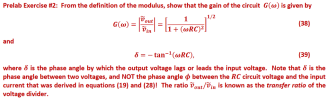 Prelab Exercise #2: From the definition of the modulus, show that the gain of the circuit G(a) is given by 7 out G(o) (38) and (39) where δ is the phase angle by which the output voltage lags or leads the input voltage. Note that δ is the phase angle between two voltages, and NOT the phase angle φ between the RC circuit voltage and the input current that was derived in equations (19) and (28)! The ratio Uout/Uin is...
Practice Problems- Basic circuits- (MENG3531) 1. For a low-pass filter with R=1k and C=0.01uF, find time...
 Practice Problems- Basic circuits- (MENG3531) 1. For a low-pass filter with R=1k and C=0.01uF, find time constant (t), rise time (tr), corner frequency (@c) and bandwidth. Sketch time and frequency response curves for the RC circuit and show the calculated parameters. 2. If the Ris changed to 10 k and C is reduced to 0.005 uF, find the corresponding values of time constant (T), rise time (tr), corner frequency (oc). Sketch time and frequency response curves for the RC circuit...
1. Calculate the RC time constant of the circuit in Fig. 1 using equation (1) 2....
 1. Calculate the RC time constant of the circuit in Fig.
1 using equation (1)
2. Derive expressions of Vout(t) for circuits in
Figs. 1 and 2
3. Sketch your derived results for Vout(t), clearly
labeling your initial voltages and time constants
10 k22 M + + Vin 0.1 uf Vout Fig. 1. RC circuit 0.1 uf + + Vin 10 k2 Vout Fig. 2. RC circuit.
1. Calculate the RC time constant of the circuit in Fig.
1 using equation (1)
2. Derive expressions of Vout(t) for circuits in
Figs. 1 and 2
3. Sketch your derived results for Vout(t), clearly
labeling your initial voltages and time constants
10 k22 M + + Vin 0.1 uf Vout Fig. 1. RC circuit 0.1 uf + + Vin 10 k2 Vout Fig. 2. RC circuit.
Consider the low pass filter RC circuit where Ri+ E E(t) The rise time t, is...
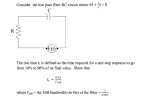 Consider the low pass filter RC circuit where Ri+ E E(t) The rise time t, is defined as the time required for a unit step response to go from 10% to 90% of its final value. Show that 0.35 3dB where f3dB-the 3dB bandwidth (in Hz) of the filter 2TTRC
chapter 8 RC electricity 8.1.2 Prelab Exercise 1 1. If the experimental set up in Fig....
 chapter 8 RC electricity
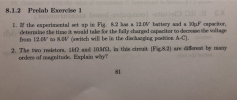
8.1.2 Prelab Exercise 1 1. If the experimental set up in Fig. 8.2 has a 12.0V battery and a 10pF capacitor, determine the time it would take for the fully charged capacitor to decrease the voltage from 12.0V to 8.0V (switch will be in the discharging position A-C). 2. The two resistors, 1k2 and 10M2, in this circuit (Fig.8.2) are different by many orders of magnitude. Explain why? 81 We were unable to transcribe this image
chapter 8 RC electricity
8.1.2 Prelab Exercise 1 1. If the experimental set up in Fig. 8.2 has a 12.0V battery and a 10pF capacitor, determine the time it would take for the fully charged capacitor to decrease the voltage from 12.0V to 8.0V (switch will be in the discharging position A-C). 2. The two resistors, 1k2 and 10M2, in this circuit (Fig.8.2) are different by many orders of magnitude. Explain why? 81 We were unable to transcribe this image
1. (a) Express the differential gain (double side) of the amplifier using TR parameters and Rc. (...
 1. (a) Express the differential gain (double side) of the amplifier using TR parameters and Rc. (3pts) (b) Express the differential gain for a single side output. (2pts) (e) Design the Re such that o velve IV when vi5mV and v2+5mV (3pts) (d) Determine the maximum common-mode input voltage (5pts) (e) Determine the differential mode input resistance of the amplifier Beta is 100.(3pts) V+ = 10V R. ci C2 ei 02 2 t )10 = 2 mA V-=-10V
1. (a)...
1. (a) Express the differential gain (double side) of the amplifier using TR parameters and Rc. (3pts) (b) Express the differential gain for a single side output. (2pts) (e) Design the Re such that o velve IV when vi5mV and v2+5mV (3pts) (d) Determine the maximum common-mode input voltage (5pts) (e) Determine the differential mode input resistance of the amplifier Beta is 100.(3pts) V+ = 10V R. ci C2 ei 02 2 t )10 = 2 mA V-=-10V
1. (a)...
Prelab 1. Perform Prelab 1 and Prel ab 2 of Experiment 3.1 if you have not already done so. 2. Us...
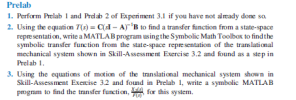 Prelab 1. Perform Prelab 1 and Prel ab 2 of Experiment 3.1 if you have not already done so. 2. Using the equation T(s) C(I A) B to find a transfer function from a state-space repre sentation, write a MATLAB program usingthe Symbolic Math Toolbox to findthe symbolic transfer function from the state-space repre sentation of the translational mechanical system shown in Skill-Assessment Exercise 3.2 and found as a step in Prelab 1 3. Using the equations of motion of...
please show work for both 1 and 2 Prelab Exercise 1. Calculate the mass and volume...
 please show work for both 1 and
2
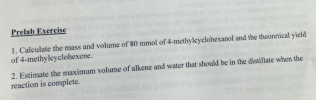
Prelab Exercise 1. Calculate the mass and volume of 80 mmol of 4-methyleyclohexanol and the theoretical yield of 4-methylcyclohexene. 2. Estimate the maximum volume of alkene and water that should be in the distillate when the reaction is complete.
please show work for both 1 and
2
Prelab Exercise 1. Calculate the mass and volume of 80 mmol of 4-methyleyclohexanol and the theoretical yield of 4-methylcyclohexene. 2. Estimate the maximum volume of alkene and water that should be in the distillate when the reaction is complete.
 III. For each given transfer function below 1) Find damping factor ς, natural frequency w , Settling Time Ts, Rise time Tr and Percent Overshoot P.O Confirm results with Matlab 240 3s2+12s 240 GOD 4s2 +24s 600) 125 a)T)+24s+600) e) T3)+0.0s + 125) T2(s)= b)
III. For each given transfer function below 1) Find damping factor ς, natural frequency w , Settling Time Ts, Rise time Tr and Percent Overshoot P.O Confirm results with Matlab 240 3s2+12s 240 GOD 4s2...
III. For each given transfer function below 1) Find damping factor ς, natural frequency w , Settling Time Ts, Rise time Tr and Percent Overshoot P.O Confirm results with Matlab 240 3s2+12s 240 GOD 4s2 +24s 600) 125 a)T)+24s+600) e) T3)+0.0s + 125) T2(s)= b)
III. For each given transfer function below 1) Find damping factor ς, natural frequency w , Settling Time Ts, Rise time Tr and Percent Overshoot P.O Confirm results with Matlab 240 3s2+12s 240 GOD 4s2...
 Prelab Exercise #2: From the definition of the modulus, show that the gain of the circuit G(a) is given by 7 out G(o) (38) and (39) where δ is the phase angle by which the output voltage lags or leads the input voltage. Note that δ is the phase angle between two voltages, and NOT the phase angle φ between the RC circuit voltage and the input current that was derived in equations (19) and (28)! The ratio Uout/Uin is...
 Practice Problems- Basic circuits- (MENG3531) 1. For a low-pass filter with R=1k and C=0.01uF, find time constant (t), rise time (tr), corner frequency (@c) and bandwidth. Sketch time and frequency response curves for the RC circuit and show the calculated parameters. 2. If the Ris changed to 10 k and C is reduced to 0.005 uF, find the corresponding values of time constant (T), rise time (tr), corner frequency (oc). Sketch time and frequency response curves for the RC circuit...
 1. Calculate the RC time constant of the circuit in Fig.
1 using equation (1)
2. Derive expressions of Vout(t) for circuits in
Figs. 1 and 2
3. Sketch your derived results for Vout(t), clearly
labeling your initial voltages and time constants
10 k22 M + + Vin 0.1 uf Vout Fig. 1. RC circuit 0.1 uf + + Vin 10 k2 Vout Fig. 2. RC circuit.
1. Calculate the RC time constant of the circuit in Fig.
1 using equation (1)
2. Derive expressions of Vout(t) for circuits in
Figs. 1 and 2
3. Sketch your derived results for Vout(t), clearly
labeling your initial voltages and time constants
10 k22 M + + Vin 0.1 uf Vout Fig. 1. RC circuit 0.1 uf + + Vin 10 k2 Vout Fig. 2. RC circuit.
 Consider the low pass filter RC circuit where Ri+ E E(t) The rise time t, is defined as the time required for a unit step response to go from 10% to 90% of its final value. Show that 0.35 3dB where f3dB-the 3dB bandwidth (in Hz) of the filter 2TTRC
 chapter 8 RC electricity
8.1.2 Prelab Exercise 1 1. If the experimental set up in Fig. 8.2 has a 12.0V battery and a 10pF capacitor, determine the time it would take for the fully charged capacitor to decrease the voltage from 12.0V to 8.0V (switch will be in the discharging position A-C). 2. The two resistors, 1k2 and 10M2, in this circuit (Fig.8.2) are different by many orders of magnitude. Explain why? 81 We were unable to transcribe this image
chapter 8 RC electricity
8.1.2 Prelab Exercise 1 1. If the experimental set up in Fig. 8.2 has a 12.0V battery and a 10pF capacitor, determine the time it would take for the fully charged capacitor to decrease the voltage from 12.0V to 8.0V (switch will be in the discharging position A-C). 2. The two resistors, 1k2 and 10M2, in this circuit (Fig.8.2) are different by many orders of magnitude. Explain why? 81 We were unable to transcribe this image
 1. (a) Express the differential gain (double side) of the amplifier using TR parameters and Rc. (3pts) (b) Express the differential gain for a single side output. (2pts) (e) Design the Re such that o velve IV when vi5mV and v2+5mV (3pts) (d) Determine the maximum common-mode input voltage (5pts) (e) Determine the differential mode input resistance of the amplifier Beta is 100.(3pts) V+ = 10V R. ci C2 ei 02 2 t )10 = 2 mA V-=-10V
1. (a)...
1. (a) Express the differential gain (double side) of the amplifier using TR parameters and Rc. (3pts) (b) Express the differential gain for a single side output. (2pts) (e) Design the Re such that o velve IV when vi5mV and v2+5mV (3pts) (d) Determine the maximum common-mode input voltage (5pts) (e) Determine the differential mode input resistance of the amplifier Beta is 100.(3pts) V+ = 10V R. ci C2 ei 02 2 t )10 = 2 mA V-=-10V
1. (a)...
 Prelab 1. Perform Prelab 1 and Prel ab 2 of Experiment 3.1 if you have not already done so. 2. Using the equation T(s) C(I A) B to find a transfer function from a state-space repre sentation, write a MATLAB program usingthe Symbolic Math Toolbox to findthe symbolic transfer function from the state-space repre sentation of the translational mechanical system shown in Skill-Assessment Exercise 3.2 and found as a step in Prelab 1 3. Using the equations of motion of...
 please show work for both 1 and
2
Prelab Exercise 1. Calculate the mass and volume of 80 mmol of 4-methyleyclohexanol and the theoretical yield of 4-methylcyclohexene. 2. Estimate the maximum volume of alkene and water that should be in the distillate when the reaction is complete.
please show work for both 1 and
2
Prelab Exercise 1. Calculate the mass and volume of 80 mmol of 4-methyleyclohexanol and the theoretical yield of 4-methylcyclohexene. 2. Estimate the maximum volume of alkene and water that should be in the distillate when the reaction is complete.
Most questions answered within 3 hours.
-
Where is the error in this code sequence?
String s1 = "Hello";
String s2 = "ello";...
asked 10 months ago -
Financial data for Joel de Paris, Inc., for last year
follow:
Joel de Paris, Inc.
Balance...
asked 10 months ago -
Consider this reaction:
Al2(SO4)3 (aq)+ BaCl3
(aq) Al2Cl6 (aq)- +
3BaSO4(s) . What is the...
asked 10 months ago -
Suppose that Savneet is considering increasing her
recent random sample from 20 car rentals to 40...
asked 10 months ago -
Trucks arrive at an unloading terminal at an average rate of 120
per hour.
Trucks arrive...
asked 10 months ago -
Why are methanol and ethanol completely soluble in water while
octanol is not very little soluble....
asked 10 months ago -
A facilities manager at a university reads in a research report
that the mean amount of...
asked 10 months ago -
When the CuSO4 is rehydrated by adding water to the anhydrous
compound, is this an endothermic...
asked 10 months ago -
A ray of sunlight is passing from diamond into crown glass; the
angle of incidence is...
asked 10 months ago -
A block of mass 0.249 kg is placed on top of a light, vertical
spring of...
asked 10 months ago -
how do the kidneys compensate in the presences of acidosis
a) trigger hyperventilate
b) reserve acid...
asked 10 months ago -
Question 501 pts
The rental rate of capital to the firm increases. Which of the
following...
asked 10 months ago