Assume that today is December 31, 2019, and that the following information applies to Abner Airlines:...
Assume that today is December 31, 2019, and that the following information applies to Abner Airlines:
After-tax operating income [EBIT(1 - T)] for 2020 is expected to
be $450 million.
The depreciation expense for 2020 is expected to be $140
million.
The capital expenditures for 2020 are expected to be $350
million.
No change is expected in net operating working capital.
The free cash flow is expected to grow at a constant rate of 4% per
year.
The required return on equity is 13%.
The WACC is 9%.
The firm has $205 million of non-operating assets.
The market value of the company's debt is $3.103 billion.
60 million shares of stock are outstanding.
Using the corporate valuation model approach, what should be the company's stock price today? Do not round intermediate calculations. Round your answer to the nearest cent.
$
Homework Answers
EBIT(1-T) = $450 million
Add: Depreciation Expense (non-cash) = $140 million
Less: Capital Expenditure = $350 million
Free cash flow = $240 million
Present value of free cash flows = Expected Free cash flow next year/(WACC – growth rate)
= 240 million/(9%-4%)
= $4,800 million
Add: Non-operating assets = $205 million
Less: Value of debt = $3103 million
Value of Equity = $1902 million
Number of shares = 60 million
Price per share = $31.7
Add Answer to:
Assume that today is December 31, 2019, and that the following
information applies to Abner Airlines:...
Assume that today is December 31, 2019, and that the following information applies to Abner Airlines:...
Assume that today is December 31, 2019, and that the following information applies to Abner Airlines: After-tax operating income [EBIT(1 - T)] for 2020 is expected to be $700 million. The depreciation expense for 2020 is expected to be $150 million. The capital expenditures for 2020 are expected to be $450 million. No change is expected in net operating working capital. The free cash flow is expected to grow at a constant rate of 3% per year. The required return...
Assume that today is December 31, 2019, and that the following information applies to Abner Airlines:...
Assume that today is December 31, 2019, and that the following information applies to Abner Airlines: After-tax operating income [EBIT(1 - T)] for 2020 is expected to be $450 million. The depreciation expense for 2020 is expected to be $130 million. The capital expenditures for 2020 are expected to be $225 million. No change is expected in net operating working capital. The free cash flow is expected to grow at a constant rate of 6% per year. The required return...
Assume that today is December 31, 2019, and that the following information applies to Abner Airlines:...
Assume that today is December 31, 2019, and that the following information applies to Abner Airlines: After-tax operating income [EBIT(1 - T)] for 2020 is expected to be $700 million. The depreciation expense for 2020 is expected to be $180 million. The capital expenditures for 2020 are expected to be $350 million. No change is expected in net operating working capital. The free cash flow is expected to grow at a constant rate of 5% per year. The required return...
Assume that today is December 31, 2019, and that the following information applies to Abner Airlines:...
Assume that today is December 31, 2019, and that the following information applies to Abner Airlines: After-tax operating income [EBIT(1 - T)] for 2020 is expected to be $500 million. The depreciation expense for 2020 is expected to be $90 million. The capital expenditures for 2020 are expected to be $350 million. No change is expected in net operating working capital. The free cash flow is expected to grow at a constant rate of 4% per year. The required return...
Assume that today is December 31, 2019, and that the following information applies to Abner Airlines:...
Assume that today is December 31, 2019, and that the following information applies to Abner Airlines: After-tax operating income [EBIT(1 - T)] for 2020 is expected to be $650 million. The depreciation expense for 2020 is expected to be $190 million. The capital expenditures for 2020 are expected to be $200 million. No change is expected in net operating working capital. The free cash flow is expected to grow at a constant rate of 4% per year. The required return...
Assume that today is December 31, 2019, and that the following information applies to Abner Airlines:...
Assume that today is December 31, 2019, and that the following information applies to Abner Airlines: After-tax operating income [EBIT(1 - T)] for 2020 is expected to be $700 million. The depreciation expense for 2020 is expected to be $120 million. The capital expenditures for 2020 are expected to be $475 million. No change is expected in net operating working capital. The free cash flow is expected to grow at a constant rate of 6% per year. The required return...
Assume that today is December 31, 2019, and that the following information applies to Abner Airlines:...
Assume that today is December 31, 2019, and that the following information applies to Abner Airlines: After-tax operating income [EBIT(1 - T)] for 2020 is expected to be $500 million. The depreciation expense for 2020 is expected to be $170 million. The capital expenditures for 2020 are expected to be $225 million. No change is expected in net operating working capital. The free cash flow is expected to grow at a constant rate of 3% per year. The required return...
Assume that today is December 31, 2019, and that the following information applies to Abner Airlines:...
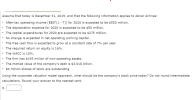 Assume that today is December 31, 2019, and that the following information applies to Abner Airlines: • After-tax operating income (EBIT(1 - T)] for 2020 is expected to be $550 million. • The depreciation expense for 2020 is expected to be $50 million. • The capital expenditures for 2020 are expected to be $275 million. • No change is expected in net operating working capital. • The free cash flow is expected to grow at a constant rate of 7%...
Assume that today is December 31, 2019, and that the following information applies to Abner Airlines: • After-tax o...
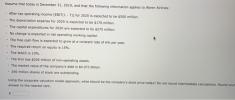 Assume that today is December 31, 2019, and that the following information applies to Abner Airlines: • After-tax operating income (EBIT(1 - T)] for 2020 is expected to be $500 million • The depreciation expense for 2020 is expected to be $170 million. • The capital expenditures for 2020 are expected to be $275 million. • No change is expected in net operating working capital. • The free cash flow is expected to grow at a constant rate of 6%...
CORPORATE VALUE MODEL Assume that today is December 31, 2016, and that the following information applies...
CORPORATE VALUE MODEL Assume that today is December 31, 2016, and that the following information applies to Abner Airlines: After-tax operating income [EBIT(1 - T)] for 2017 is expected to be $450 million. The depreciation expense for 2017 is expected to be $80 million. The capital expenditures for 2017 are expected to be $300 million. No change is expected in net operating working capital. The free cash flow is expected to grow at a constant rate of 6% per year....
 Assume that today is December 31, 2019, and that the following information applies to Abner Airlines: • After-tax operating income (EBIT(1 - T)] for 2020 is expected to be $550 million. • The depreciation expense for 2020 is expected to be $50 million. • The capital expenditures for 2020 are expected to be $275 million. • No change is expected in net operating working capital. • The free cash flow is expected to grow at a constant rate of 7%...
 Assume that today is December 31, 2019, and that the following information applies to Abner Airlines: • After-tax operating income (EBIT(1 - T)] for 2020 is expected to be $500 million • The depreciation expense for 2020 is expected to be $170 million. • The capital expenditures for 2020 are expected to be $275 million. • No change is expected in net operating working capital. • The free cash flow is expected to grow at a constant rate of 6%...
Most questions answered within 3 hours.
-
Where is the error in this code sequence?
String s1 = "Hello";
String s2 = "ello";...
asked 11 months ago -
Financial data for Joel de Paris, Inc., for last year
follow:
Joel de Paris, Inc.
Balance...
asked 11 months ago -
Consider this reaction:
Al2(SO4)3 (aq)+ BaCl3
(aq) Al2Cl6 (aq)- +
3BaSO4(s) . What is the...
asked 11 months ago -
Suppose that Savneet is considering increasing her
recent random sample from 20 car rentals to 40...
asked 11 months ago -
Trucks arrive at an unloading terminal at an average rate of 120
per hour.
Trucks arrive...
asked 11 months ago -
Why are methanol and ethanol completely soluble in water while
octanol is not very little soluble....
asked 11 months ago -
A facilities manager at a university reads in a research report
that the mean amount of...
asked 11 months ago -
When the CuSO4 is rehydrated by adding water to the anhydrous
compound, is this an endothermic...
asked 11 months ago -
A ray of sunlight is passing from diamond into crown glass; the
angle of incidence is...
asked 11 months ago -
A block of mass 0.249 kg is placed on top of a light, vertical
spring of...
asked 11 months ago -
how do the kidneys compensate in the presences of acidosis
a) trigger hyperventilate
b) reserve acid...
asked 11 months ago -
Question 501 pts
The rental rate of capital to the firm increases. Which of the
following...
asked 11 months ago