
Homework Answers
Add Answer to:
Consider the reaction at 25°C: 2A (aq) + B (aq) → C (aq) +2D (aq) An...
help with this question Consider the reaction at 25°C: 2A (aq) + B (aq) → C (aq) +2D (aq) An experiment was performe...
 help with this question
Consider the reaction at 25°C: 2A (aq) + B (aq) → C (aq) +2D (aq) An experiment was performed with the following initial concentrations: [A] = 2.50 M, [B] = 2.50 M, [C] = 0.250 M, [D] = 0.500 M. The reaction was allowed to proceed until equilibrium was reached at which time [A] = 0.750 M. What is the value of wmax for the maximum work that could have been performed as the reaction began?...
help with this question
Consider the reaction at 25°C: 2A (aq) + B (aq) → C (aq) +2D (aq) An experiment was performed with the following initial concentrations: [A] = 2.50 M, [B] = 2.50 M, [C] = 0.250 M, [D] = 0.500 M. The reaction was allowed to proceed until equilibrium was reached at which time [A] = 0.750 M. What is the value of wmax for the maximum work that could have been performed as the reaction began?...
Just revisiting this question to understand why I got it wrong. Please show work Consider the...
 Just revisiting this question to understand why I got it wrong.
Please show work
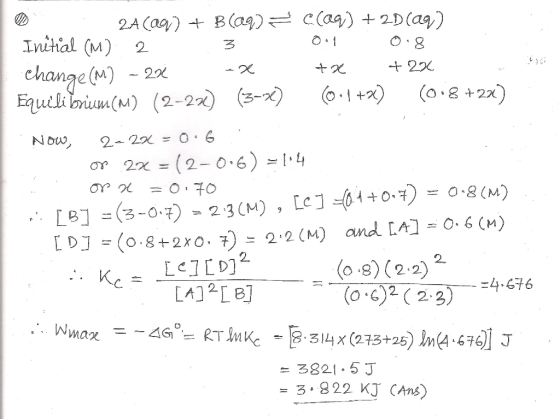
Consider the reaction at 25°C: 2A (aq) B (aq) C (aq) +2D (aq) An experiment was performed with the following initial concentrations: [A] 3.00 M, [B] 3.00 M, [C] = 0.100 M, [D] = 0.800 M The reaction was allowed to proceed until equilibrium was reached at which time [A]-0.900 M What is the value of Wmax for the maximum work that could have been performed...
Just revisiting this question to understand why I got it wrong.
Please show work
Consider the reaction at 25°C: 2A (aq) B (aq) C (aq) +2D (aq) An experiment was performed with the following initial concentrations: [A] 3.00 M, [B] 3.00 M, [C] = 0.100 M, [D] = 0.800 M The reaction was allowed to proceed until equilibrium was reached at which time [A]-0.900 M What is the value of Wmax for the maximum work that could have been performed...
New Problem Vortion Practice Problem Submissions are not permanently recorded Consider the following reaction t251 K:...
 New Problem Vortion Practice Problem Submissions are not permanently recorded Consider the following reaction t251 K: 18 (ma) + B (sa) - 2G (aq) +10 (m) An experiment was performed with the following initial concentrations: A 1.49 M determined that (A) - 0.57 M. What is n o t the initial conditions? 0241 B) - 2.17 MICI - 0.29 M10 - 0.23 M. The reaction was allowed to proceed until equilibrium was reached at which time it was Incorrect 1...
2. The rate of the reaction 2A+B → has been observed at 25°C. From the following...
 2. The rate of the reaction 2A+B → has been observed at 25°C. From the following data, determine the rate law for the reaction and calculate the rate constant. Experiment ) 2 3 4 5 Initial IAI(M) 0.100 0.200 0.400 0.100 0.100 Initial ( B M 0.100 0.100 0.100 0.300 0.600 Initial rate (M/s) 5.50 x 10⁶ 2.20 x 10 8.80 x 10 1.65 x 10 3.30 x 10
Consider the equilibrium reaction: 2A (aq) + 3B (aq) <--> C (aq) (in my notation <-->...
Consider the equilibrium reaction: 2A (aq) + 3B (aq) <--> C (aq) (in my notation <--> means equilibrium arrows) Initially A is present at 6.00 M and B is present at 7.00 M. Also, initially there is no C present. At equilibrium B is present at 1.00 M. What is the Kc for this reaction? ( report your answer to 3 significant figures)
A reaction A(aq)+B(aq)↽−−⇀C(aq)A(aq)+B(aq)↽−−⇀C(aq) has a standard free‑energy change of −3.76 kJ/mol−3.76 kJ/mol at 25 °C.25 °C....
A reaction A(aq)+B(aq)↽−−⇀C(aq)A(aq)+B(aq)↽−−⇀C(aq) has a standard free‑energy change of −3.76 kJ/mol−3.76 kJ/mol at 25 °C.25 °C. What are the concentrations of A,A, B,B, and CC at equilibrium if, at the beginning of the reaction, their concentrations are 0.30 M,0.30 M, 0.40 M,0.40 M, and 0 M,0 M, respectively?
The reversible chemical reaction A(aq)+B(aq)⇌C(aq)+D(aq) has the following equilibrium constant: K=[C][D][A][B]=4.8 Part A: Initially, only A...
The reversible chemical reaction A(aq)+B(aq)⇌C(aq)+D(aq) has the following equilibrium constant: K=[C][D][A][B]=4.8 Part A: Initially, only A and B are present, each at 2.00 mol⋅L−1. What is the final concentration of A once equilibrium is reached? Express your answer to two significant figures and include the appropriate units. Part B: What is the final concentration of D at equilibrium if the initial concentrations are [A] = 1.00 mol⋅L−1and [B] = 2.00 mol⋅L−1 ?
Again, consider the exothermic reaction, with K=3.00: 2A(aq) + B(g) ⇌ C(aq) + D(g) With initial c...
Again, consider the exothermic reaction, with K=3.00: 2A(aq) + B(g) ⇌ C(aq) + D(g) With initial concentrations of [A] = 0.5M, [B] = 2.0M, [C] = 1.0M, and [D] = 1.5M. For each of the following disruptions, predict weather the reaction will go forward (toward products), reverse (towards reactants), or be unchanged. a) [A] increased to 2.0M b) Pressure doubled. c) Volume of solution doubled by dilution. d) The temperature is increased by 100.0oC (15.83 from text) When 1.50mol CO2...
The energy required for the hypothetical reaction 2A+B=2C+2D is 283 kJ as written. How much heat...
 The energy required for the hypothetical reaction 2A+B=2C+2D is 283 kJ as written. How much heat is absorbed when 2.60 mol of A reacts? Express your answer to three significant figures and include the appropriate units. View Available Hint(s) 368 kJ Submit Previous Answers Correct Part B The energy required for the hypothetical reaction 2A+B=2C+2D is 283 kJ as written. How much heat is absorbed when 165 g of A reacts given that A has a molar mass of 46.59...
A reaction A ( aq ) + B ( aq ) − ⇀ ↽ − C...
A reaction A ( aq ) + B ( aq ) − ⇀ ↽ − C ( aq ) has a standard free‑energy change of − 5.46 kJ / mol at 25 °C. What are the concentrations of A , B , and C at equilibrium if, at the beginning of the reaction, their concentrations are 0.30 M, 0.40 M, and 0 M, respectively? How would your answers change if the reaction had a standard free‑energy change of + 5.46...
 help with this question
Consider the reaction at 25°C: 2A (aq) + B (aq) → C (aq) +2D (aq) An experiment was performed with the following initial concentrations: [A] = 2.50 M, [B] = 2.50 M, [C] = 0.250 M, [D] = 0.500 M. The reaction was allowed to proceed until equilibrium was reached at which time [A] = 0.750 M. What is the value of wmax for the maximum work that could have been performed as the reaction began?...
help with this question
Consider the reaction at 25°C: 2A (aq) + B (aq) → C (aq) +2D (aq) An experiment was performed with the following initial concentrations: [A] = 2.50 M, [B] = 2.50 M, [C] = 0.250 M, [D] = 0.500 M. The reaction was allowed to proceed until equilibrium was reached at which time [A] = 0.750 M. What is the value of wmax for the maximum work that could have been performed as the reaction began?...
 Just revisiting this question to understand why I got it wrong.
Please show work
Consider the reaction at 25°C: 2A (aq) B (aq) C (aq) +2D (aq) An experiment was performed with the following initial concentrations: [A] 3.00 M, [B] 3.00 M, [C] = 0.100 M, [D] = 0.800 M The reaction was allowed to proceed until equilibrium was reached at which time [A]-0.900 M What is the value of Wmax for the maximum work that could have been performed...
Just revisiting this question to understand why I got it wrong.
Please show work
Consider the reaction at 25°C: 2A (aq) B (aq) C (aq) +2D (aq) An experiment was performed with the following initial concentrations: [A] 3.00 M, [B] 3.00 M, [C] = 0.100 M, [D] = 0.800 M The reaction was allowed to proceed until equilibrium was reached at which time [A]-0.900 M What is the value of Wmax for the maximum work that could have been performed...
 New Problem Vortion Practice Problem Submissions are not permanently recorded Consider the following reaction t251 K: 18 (ma) + B (sa) - 2G (aq) +10 (m) An experiment was performed with the following initial concentrations: A 1.49 M determined that (A) - 0.57 M. What is n o t the initial conditions? 0241 B) - 2.17 MICI - 0.29 M10 - 0.23 M. The reaction was allowed to proceed until equilibrium was reached at which time it was Incorrect 1...
 2. The rate of the reaction 2A+B → has been observed at 25°C. From the following data, determine the rate law for the reaction and calculate the rate constant. Experiment ) 2 3 4 5 Initial IAI(M) 0.100 0.200 0.400 0.100 0.100 Initial ( B M 0.100 0.100 0.100 0.300 0.600 Initial rate (M/s) 5.50 x 10⁶ 2.20 x 10 8.80 x 10 1.65 x 10 3.30 x 10
 The energy required for the hypothetical reaction 2A+B=2C+2D is 283 kJ as written. How much heat is absorbed when 2.60 mol of A reacts? Express your answer to three significant figures and include the appropriate units. View Available Hint(s) 368 kJ Submit Previous Answers Correct Part B The energy required for the hypothetical reaction 2A+B=2C+2D is 283 kJ as written. How much heat is absorbed when 165 g of A reacts given that A has a molar mass of 46.59...
Most questions answered within 3 hours.
-
Where is the error in this code sequence?
String s1 = "Hello";
String s2 = "ello";...
asked 10 months ago -
Financial data for Joel de Paris, Inc., for last year
follow:
Joel de Paris, Inc.
Balance...
asked 10 months ago -
Consider this reaction:
Al2(SO4)3 (aq)+ BaCl3
(aq) Al2Cl6 (aq)- +
3BaSO4(s) . What is the...
asked 10 months ago -
Suppose that Savneet is considering increasing her
recent random sample from 20 car rentals to 40...
asked 10 months ago -
Trucks arrive at an unloading terminal at an average rate of 120
per hour.
Trucks arrive...
asked 10 months ago -
Why are methanol and ethanol completely soluble in water while
octanol is not very little soluble....
asked 10 months ago -
A facilities manager at a university reads in a research report
that the mean amount of...
asked 10 months ago -
When the CuSO4 is rehydrated by adding water to the anhydrous
compound, is this an endothermic...
asked 10 months ago -
A ray of sunlight is passing from diamond into crown glass; the
angle of incidence is...
asked 10 months ago -
A block of mass 0.249 kg is placed on top of a light, vertical
spring of...
asked 10 months ago -
how do the kidneys compensate in the presences of acidosis
a) trigger hyperventilate
b) reserve acid...
asked 10 months ago -
Question 501 pts
The rental rate of capital to the firm increases. Which of the
following...
asked 10 months ago