
Homework Answers
Q2. (a)  So = So products - So
reactants
So = So products - So
reactants
So
= [8 * So CO2 (g) + 10 * So
H2O (g)] - [2 * So
C4H10 (g) + 13 * So O2
(g)]
So
= [8 * (213.6 J/K.mol) + 10 * (188.83
J/K.mol)] - [2 * (310.0 J/K.mol)
+ 13 * (205.0 J/K.mol)]
So
= 1708.8 J/K + 1888.3 J/K - 620.0 J/K - 2665 J/K
So
= 312.1 J/K
(b)
Go =
Ho - (T) * (So)
where T = standard temperature = 298 K
Go
= (-125 kJ) - (298 K) * (312.1 J/K) * (1 kJ / 1000 J)
Go
= -125 kJ - 93 kJ
Go
= -218 kJ
Since
Go is less than zero, therefore reaction is
spontaneous.
(c) ln(K) = -(Go)
/ (R * T)
where R = constant = 8.314 J/mol-K
T = standard temperature = 298 K
K = equilibrium constant
ln(K) = -(-218 x 103 J) / [(8.314 J/mol-K) * (298 K)]
kn(K) = 88
K = e88
K = 1.64 x 1038
Add Answer to:
(eao 20) anoiteu For 52 FDIDD:C CHo1ce Oneaou bopra eg 2) 2unot old:Toibolno 2. (9 pts)...
In an experiment, 1.000 atm of H2(g) in a 5.00 L container at 25.00°C was reacted under standard ...
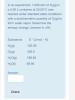 In an experiment, 1.000 atm of H2(g) in a 5.00 L container at 25.00°C was reacted under standard state conditions with a stoichiometric quantity of O2(g) to form water vapor. Determine the entropy change. (answer in J/K) Substance S (J/mol K H2(g) 02(g) H20(g) 188.83 H20)69.95 30.58 205.0 Answer: Check
In an experiment, 1.000 atm of H2(g) in a 5.00 L container at 25.00°C was reacted under standard state conditions with a stoichiometric quantity of O2(g) to form water vapor....
In an experiment, 1.000 atm of H2(g) in a 5.00 L container at 25.00°C was reacted under standard state conditions with a stoichiometric quantity of O2(g) to form water vapor. Determine the entropy change. (answer in J/K) Substance S (J/mol K H2(g) 02(g) H20(g) 188.83 H20)69.95 30.58 205.0 Answer: Check
In an experiment, 1.000 atm of H2(g) in a 5.00 L container at 25.00°C was reacted under standard state conditions with a stoichiometric quantity of O2(g) to form water vapor....
Please explain the correct answer to both questions. Thank you! Incorrect Question 19 0/1 pts The...
 Please explain the correct
answer to both questions. Thank you!
Incorrect Question 19 0/1 pts The value of A Sº for the catalytic hydrogenation of acetylene to ethene, C2H2(g) + H2(g) →C2H4 (g) is_ J/K.mol. Use the following thermodynamic quantities for selected substances at 298.15 K (25°C). Substance AHºf (kJ/mol) AG°f (kJ/mol) S (J/K-mol) 2.84 Carbon C(s, diamond) 1.88 C(s, graphite) 0 C2H2(g) 226.7 C2H4 (g) 52.30 C2H6 (g) -84.68 CO(g) -110.5 CO2 (g) -393.5 209.2 68.11 -32.89 -137.2 -394.4...
Please explain the correct
answer to both questions. Thank you!
Incorrect Question 19 0/1 pts The value of A Sº for the catalytic hydrogenation of acetylene to ethene, C2H2(g) + H2(g) →C2H4 (g) is_ J/K.mol. Use the following thermodynamic quantities for selected substances at 298.15 K (25°C). Substance AHºf (kJ/mol) AG°f (kJ/mol) S (J/K-mol) 2.84 Carbon C(s, diamond) 1.88 C(s, graphite) 0 C2H2(g) 226.7 C2H4 (g) 52.30 C2H6 (g) -84.68 CO(g) -110.5 CO2 (g) -393.5 209.2 68.11 -32.89 -137.2 -394.4...
In an experiment, 1.000 atm of H2(g) in a 10.00 L container at 25.00°C was reacted...
 In an experiment, 1.000 atm of H2(g) in a 10.00 L container at 25.00°C was reacted under standard state conditions with a stoichiometric quantity of O2(g) to form water vapor. Determine the entropy change. (answer in J/K) Substance Hag) O2(g) H2O(g) H2O( /mol.) 130.58 205.0 188.83 69.95
ANSWER EACH QUESTION AND SHOW WORK 4) Using the accompanying data, calculate the standard entropy changes...
 ANSWER EACH QUESTION AND SHOW WORK
4) Using the accompanying data, calculate the standard entropy changes for the following reactions at 25 °C: MgCo. (s) → MgO (s) + CO2 AS(/K-moll) 65.69 2 6.78 213.6 AS (J/K-mol) 2 CH. () + 70, (g) → 4CO2(g) + 6H20 (1) 172.8 205.0 213.6 69.9 5) Calculate the free energy change for this reaction at 25°C. Is the reaction spontaneous? 2 Ca (s) + 02 (g) + 2 Cao (s) AH = -1269.8...
ANSWER EACH QUESTION AND SHOW WORK
4) Using the accompanying data, calculate the standard entropy changes for the following reactions at 25 °C: MgCo. (s) → MgO (s) + CO2 AS(/K-moll) 65.69 2 6.78 213.6 AS (J/K-mol) 2 CH. () + 70, (g) → 4CO2(g) + 6H20 (1) 172.8 205.0 213.6 69.9 5) Calculate the free energy change for this reaction at 25°C. Is the reaction spontaneous? 2 Ca (s) + 02 (g) + 2 Cao (s) AH = -1269.8...
use the following table for the reaction C2H2 (g) + 5/2 O2 (g) = 2CO2 (g)...
use the following table for the reaction C2H2 (g) + 5/2 O2 (g) = 2CO2 (g) + H2O (g) delta H = -1255.5 KJ/mol substance S (J. mol-1. K-1) C2H2 (g) 200.8 C2H4 (g) 219.5 CO (g) 197.6 CO2 (g) 213.6 CO2 (aq) 117.6 H2O (l) 69.91 H2O (g) 188.7 O2 (g) 205.0 O (g) 161.0 O3 (g) 238.8 a. Use the data to calculate delta S in J/K for this reaction b. Calculate delta G in KJ , since the...
how do I do this? Review Intelligent Tutoring Question 18.078 Calculate ΔS"for the following reactions in...
 how do I do this?
Review Intelligent Tutoring Question 18.078 Calculate ΔS"for the following reactions in J K-1 Substance S (J mol-K-) Substance S J mol-K- Agf) AgCIG) Ch(g) H2(g) O-(g) H,0(g) H,oU) 42.55 96.2 223.0 130.6 205.0 188.7 69.96 CaCO6) CaSO,() H.sOA1) CO2(g) NHs(g) HCKg) NH CIG) 92.9 107 157 213.6 192.5 186.7 94.6 Ag(s) + 1 /2 Cl2(g) → AgCl(s) JK- the tolerance is +/-3% H2(g) + 1 /2 02(g) → H2O(g) JK1 the tolerance is +/-3%
how do I do this?
Review Intelligent Tutoring Question 18.078 Calculate ΔS"for the following reactions in J K-1 Substance S (J mol-K-) Substance S J mol-K- Agf) AgCIG) Ch(g) H2(g) O-(g) H,0(g) H,oU) 42.55 96.2 223.0 130.6 205.0 188.7 69.96 CaCO6) CaSO,() H.sOA1) CO2(g) NHs(g) HCKg) NH CIG) 92.9 107 157 213.6 192.5 186.7 94.6 Ag(s) + 1 /2 Cl2(g) → AgCl(s) JK- the tolerance is +/-3% H2(g) + 1 /2 02(g) → H2O(g) JK1 the tolerance is +/-3%
(2) (24 pts) A fuel cell produces electricity via a combustion reaction. A DMFC is a...
 (2) (24 pts) A fuel cell produces electricity via a combustion reaction. A DMFC is a proton-exchange fuel cell that uses methanol CH OH() as the fuel, which reacts with molecular oxygen to produce carbon dioxide and water. (a) (4 pts) Write the balanced combustion reaction for this methanol fuel cell (b) (4 pts) Write the balanced half-reactions occurring at the cathode and anode of this fuel cell (assume standard acidic conditions). (c) (4 pts) Evaluate AG° (kJ) and AE...
step by step please Cis. Thermodynamic Quantities for Selected Substances at 298.15 K (25°C) AHºf AG°f...
 step by step please
Cis. Thermodynamic Quantities for Selected Substances at 298.15 K (25°C) AHºf AG°f S (J/K- Substance KkJ/mol KkJ/mol mol) C(s. 1.88 2.84 2.43 diamond) lo 6 5.69 graphite) C2H2(8) 226.7 209.2 200.8 C2H4 (8) 52.30 68.11 219.4 C2H6 (g) -84.68 -32.89 229.5 CO(g) - 110.5 -137.2 197.9 CO2(g) -393.5 394.4 213.6 H2(g) 130.58 O2 (g) 0 205.0 H20 (1) 285.83 -237.13 69.91 0 The combustion of acetylene in the presence of excess oxygen yields carbon dioxide and...
step by step please
Cis. Thermodynamic Quantities for Selected Substances at 298.15 K (25°C) AHºf AG°f S (J/K- Substance KkJ/mol KkJ/mol mol) C(s. 1.88 2.84 2.43 diamond) lo 6 5.69 graphite) C2H2(8) 226.7 209.2 200.8 C2H4 (8) 52.30 68.11 219.4 C2H6 (g) -84.68 -32.89 229.5 CO(g) - 110.5 -137.2 197.9 CO2(g) -393.5 394.4 213.6 H2(g) 130.58 O2 (g) 0 205.0 H20 (1) 285.83 -237.13 69.91 0 The combustion of acetylene in the presence of excess oxygen yields carbon dioxide and...
2. Lastly, use the table of thermodynamic functions to compute the AHo and ASo for the...
 2. Lastly, use the table of thermodynamic functions to compute the AHo and ASo for the reactions in #1. Then using AH° and AS° and your knowledge of the second law, compute which reactions are spontaneous under standard conditions. You must show all your calcualtions. (7pts) Spontaneous ASo ASuniv ΔΗ Reaction 2H2(g) + 02(g) 2H20() CO2(s)-CO2(g) K (aq)+ Cl (aq)- KCI(s) Thermodynamic Properties at 298 K AH AG Substance kJ/mol kJ/mol 3/(mol-K) Ag(s) Ag (aq) AgBr(s) AgCls) Agl(s) Cl:(g) CI(8)...
3 attempts left Check my work Enter your answer in the provided box. Calculate AG for...
 3 attempts left Check my work Enter your answer in the provided box. Calculate AG for the reaction at 25°C. 2C6H61) + 1502(8) 12C028) + 6H20(1) agº = kJ AH° (kJ/mol Agº (kJ/mol) sº (J/K mol) 5.69 2.4 Substance C(graphite) C(diamond) CO(g) CO2(g) CO2(aq) C0,- (aq) O(g) O2(8) O3(aq) O3(8) H20(1) CH 1.90 -110.5 -393.5 -412.9 -676.3 249.4 2.87 --137.3 -394.4 -386.2 --528.1 230.1 0 16.3 163.4 -237.2 124.5 197.9 213.6 121.3 -53.1 160.95 205.0 110.88 237.6 -12.09 142.2 -285.8...
 In an experiment, 1.000 atm of H2(g) in a 5.00 L container at 25.00°C was reacted under standard state conditions with a stoichiometric quantity of O2(g) to form water vapor. Determine the entropy change. (answer in J/K) Substance S (J/mol K H2(g) 02(g) H20(g) 188.83 H20)69.95 30.58 205.0 Answer: Check
In an experiment, 1.000 atm of H2(g) in a 5.00 L container at 25.00°C was reacted under standard state conditions with a stoichiometric quantity of O2(g) to form water vapor....
In an experiment, 1.000 atm of H2(g) in a 5.00 L container at 25.00°C was reacted under standard state conditions with a stoichiometric quantity of O2(g) to form water vapor. Determine the entropy change. (answer in J/K) Substance S (J/mol K H2(g) 02(g) H20(g) 188.83 H20)69.95 30.58 205.0 Answer: Check
In an experiment, 1.000 atm of H2(g) in a 5.00 L container at 25.00°C was reacted under standard state conditions with a stoichiometric quantity of O2(g) to form water vapor....
 Please explain the correct
answer to both questions. Thank you!
Incorrect Question 19 0/1 pts The value of A Sº for the catalytic hydrogenation of acetylene to ethene, C2H2(g) + H2(g) →C2H4 (g) is_ J/K.mol. Use the following thermodynamic quantities for selected substances at 298.15 K (25°C). Substance AHºf (kJ/mol) AG°f (kJ/mol) S (J/K-mol) 2.84 Carbon C(s, diamond) 1.88 C(s, graphite) 0 C2H2(g) 226.7 C2H4 (g) 52.30 C2H6 (g) -84.68 CO(g) -110.5 CO2 (g) -393.5 209.2 68.11 -32.89 -137.2 -394.4...
Please explain the correct
answer to both questions. Thank you!
Incorrect Question 19 0/1 pts The value of A Sº for the catalytic hydrogenation of acetylene to ethene, C2H2(g) + H2(g) →C2H4 (g) is_ J/K.mol. Use the following thermodynamic quantities for selected substances at 298.15 K (25°C). Substance AHºf (kJ/mol) AG°f (kJ/mol) S (J/K-mol) 2.84 Carbon C(s, diamond) 1.88 C(s, graphite) 0 C2H2(g) 226.7 C2H4 (g) 52.30 C2H6 (g) -84.68 CO(g) -110.5 CO2 (g) -393.5 209.2 68.11 -32.89 -137.2 -394.4...
 In an experiment, 1.000 atm of H2(g) in a 10.00 L container at 25.00°C was reacted under standard state conditions with a stoichiometric quantity of O2(g) to form water vapor. Determine the entropy change. (answer in J/K) Substance Hag) O2(g) H2O(g) H2O( /mol.) 130.58 205.0 188.83 69.95
 ANSWER EACH QUESTION AND SHOW WORK
4) Using the accompanying data, calculate the standard entropy changes for the following reactions at 25 °C: MgCo. (s) → MgO (s) + CO2 AS(/K-moll) 65.69 2 6.78 213.6 AS (J/K-mol) 2 CH. () + 70, (g) → 4CO2(g) + 6H20 (1) 172.8 205.0 213.6 69.9 5) Calculate the free energy change for this reaction at 25°C. Is the reaction spontaneous? 2 Ca (s) + 02 (g) + 2 Cao (s) AH = -1269.8...
ANSWER EACH QUESTION AND SHOW WORK
4) Using the accompanying data, calculate the standard entropy changes for the following reactions at 25 °C: MgCo. (s) → MgO (s) + CO2 AS(/K-moll) 65.69 2 6.78 213.6 AS (J/K-mol) 2 CH. () + 70, (g) → 4CO2(g) + 6H20 (1) 172.8 205.0 213.6 69.9 5) Calculate the free energy change for this reaction at 25°C. Is the reaction spontaneous? 2 Ca (s) + 02 (g) + 2 Cao (s) AH = -1269.8...
 how do I do this?
Review Intelligent Tutoring Question 18.078 Calculate ΔS"for the following reactions in J K-1 Substance S (J mol-K-) Substance S J mol-K- Agf) AgCIG) Ch(g) H2(g) O-(g) H,0(g) H,oU) 42.55 96.2 223.0 130.6 205.0 188.7 69.96 CaCO6) CaSO,() H.sOA1) CO2(g) NHs(g) HCKg) NH CIG) 92.9 107 157 213.6 192.5 186.7 94.6 Ag(s) + 1 /2 Cl2(g) → AgCl(s) JK- the tolerance is +/-3% H2(g) + 1 /2 02(g) → H2O(g) JK1 the tolerance is +/-3%
how do I do this?
Review Intelligent Tutoring Question 18.078 Calculate ΔS"for the following reactions in J K-1 Substance S (J mol-K-) Substance S J mol-K- Agf) AgCIG) Ch(g) H2(g) O-(g) H,0(g) H,oU) 42.55 96.2 223.0 130.6 205.0 188.7 69.96 CaCO6) CaSO,() H.sOA1) CO2(g) NHs(g) HCKg) NH CIG) 92.9 107 157 213.6 192.5 186.7 94.6 Ag(s) + 1 /2 Cl2(g) → AgCl(s) JK- the tolerance is +/-3% H2(g) + 1 /2 02(g) → H2O(g) JK1 the tolerance is +/-3%
 (2) (24 pts) A fuel cell produces electricity via a combustion reaction. A DMFC is a proton-exchange fuel cell that uses methanol CH OH() as the fuel, which reacts with molecular oxygen to produce carbon dioxide and water. (a) (4 pts) Write the balanced combustion reaction for this methanol fuel cell (b) (4 pts) Write the balanced half-reactions occurring at the cathode and anode of this fuel cell (assume standard acidic conditions). (c) (4 pts) Evaluate AG° (kJ) and AE...
 step by step please
Cis. Thermodynamic Quantities for Selected Substances at 298.15 K (25°C) AHºf AG°f S (J/K- Substance KkJ/mol KkJ/mol mol) C(s. 1.88 2.84 2.43 diamond) lo 6 5.69 graphite) C2H2(8) 226.7 209.2 200.8 C2H4 (8) 52.30 68.11 219.4 C2H6 (g) -84.68 -32.89 229.5 CO(g) - 110.5 -137.2 197.9 CO2(g) -393.5 394.4 213.6 H2(g) 130.58 O2 (g) 0 205.0 H20 (1) 285.83 -237.13 69.91 0 The combustion of acetylene in the presence of excess oxygen yields carbon dioxide and...
step by step please
Cis. Thermodynamic Quantities for Selected Substances at 298.15 K (25°C) AHºf AG°f S (J/K- Substance KkJ/mol KkJ/mol mol) C(s. 1.88 2.84 2.43 diamond) lo 6 5.69 graphite) C2H2(8) 226.7 209.2 200.8 C2H4 (8) 52.30 68.11 219.4 C2H6 (g) -84.68 -32.89 229.5 CO(g) - 110.5 -137.2 197.9 CO2(g) -393.5 394.4 213.6 H2(g) 130.58 O2 (g) 0 205.0 H20 (1) 285.83 -237.13 69.91 0 The combustion of acetylene in the presence of excess oxygen yields carbon dioxide and...
 2. Lastly, use the table of thermodynamic functions to compute the AHo and ASo for the reactions in #1. Then using AH° and AS° and your knowledge of the second law, compute which reactions are spontaneous under standard conditions. You must show all your calcualtions. (7pts) Spontaneous ASo ASuniv ΔΗ Reaction 2H2(g) + 02(g) 2H20() CO2(s)-CO2(g) K (aq)+ Cl (aq)- KCI(s) Thermodynamic Properties at 298 K AH AG Substance kJ/mol kJ/mol 3/(mol-K) Ag(s) Ag (aq) AgBr(s) AgCls) Agl(s) Cl:(g) CI(8)...
 3 attempts left Check my work Enter your answer in the provided box. Calculate AG for the reaction at 25°C. 2C6H61) + 1502(8) 12C028) + 6H20(1) agº = kJ AH° (kJ/mol Agº (kJ/mol) sº (J/K mol) 5.69 2.4 Substance C(graphite) C(diamond) CO(g) CO2(g) CO2(aq) C0,- (aq) O(g) O2(8) O3(aq) O3(8) H20(1) CH 1.90 -110.5 -393.5 -412.9 -676.3 249.4 2.87 --137.3 -394.4 -386.2 --528.1 230.1 0 16.3 163.4 -237.2 124.5 197.9 213.6 121.3 -53.1 160.95 205.0 110.88 237.6 -12.09 142.2 -285.8...
Most questions answered within 3 hours.
-
Where is the error in this code sequence?
String s1 = "Hello";
String s2 = "ello";...
asked 10 months ago -
Financial data for Joel de Paris, Inc., for last year
follow:
Joel de Paris, Inc.
Balance...
asked 10 months ago -
Consider this reaction:
Al2(SO4)3 (aq)+ BaCl3
(aq) Al2Cl6 (aq)- +
3BaSO4(s) . What is the...
asked 10 months ago -
Suppose that Savneet is considering increasing her
recent random sample from 20 car rentals to 40...
asked 10 months ago -
Trucks arrive at an unloading terminal at an average rate of 120
per hour.
Trucks arrive...
asked 10 months ago -
Why are methanol and ethanol completely soluble in water while
octanol is not very little soluble....
asked 10 months ago -
A facilities manager at a university reads in a research report
that the mean amount of...
asked 10 months ago -
When the CuSO4 is rehydrated by adding water to the anhydrous
compound, is this an endothermic...
asked 10 months ago -
A ray of sunlight is passing from diamond into crown glass; the
angle of incidence is...
asked 10 months ago -
A block of mass 0.249 kg is placed on top of a light, vertical
spring of...
asked 10 months ago -
how do the kidneys compensate in the presences of acidosis
a) trigger hyperventilate
b) reserve acid...
asked 10 months ago -
Question 501 pts
The rental rate of capital to the firm increases. Which of the
following...
asked 10 months ago