

Homework Answers
Add Answer to:
Complete Analysis of Heat Engine Goal Solve for the efficiency of a heat engine using a...
+ -/24 points Complete Analysis of Heat Engine Goal Solve for the efficiency of a heat...
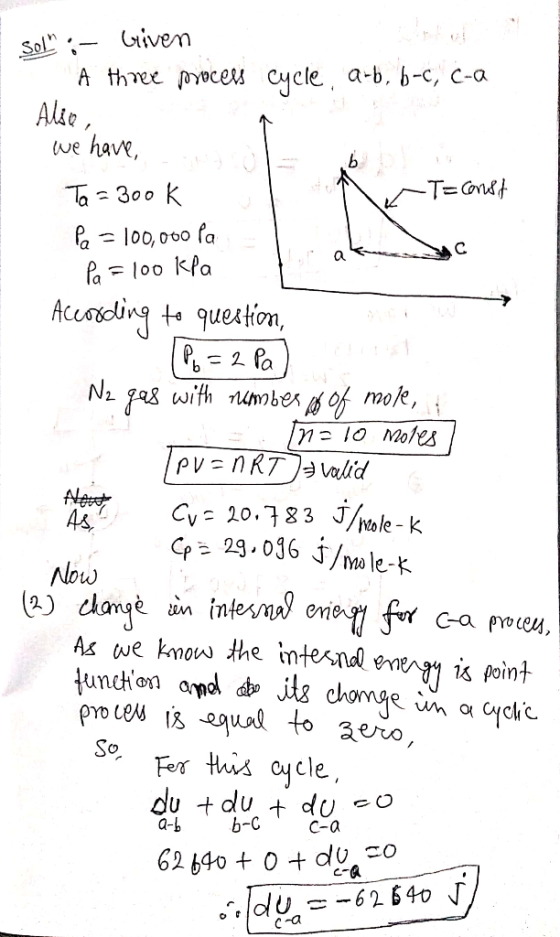
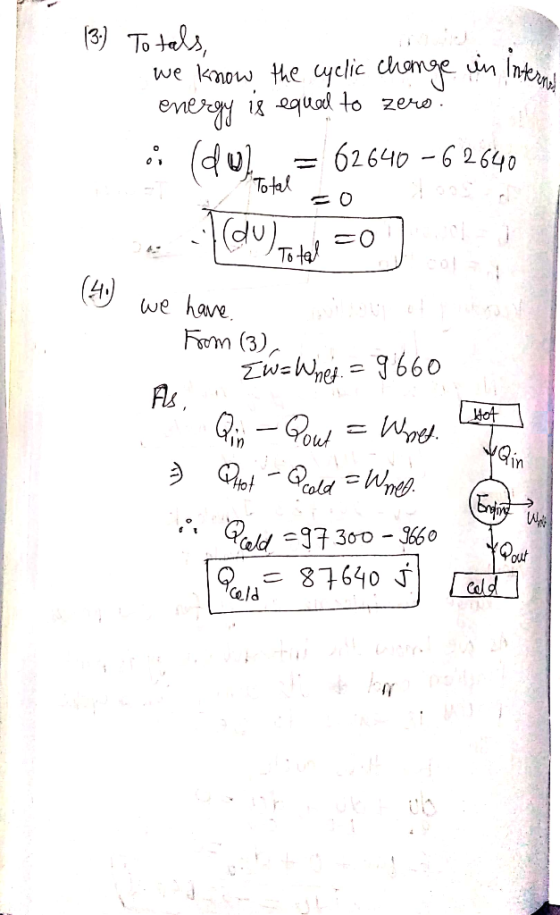
 + -/24 points Complete Analysis of Heat Engine Goal Solve for the efficiency of a heat engine using a five-step process the includes: 1. Making a state table. 2. Making a process table. 3. Calculating the totals for Work, Heat, and Internal-Energy-Change. 4. Identifying the heat input (hot reservoir) and output (cold reservoir). 5. Calculating the efficiency of the engine. isothermal Problem Shown in the figure to the right is a cyclic process undergone by a heat engine. Your heat...
Goal Solve for the efficiency of a heat engine using a five-step process the includes: 1....
 Goal Solve for the efficiency of a heat engine using a five-step process the includes: 1. Making a state table. 2. Making a process table. 3. Calculating the totals for Work, Heat, and Internal-Energy-Change. 4. Identifying the heat input (hot reservoir) and output (cold reservoir). 5. Calculating the efficiency of the engine. isothermal Problem Shown in the figure to the right is a cyclic process undergone by a heat engine. Your heat engine shall use 10.0 moles of nitrogen gas...
Goal Solve for the performance coefficient of a refrigerator using a five- step process the includes:...
 Goal Solve for the performance coefficient of a refrigerator using a five- step process the includes: 1. Making a state table. 2. Making a process table. 3. Calculating the totals for Work, Heat, and Internal-Energy-Change. 4. Identifying the heat input (cold reservoir) and output (hot reservoir). 5. Calculating the performance coefficient of the refrigerator. isothermal Problem Shown in the figure to the right is a cyclic process undergone by a refrigerator. Your refrigerator shall use 8.0 moles of helium gas...
Solution (1) Fill in the State Table (all pressures in Pascals, all volumes in cubic meters,...
 Solution (1) Fill in the State Table (all pressures in Pascals, all volumes in cubic meters, all temperatures in K). Pressure 100000 Volume 0.2 Temperature 300 100000 902.9 300000 0.2 902.9 du Work 40000 Heat 59.72 99.72 a- >b (2) Fill in the Process Table (all entries in Joules). -65900 O -65.9 X > c- 0 -59720 -59720 (3) Find the Totals: Work = -25900 Heat = -25900 dU = 0 X ] (4) Find the heat input (from "cold...
please help. I did most of it, I just need the ones that were marked incorrect....
 please help. I did most of it, I just need the ones that were
marked incorrect. Thanks!
Complete Analysis of a Refrigerator Goal Solve for the performance coefficient of a refrigerator using a five-step process the includes: 1. Making a state table. 2. Making a process table. 3. Calculating the totals for Work, Heat, and Internal-Energy-Change. 4. Identifying the heat input (cold reservoir) and output (hot reservoir). 5. Calculating the performance coefficient of the refrigerator. isothermal Problem Shown in the...
please help. I did most of it, I just need the ones that were
marked incorrect. Thanks!
Complete Analysis of a Refrigerator Goal Solve for the performance coefficient of a refrigerator using a five-step process the includes: 1. Making a state table. 2. Making a process table. 3. Calculating the totals for Work, Heat, and Internal-Energy-Change. 4. Identifying the heat input (cold reservoir) and output (hot reservoir). 5. Calculating the performance coefficient of the refrigerator. isothermal Problem Shown in the...
A heat engine with an efficiency of 35% does 1200 J of work. (a) How much...
A heat engine with an efficiency of 35% does 1200 J of work. (a) How much energy (in Joules) is extracted from the hot reservoir? (b) How much energy (in Joules) is exhausted to the cold reservoir?
Part A A Carnot engine has an efficiency e = 0.25. The temperature of the cold...
Part A A Carnot engine has an efficiency e = 0.25. The temperature of the cold reservoir is 250 K. What is the temperature of the hot reservoir? Express your answer in kelvins. Part B What is the change of entropy of the engine if it absorbs 160 J of heat energy during an isothermal expansion? Express your answer in joules per kelvin.
IP A heat engine does 3400 J of work with an efficiency of 0.20. Find the...
IP A heat engine does 3400 J of work with an efficiency of 0.20. Find the heat taken in from the hot reservoir. Find the heat given off to the cold reservoir.
[3] A heat engine is reported to operate with 25 % efficiency when the cold reservoir...
 [3] A heat engine is reported to operate with 25 % efficiency when the cold reservoir is at 0° C. (a) Assuming this engine follows the Carnot cycle, what is the temperature of the hot reservoir? (b) Suppose the heat input to this engine was 10 J. Calculate the work done by this engine c) Suppose the heat input to this engine was 5). Calculate the heat rejected by this engine.
The input heat of a Carnot engine is 3,000 J. The temperature of a hot reservoir...
The input heat of a Carnot engine is 3,000 J. The temperature of a hot reservoir is 600 K and that of a cold reservoir is 300 K. What is the work done? Hint: The efficiency e of a Carnot engine is defined as the ratio of the work done, W, by the engine to the input heat QH : e=W/QH. W=QH – QC, where Qc is the output heat. That is, e=1-Qc/QH =1-Tc/TH, where Tc for a temperature of...
 + -/24 points Complete Analysis of Heat Engine Goal Solve for the efficiency of a heat engine using a five-step process the includes: 1. Making a state table. 2. Making a process table. 3. Calculating the totals for Work, Heat, and Internal-Energy-Change. 4. Identifying the heat input (hot reservoir) and output (cold reservoir). 5. Calculating the efficiency of the engine. isothermal Problem Shown in the figure to the right is a cyclic process undergone by a heat engine. Your heat...
 Goal Solve for the efficiency of a heat engine using a five-step process the includes: 1. Making a state table. 2. Making a process table. 3. Calculating the totals for Work, Heat, and Internal-Energy-Change. 4. Identifying the heat input (hot reservoir) and output (cold reservoir). 5. Calculating the efficiency of the engine. isothermal Problem Shown in the figure to the right is a cyclic process undergone by a heat engine. Your heat engine shall use 10.0 moles of nitrogen gas...
 Goal Solve for the performance coefficient of a refrigerator using a five- step process the includes: 1. Making a state table. 2. Making a process table. 3. Calculating the totals for Work, Heat, and Internal-Energy-Change. 4. Identifying the heat input (cold reservoir) and output (hot reservoir). 5. Calculating the performance coefficient of the refrigerator. isothermal Problem Shown in the figure to the right is a cyclic process undergone by a refrigerator. Your refrigerator shall use 8.0 moles of helium gas...
 Solution (1) Fill in the State Table (all pressures in Pascals, all volumes in cubic meters, all temperatures in K). Pressure 100000 Volume 0.2 Temperature 300 100000 902.9 300000 0.2 902.9 du Work 40000 Heat 59.72 99.72 a- >b (2) Fill in the Process Table (all entries in Joules). -65900 O -65.9 X > c- 0 -59720 -59720 (3) Find the Totals: Work = -25900 Heat = -25900 dU = 0 X ] (4) Find the heat input (from "cold...
 please help. I did most of it, I just need the ones that were
marked incorrect. Thanks!
Complete Analysis of a Refrigerator Goal Solve for the performance coefficient of a refrigerator using a five-step process the includes: 1. Making a state table. 2. Making a process table. 3. Calculating the totals for Work, Heat, and Internal-Energy-Change. 4. Identifying the heat input (cold reservoir) and output (hot reservoir). 5. Calculating the performance coefficient of the refrigerator. isothermal Problem Shown in the...
please help. I did most of it, I just need the ones that were
marked incorrect. Thanks!
Complete Analysis of a Refrigerator Goal Solve for the performance coefficient of a refrigerator using a five-step process the includes: 1. Making a state table. 2. Making a process table. 3. Calculating the totals for Work, Heat, and Internal-Energy-Change. 4. Identifying the heat input (cold reservoir) and output (hot reservoir). 5. Calculating the performance coefficient of the refrigerator. isothermal Problem Shown in the...
 [3] A heat engine is reported to operate with 25 % efficiency when the cold reservoir is at 0° C. (a) Assuming this engine follows the Carnot cycle, what is the temperature of the hot reservoir? (b) Suppose the heat input to this engine was 10 J. Calculate the work done by this engine c) Suppose the heat input to this engine was 5). Calculate the heat rejected by this engine.
Most questions answered within 3 hours.
-
Where is the error in this code sequence?
String s1 = "Hello";
String s2 = "ello";...
asked 10 months ago -
Financial data for Joel de Paris, Inc., for last year
follow:
Joel de Paris, Inc.
Balance...
asked 10 months ago -
Consider this reaction:
Al2(SO4)3 (aq)+ BaCl3
(aq) Al2Cl6 (aq)- +
3BaSO4(s) . What is the...
asked 10 months ago -
Suppose that Savneet is considering increasing her
recent random sample from 20 car rentals to 40...
asked 10 months ago -
Trucks arrive at an unloading terminal at an average rate of 120
per hour.
Trucks arrive...
asked 10 months ago -
Why are methanol and ethanol completely soluble in water while
octanol is not very little soluble....
asked 10 months ago -
A facilities manager at a university reads in a research report
that the mean amount of...
asked 10 months ago -
When the CuSO4 is rehydrated by adding water to the anhydrous
compound, is this an endothermic...
asked 10 months ago -
A ray of sunlight is passing from diamond into crown glass; the
angle of incidence is...
asked 10 months ago -
A block of mass 0.249 kg is placed on top of a light, vertical
spring of...
asked 10 months ago -
how do the kidneys compensate in the presences of acidosis
a) trigger hyperventilate
b) reserve acid...
asked 10 months ago -
Question 501 pts
The rental rate of capital to the firm increases. Which of the
following...
asked 10 months ago