
Homework Answers
By using the property of matrix multiplication and trigonometric identity we can prove that
A^2=I

Add Answer to:
(c) Evaluate (A B)C and AT (BC) and show that they are equal. 4. Show that...
Two n x n matrices A and B are called similar if there is an invertible...
 Two n x n matrices A and B are called similar if there is an invertible matrix P such that B = P-AP. Show that two similar matrices enjoy the following properties. (a) They have the same determinant. (b) They have the same eigenvalues: specifically, show that if v is an eigenvector of A with eigenvalue 1, then P-lv is an eigenvector of B with eigenvalue l. (c) For any polynomial p(x), P(A) = 0 is equivalent to p(B) =...
4. Evaluate the following integrals using the Residue Theorem. Justify your calculations, show th...
 4. Evaluate the following integrals using the Residue Theorem. Justify your calculations, show the work. (10 points each) a) 12 cos a + 13 2 da b) (x2 +6x + 10)2 x sin 2x 24 13 da: c)
4. Evaluate the following integrals using the Residue Theorem. Justify your calculations, show the work. (10 points each) a) 12 cos a + 13 2 da b) (x2 +6x + 10)2 x sin 2x 24 13 da: c)
4. Evaluate the following integrals using the Residue Theorem. Justify your calculations, show the work. (10 points each) a) 12 cos a + 13 2 da b) (x2 +6x + 10)2 x sin 2x 24 13 da: c)
Seard 2. Evaluate without using a calculator. Draw a picture. Show and label where your answer...
 Seard 2. Evaluate without using a calculator. Draw a picture. Show and label where your answer lies. What is the reference angle? Write your answer as an exact value. You must show your work. Do not skip steps. v2 2 a. sin b. tan (13) 3. Find the length of the arc s intercepted by a central angle 0 = 330 in a circle of radius r =6 in. Round your answer to the nearest tenth. 1 4. If cos...
plz show steps thx 5. a) Evaluate st -2x + 7x? dx. b) Evaluate: [** sin(x*...
 plz show steps thx
5. a) Evaluate st -2x + 7x? dx. b) Evaluate: [** sin(x* +1]dx. c) Evaluate: [(3x? –5x+4-4e”)dx
plz show steps thx
5. a) Evaluate st -2x + 7x? dx. b) Evaluate: [** sin(x* +1]dx. c) Evaluate: [(3x? –5x+4-4e”)dx
I have question about 5b and c. For b I think i got it, but I'm...
 I have question about 5b and c. For b I think i got it, but I'm
not so sure about c.
5. Let B be the following matrix in reduced row-echelon form: 1 0 - 1 0 0 1 2 B= 0 0 0 0 0 0 0 (a) (3 pts) Let C be a matrix with rref(C) B. Find a basis of ker(C). (b) (3 pts) Find two matrices A1 and A2 so that rref(A1) rref(A2) im(Au) # im(A2)....
I have question about 5b and c. For b I think i got it, but I'm
not so sure about c.
5. Let B be the following matrix in reduced row-echelon form: 1 0 - 1 0 0 1 2 B= 0 0 0 0 0 0 0 (a) (3 pts) Let C be a matrix with rref(C) B. Find a basis of ker(C). (b) (3 pts) Find two matrices A1 and A2 so that rref(A1) rref(A2) im(Au) # im(A2)....
Problem 5: Evaluate log(x) Jo 4+2 0 3. Show that 2x cos(e) Jo 1-cos(0) Problem 5: Evaluate log(x) Jo 4+2 0 3. Show that 2x cos(e) Jo 1-cos(0)
 Problem 5: Evaluate log(x) Jo 4+2 0 3. Show that 2x cos(e) Jo 1-cos(0)
Problem 5: Evaluate log(x) Jo 4+2 0 3. Show that 2x cos(e) Jo 1-cos(0)
Problem 5: Evaluate log(x) Jo 4+2 0 3. Show that 2x cos(e) Jo 1-cos(0)
-2x +1, if x s -1 For the function f(x)= 2,1. ifxs- 6. I. Evaluate: a) f(-2) b) f(-1) c) f(o) II. Graph the function f(x) 5 2 -3 -5 7. Expand the following logarithmic expression using the prope...
 -2x +1, if x s -1 For the function f(x)= 2,1. ifxs- 6. I. Evaluate: a) f(-2) b) f(-1) c) f(o) II. Graph the function f(x) 5 2 -3 -5 7. Expand the following logarithmic expression using the properties of the logarith Assume all variables are positive. In Ve , find sin θ and tan θ, where θ terminates in the third quadra If cos θ 8.
-2x +1, if x s -1 For the function f(x)= 2,1. ifxs- 6....
-2x +1, if x s -1 For the function f(x)= 2,1. ifxs- 6. I. Evaluate: a) f(-2) b) f(-1) c) f(o) II. Graph the function f(x) 5 2 -3 -5 7. Expand the following logarithmic expression using the properties of the logarith Assume all variables are positive. In Ve , find sin θ and tan θ, where θ terminates in the third quadra If cos θ 8.
-2x +1, if x s -1 For the function f(x)= 2,1. ifxs- 6....
Please answer # 22 and 24 hapter 1 Systems of Linear Equations and Matrices *21. Suppose...
 Please answer # 22 and 24
hapter 1 Systems of Linear Equations and Matrices *21. Suppose that A is n × m and B is m × n so that AB is n × n. Show that AB is no invertible if n> m. [Hint: Show that there is a nonzero vector x such that AB then apply Theorem 6.] and 22.) Use the methods of this section to find the inverses of the following matrices complex entries: 1- 0...
Please answer # 22 and 24
hapter 1 Systems of Linear Equations and Matrices *21. Suppose that A is n × m and B is m × n so that AB is n × n. Show that AB is no invertible if n> m. [Hint: Show that there is a nonzero vector x such that AB then apply Theorem 6.] and 22.) Use the methods of this section to find the inverses of the following matrices complex entries: 1- 0...
undetermined coefficents solutions with designated method please complete circled equations 4. Find the general solution by...
 undetermined coefficents solutions with designated method
please complete circled equations
4. Find the general solution by undetermined coethcies "+4y Sr +4sin(2). cos(2) +c2 sin(2r). SOLUTION: The homogeneous solution is +4-02 does match ga so we must multiply by z. So For the particular solution, Se Ae2 which does not match h. But B cos(2z)+Csin(2) Ae Br cos(2x)+ Cr sin(2r) (Bs cos(2x) )" = 0cm(2x)-,4B sin(2x)-4B2 cos(2z), Using ()"-f'g+2f's+is", we have Ca sin(2x)Osin(2r)+4C cos(22)-4Cz sin(2r). So plugging Vo in for y,...
undetermined coefficents solutions with designated method
please complete circled equations
4. Find the general solution by undetermined coethcies "+4y Sr +4sin(2). cos(2) +c2 sin(2r). SOLUTION: The homogeneous solution is +4-02 does match ga so we must multiply by z. So For the particular solution, Se Ae2 which does not match h. But B cos(2z)+Csin(2) Ae Br cos(2x)+ Cr sin(2r) (Bs cos(2x) )" = 0cm(2x)-,4B sin(2x)-4B2 cos(2z), Using ()"-f'g+2f's+is", we have Ca sin(2x)Osin(2r)+4C cos(22)-4Cz sin(2r). So plugging Vo in for y,...
4. a) Prove or verify that (A, BC] = [A, B] + BACI b) For a...
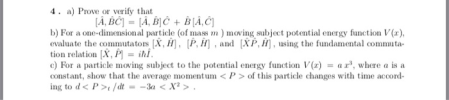 4. a) Prove or verify that (A, BC] = [A, B] + BACI b) For a one-dimensional particle (of mass m ) moving subject potential energy function V (2), evaluate the commutators (X, H, (P, H, and (XP, H, using the fundamental commuta- tion relation [XP] = ini. c) For a particle moving subject to the potential energy function V ) = ar, where a is a constant, show that the average momentum <P> of this particle changes with time...
 Two n x n matrices A and B are called similar if there is an invertible matrix P such that B = P-AP. Show that two similar matrices enjoy the following properties. (a) They have the same determinant. (b) They have the same eigenvalues: specifically, show that if v is an eigenvector of A with eigenvalue 1, then P-lv is an eigenvector of B with eigenvalue l. (c) For any polynomial p(x), P(A) = 0 is equivalent to p(B) =...
 4. Evaluate the following integrals using the Residue Theorem. Justify your calculations, show the work. (10 points each) a) 12 cos a + 13 2 da b) (x2 +6x + 10)2 x sin 2x 24 13 da: c)
4. Evaluate the following integrals using the Residue Theorem. Justify your calculations, show the work. (10 points each) a) 12 cos a + 13 2 da b) (x2 +6x + 10)2 x sin 2x 24 13 da: c)
4. Evaluate the following integrals using the Residue Theorem. Justify your calculations, show the work. (10 points each) a) 12 cos a + 13 2 da b) (x2 +6x + 10)2 x sin 2x 24 13 da: c)
 Seard 2. Evaluate without using a calculator. Draw a picture. Show and label where your answer lies. What is the reference angle? Write your answer as an exact value. You must show your work. Do not skip steps. v2 2 a. sin b. tan (13) 3. Find the length of the arc s intercepted by a central angle 0 = 330 in a circle of radius r =6 in. Round your answer to the nearest tenth. 1 4. If cos...
 plz show steps thx
5. a) Evaluate st -2x + 7x? dx. b) Evaluate: [** sin(x* +1]dx. c) Evaluate: [(3x? –5x+4-4e”)dx
plz show steps thx
5. a) Evaluate st -2x + 7x? dx. b) Evaluate: [** sin(x* +1]dx. c) Evaluate: [(3x? –5x+4-4e”)dx
 I have question about 5b and c. For b I think i got it, but I'm
not so sure about c.
5. Let B be the following matrix in reduced row-echelon form: 1 0 - 1 0 0 1 2 B= 0 0 0 0 0 0 0 (a) (3 pts) Let C be a matrix with rref(C) B. Find a basis of ker(C). (b) (3 pts) Find two matrices A1 and A2 so that rref(A1) rref(A2) im(Au) # im(A2)....
I have question about 5b and c. For b I think i got it, but I'm
not so sure about c.
5. Let B be the following matrix in reduced row-echelon form: 1 0 - 1 0 0 1 2 B= 0 0 0 0 0 0 0 (a) (3 pts) Let C be a matrix with rref(C) B. Find a basis of ker(C). (b) (3 pts) Find two matrices A1 and A2 so that rref(A1) rref(A2) im(Au) # im(A2)....
 Problem 5: Evaluate log(x) Jo 4+2 0 3. Show that 2x cos(e) Jo 1-cos(0)
Problem 5: Evaluate log(x) Jo 4+2 0 3. Show that 2x cos(e) Jo 1-cos(0)
Problem 5: Evaluate log(x) Jo 4+2 0 3. Show that 2x cos(e) Jo 1-cos(0)
 -2x +1, if x s -1 For the function f(x)= 2,1. ifxs- 6. I. Evaluate: a) f(-2) b) f(-1) c) f(o) II. Graph the function f(x) 5 2 -3 -5 7. Expand the following logarithmic expression using the properties of the logarith Assume all variables are positive. In Ve , find sin θ and tan θ, where θ terminates in the third quadra If cos θ 8.
-2x +1, if x s -1 For the function f(x)= 2,1. ifxs- 6....
-2x +1, if x s -1 For the function f(x)= 2,1. ifxs- 6. I. Evaluate: a) f(-2) b) f(-1) c) f(o) II. Graph the function f(x) 5 2 -3 -5 7. Expand the following logarithmic expression using the properties of the logarith Assume all variables are positive. In Ve , find sin θ and tan θ, where θ terminates in the third quadra If cos θ 8.
-2x +1, if x s -1 For the function f(x)= 2,1. ifxs- 6....
 Please answer # 22 and 24
hapter 1 Systems of Linear Equations and Matrices *21. Suppose that A is n × m and B is m × n so that AB is n × n. Show that AB is no invertible if n> m. [Hint: Show that there is a nonzero vector x such that AB then apply Theorem 6.] and 22.) Use the methods of this section to find the inverses of the following matrices complex entries: 1- 0...
Please answer # 22 and 24
hapter 1 Systems of Linear Equations and Matrices *21. Suppose that A is n × m and B is m × n so that AB is n × n. Show that AB is no invertible if n> m. [Hint: Show that there is a nonzero vector x such that AB then apply Theorem 6.] and 22.) Use the methods of this section to find the inverses of the following matrices complex entries: 1- 0...
 undetermined coefficents solutions with designated method
please complete circled equations
4. Find the general solution by undetermined coethcies "+4y Sr +4sin(2). cos(2) +c2 sin(2r). SOLUTION: The homogeneous solution is +4-02 does match ga so we must multiply by z. So For the particular solution, Se Ae2 which does not match h. But B cos(2z)+Csin(2) Ae Br cos(2x)+ Cr sin(2r) (Bs cos(2x) )" = 0cm(2x)-,4B sin(2x)-4B2 cos(2z), Using ()"-f'g+2f's+is", we have Ca sin(2x)Osin(2r)+4C cos(22)-4Cz sin(2r). So plugging Vo in for y,...
undetermined coefficents solutions with designated method
please complete circled equations
4. Find the general solution by undetermined coethcies "+4y Sr +4sin(2). cos(2) +c2 sin(2r). SOLUTION: The homogeneous solution is +4-02 does match ga so we must multiply by z. So For the particular solution, Se Ae2 which does not match h. But B cos(2z)+Csin(2) Ae Br cos(2x)+ Cr sin(2r) (Bs cos(2x) )" = 0cm(2x)-,4B sin(2x)-4B2 cos(2z), Using ()"-f'g+2f's+is", we have Ca sin(2x)Osin(2r)+4C cos(22)-4Cz sin(2r). So plugging Vo in for y,...
 4. a) Prove or verify that (A, BC] = [A, B] + BACI b) For a one-dimensional particle (of mass m ) moving subject potential energy function V (2), evaluate the commutators (X, H, (P, H, and (XP, H, using the fundamental commuta- tion relation [XP] = ini. c) For a particle moving subject to the potential energy function V ) = ar, where a is a constant, show that the average momentum <P> of this particle changes with time...
Most questions answered within 3 hours.
-
Where is the error in this code sequence?
String s1 = "Hello";
String s2 = "ello";...
asked 11 months ago -
Financial data for Joel de Paris, Inc., for last year
follow:
Joel de Paris, Inc.
Balance...
asked 11 months ago -
Consider this reaction:
Al2(SO4)3 (aq)+ BaCl3
(aq) Al2Cl6 (aq)- +
3BaSO4(s) . What is the...
asked 11 months ago -
Suppose that Savneet is considering increasing her
recent random sample from 20 car rentals to 40...
asked 11 months ago -
Trucks arrive at an unloading terminal at an average rate of 120
per hour.
Trucks arrive...
asked 11 months ago -
Why are methanol and ethanol completely soluble in water while
octanol is not very little soluble....
asked 11 months ago -
A facilities manager at a university reads in a research report
that the mean amount of...
asked 11 months ago -
When the CuSO4 is rehydrated by adding water to the anhydrous
compound, is this an endothermic...
asked 11 months ago -
A ray of sunlight is passing from diamond into crown glass; the
angle of incidence is...
asked 11 months ago -
A block of mass 0.249 kg is placed on top of a light, vertical
spring of...
asked 11 months ago -
how do the kidneys compensate in the presences of acidosis
a) trigger hyperventilate
b) reserve acid...
asked 11 months ago -
Question 501 pts
The rental rate of capital to the firm increases. Which of the
following...
asked 11 months ago