Professor Wendy Smith has been offered the following opportunity: A law firm would like to retain...
Professor Wendy Smith has been offered the following opportunity: A law firm would like to retain her for an upfront payment of
$50,000.
In return, for the next year the firm would have access to eight hours of her time every month. As an alternative payment arrangement, the firm would pay Professor Smith's hourly rate for the eight hours each month. Smith's rate is
$555
per hour and her opportunity cost of capital is
15%
per year. What does the IRR rule advise regarding the payment arrangement? (Hint: Find the monthly rate that will yield an effective annual rate of
15%.)
What about the NPV rule?
Homework Answers
a.
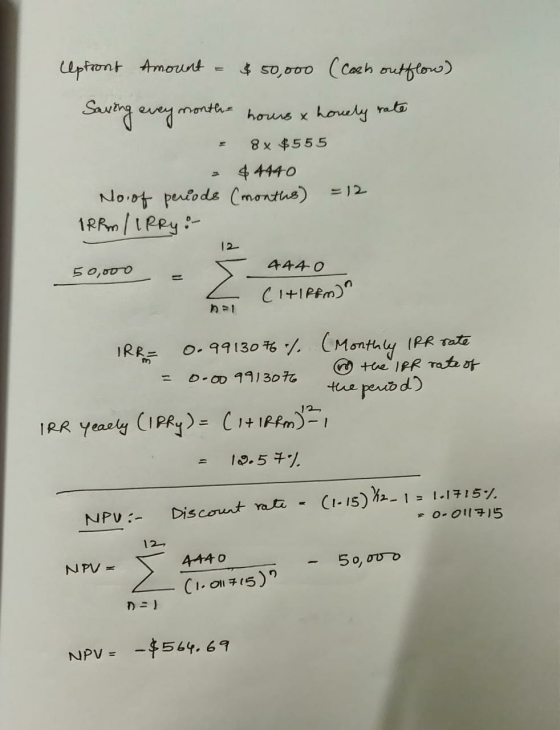
IRR: It is the discount rate at which the present value of projects
cash outflows (cost) is equal to the present value of projects cash
inflow.
IRR (yearly) = 12.57%
The IRR (12.57%) must be above the cost of capital/required rate of return (15%) in order to accept the upfront payment.
In this case, we should reject the upfront payment of $50,000
b. Net present value.
NPV = present value of cash inflow- the present value of cash
outflow.
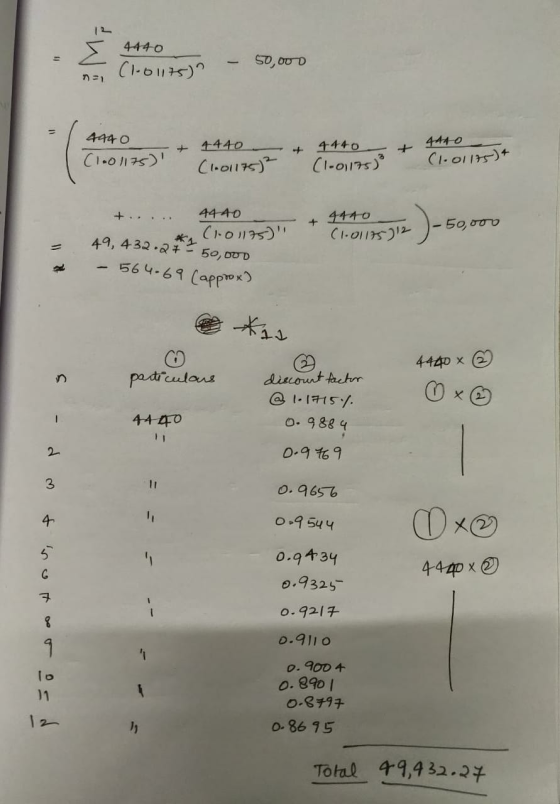
Discounted at the cost of capital/required rate of return (0.0011715)
NPV = -$564.69
NPV must be positive to accept the upfront payment.
As NPV is negative we should not accept the upfront payment of $50,000.
Add Answer to:
Professor Wendy Smith has been offered the following
opportunity: A law firm would like to retain...
Professor Wendy Smith has been offered the following opportunity: A law firm would like to retain...
Professor Wendy Smith has been offered the following opportunity: A law firm would like to retain her for an upfront payment of $50,000. In return, for the next year the firm would have access to eight hours of her time every month. As an alternative payment arrangement, the firm would pay Professor Smith's hourly rate for the eight hours each month. Smith's rate is $550 per hour and her opportunity cost of capital is 15% per year. What does...
Professor Wendy Smith has been offered the following opportunity: A law firm would like to retain...
Professor Wendy Smith has been offered the following opportunity: A law firm would like to retain her for an upfront payment of $50,000. In return, for the next year the firm would have access to eight hours of her time every month. As an alternative payment arrangement, the firm would pay Professor Smith's hourly rate for the eight hours each month. Smith's rate is $540 per hour and her opportunity cost of capital is 15% per year. What does...
Professor Wendy Smith has been offered the following opportunity: A law firm would like to retain her for an upfront pa...
Professor Wendy Smith has been offered the following opportunity: A law firm would like to retain her for an upfront payment of $49,000. In return, for the next year the firm would have access to eight hours of her time every month. As an alternative payment arrangement, the firm would pay Professor Smith's hourly rate for the eight hours each month. Smith's rate is $535 per hour and her opportunity cost of capital is 15% per year. What does the...
Professor Wendy Smith has been offered the following opportunity: A law firm would like to retain...
 Professor Wendy Smith has been offered the following opportunity: A law firm would like to retain her for an upfront payment of $49,000. In return, for the next year the firm would have access to eight hours of her time every month. As an alternative payment arrangement, the firm would pay Professor Smith's hourly rate for the eight hours each month. Smith's rate is $540 per hour and her opportunity cost of capital is 15% per year. What does the...
Professor Wendy Smith has been offered the following opportunity: A law firm would like to retain...
Professor Wendy Smith has been offered the following opportunity: A law firm would like to retain her for an upfront payment of $49,000. In return, for the next year the firm would have access to eight hours of her time every month. As an alternative payment arrangement, the firm would pay Professor Smith's hourly rate for the eight hours each month. Smith's rate is $545 per hour and her opportunity cost of capital is 15% per year. What does...
4. Professor Wendy Smith has been offered the following opportunity: A law firm would like to...
 4. Professor Wendy Smith has been offered the following opportunity: A law firm would like to retain her for an upfront payment of $49,000. In return, for the next year the firm would have access to eight hours of her time every month. As an alternative payment arrangement, the firm would pay Professor Smith's hourly rate for the eight hours each month. Smith's rate is $540 per hour and her opportunity cost of capital is 15% per year. What does...
Professor Wendy Smith has been offered the following deal: A law firm would like to retain...
 Professor Wendy Smith has been offered the following deal: A law firm would like to retain her for an upfront payment of $50,000. In return, for the next year, the firm would have access to eight hours of her time every month. Smith's rate is $550 per hour, and her opportunity cost of capital is 15% (equivalent annual rate, EAR). What is the IRR (annual)? What does the IRR rule advise regarding this opportunity? What is the NPV? What does...
Professor Wendy Smith has been offered the following deal: A law firm would like to retain...
Professor Wendy Smith has been offered the following deal: A law firm would like to retain her for an upfront payment of $ 60,000. In return, for the next year, the firm would have access to eight hours of her time every month. Smith's rate is $ 630 per hour, and her opportunity cost of capital is 14 % (equivalent annual rate, EAR). What is the IRR (annual)? What does the IRR rule advice regarding this opportunity? What is the...
Problem 8-18 Professor Wendy Smith has been offered the following deal: A law firm would like...
 Problem 8-18 Professor Wendy Smith has been offered the following deal: A law firm would like to retain her for an up- front payment of $50,000. In return, for the next year the firm would have access to eight hours of her time every month. Smith's rate is $550 per hour and her opportunity cost of capital is 15% per year. What does the IRR rule advise regarding this opportunity? What about the NPV rule? Complete the steps below using...
please do not use Excel I want to see the longhand steps The image is fine....
 please do not use Excel I want to see the longhand steps
The image is fine.
Professor Wendy Smith has been offered the following opportunity. A law firm would like to retain her for an upfront payment of $48.000. In retum, for the next year the firm would have access to eight hours of her time every month As an alternative payment arrangement the firm would pay Professor Smith's hourly rate for the eight hours each month Smith's rate is...
please do not use Excel I want to see the longhand steps
The image is fine.
Professor Wendy Smith has been offered the following opportunity. A law firm would like to retain her for an upfront payment of $48.000. In retum, for the next year the firm would have access to eight hours of her time every month As an alternative payment arrangement the firm would pay Professor Smith's hourly rate for the eight hours each month Smith's rate is...
 Professor Wendy Smith has been offered the following opportunity: A law firm would like to retain her for an upfront payment of $49,000. In return, for the next year the firm would have access to eight hours of her time every month. As an alternative payment arrangement, the firm would pay Professor Smith's hourly rate for the eight hours each month. Smith's rate is $540 per hour and her opportunity cost of capital is 15% per year. What does the...
 4. Professor Wendy Smith has been offered the following opportunity: A law firm would like to retain her for an upfront payment of $49,000. In return, for the next year the firm would have access to eight hours of her time every month. As an alternative payment arrangement, the firm would pay Professor Smith's hourly rate for the eight hours each month. Smith's rate is $540 per hour and her opportunity cost of capital is 15% per year. What does...
 Professor Wendy Smith has been offered the following deal: A law firm would like to retain her for an upfront payment of $50,000. In return, for the next year, the firm would have access to eight hours of her time every month. Smith's rate is $550 per hour, and her opportunity cost of capital is 15% (equivalent annual rate, EAR). What is the IRR (annual)? What does the IRR rule advise regarding this opportunity? What is the NPV? What does...
 Problem 8-18 Professor Wendy Smith has been offered the following deal: A law firm would like to retain her for an up- front payment of $50,000. In return, for the next year the firm would have access to eight hours of her time every month. Smith's rate is $550 per hour and her opportunity cost of capital is 15% per year. What does the IRR rule advise regarding this opportunity? What about the NPV rule? Complete the steps below using...
 please do not use Excel I want to see the longhand steps
The image is fine.
Professor Wendy Smith has been offered the following opportunity. A law firm would like to retain her for an upfront payment of $48.000. In retum, for the next year the firm would have access to eight hours of her time every month As an alternative payment arrangement the firm would pay Professor Smith's hourly rate for the eight hours each month Smith's rate is...
please do not use Excel I want to see the longhand steps
The image is fine.
Professor Wendy Smith has been offered the following opportunity. A law firm would like to retain her for an upfront payment of $48.000. In retum, for the next year the firm would have access to eight hours of her time every month As an alternative payment arrangement the firm would pay Professor Smith's hourly rate for the eight hours each month Smith's rate is...
Most questions answered within 3 hours.
-
Where is the error in this code sequence?
String s1 = "Hello";
String s2 = "ello";...
asked 10 months ago -
Financial data for Joel de Paris, Inc., for last year
follow:
Joel de Paris, Inc.
Balance...
asked 10 months ago -
Consider this reaction:
Al2(SO4)3 (aq)+ BaCl3
(aq) Al2Cl6 (aq)- +
3BaSO4(s) . What is the...
asked 10 months ago -
Suppose that Savneet is considering increasing her
recent random sample from 20 car rentals to 40...
asked 10 months ago -
Trucks arrive at an unloading terminal at an average rate of 120
per hour.
Trucks arrive...
asked 10 months ago -
Why are methanol and ethanol completely soluble in water while
octanol is not very little soluble....
asked 10 months ago -
A facilities manager at a university reads in a research report
that the mean amount of...
asked 10 months ago -
When the CuSO4 is rehydrated by adding water to the anhydrous
compound, is this an endothermic...
asked 10 months ago -
A ray of sunlight is passing from diamond into crown glass; the
angle of incidence is...
asked 10 months ago -
A block of mass 0.249 kg is placed on top of a light, vertical
spring of...
asked 10 months ago -
how do the kidneys compensate in the presences of acidosis
a) trigger hyperventilate
b) reserve acid...
asked 10 months ago -
Question 501 pts
The rental rate of capital to the firm increases. Which of the
following...
asked 10 months ago