SHOW WORK CLEARLY, DO ALL PARTS AND USE SIGNIFICANT FIGURES! DO QUESTION 8 ONLY!!! IF YOU DO QUESTION 7 I WILL REPORT YOU
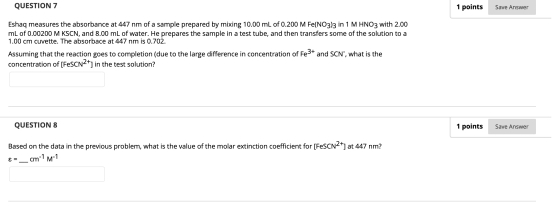
Homework Answers
![320 We Th Fr Sa Su 0B Fe3+ (92) + SON-(04) 5 Fees C) Here, we can se, [SCN- zo 00200M initially and [Fe3+] = 0.200 m, so [SEN](http://img.homeworklib.com/questions/802fb6c0-711b-11ea-99ca-176a19232fbb.png?x-oss-process=image/resize,w_560)
Add Answer to:
SHOW WORK CLEARLY, DO ALL PARTS AND USE SIGNIFICANT FIGURES! DO
QUESTION 8 ONLY!!! IF YOU...
DO ALL PARTS OF QUESTION AND USE SIGNIFICANT FIGURES!!!!!!!!! IF YOU DO NOT DO THIS I...
 DO ALL PARTS OF QUESTION AND USE SIGNIFICANT FIGURES!!!!!!!!! IF
YOU DO NOT DO THIS I WILL DOWNVOTE YOU
HERE ARE THE QUESTIONS:
INFORMATION TO USE FOR CALCULATING QUESTIONS:
QUESTION 1 For all of the samples, [Fe3+10 = _M QUESTION 2 For sample 1, [SCN lo = _M. QUESTION 3 For sample 2, [SCN lo = _M For the prelaboratory assignment, you will need to calculate the initial concentrations of [Fe3+10 and [SCN-10 for samples 1-5 that you will use...
DO ALL PARTS OF QUESTION AND USE SIGNIFICANT FIGURES!!!!!!!!! IF
YOU DO NOT DO THIS I WILL DOWNVOTE YOU
HERE ARE THE QUESTIONS:
INFORMATION TO USE FOR CALCULATING QUESTIONS:
QUESTION 1 For all of the samples, [Fe3+10 = _M QUESTION 2 For sample 1, [SCN lo = _M. QUESTION 3 For sample 2, [SCN lo = _M For the prelaboratory assignment, you will need to calculate the initial concentrations of [Fe3+10 and [SCN-10 for samples 1-5 that you will use...
DO ALL PARTS OF QUESTION AND USE SIGNIFICANT FIGURES!!!!!!!!! IF YOU DO NOT DO THIS I...
 DO ALL PARTS OF QUESTION AND USE SIGNIFICANT FIGURES!!!!!!!!! IF
YOU DO NOT DO THIS I WILL DOWNVOTE YOU HERE ARE THE QUESTIONS:
INFO TO USE TO CALCULATE QUESTIONS:
QUESTION 4 0.5 points Save Answer For sample 3, [SCN'Jo =M QUESTION 5 0.5 points Save Answer For sample 4, [SCNJ0 = M QUESTION 6 0.5 points Save Answer For sample 5, [SCNJ0 = _ M For the prelaboratory assignment, you will need to calculate the initial concentrations of [Fe5tlo and...
DO ALL PARTS OF QUESTION AND USE SIGNIFICANT FIGURES!!!!!!!!! IF
YOU DO NOT DO THIS I WILL DOWNVOTE YOU HERE ARE THE QUESTIONS:
INFO TO USE TO CALCULATE QUESTIONS:
QUESTION 4 0.5 points Save Answer For sample 3, [SCN'Jo =M QUESTION 5 0.5 points Save Answer For sample 4, [SCNJ0 = M QUESTION 6 0.5 points Save Answer For sample 5, [SCNJ0 = _ M For the prelaboratory assignment, you will need to calculate the initial concentrations of [Fe5tlo and...
Show all work to receive full credit. Express answers to the correct number of significant figures. Note: Complete...
 Show all work to receive full credit. Express answers to the correct number of significant figures. Note: Complete the table below by calculating the initial SCN and equilibrium Fe(SCN)2+ concentrations for each of the five standard solutions. In addition to the volume of KSCN indicated in the table below each solution contains 5.00 mL of Fe(NO,)a and sufficient 0.050 M HNO3 to produce a total volume of 25.00 mL of solution. 1. Fe3+ +SCN Fe(SCN)2+ 0.00200 M Molarity of KSCN...
Table A. Preparation of Standard solutions of FeSCN2+ 1.0 M HNO3 0.002 M 0.200 M Solution...
 Table A. Preparation of Standard solutions of FeSCN2+ 1.0 M HNO3 0.002 M 0.200 M Solution KSCN (mL) Fe(NO3)3 (mL) 0.5 5 [FeSCN2+] (mol/L)* 1 4.0x10^-5 Add 1.0 M 2 1.0 5 8.0x10^-5 HNO3 3 1.5 5 1.2x10^-10 4 2.0 5 1.6x10⁻⁴ to each to adjust the volume to 25 mL. 5 2.5 5 2.0x10⁻⁴ * Calculate the concentrations of FeSCN2+ in each beaker, assuming that all SCN-ions exist as FeSCN2+. In other words, [FeSCN2+] (in Soln 1) = [SCN-]...
What's the concentration of [FeSCN2+] using limiting reactant theory and equation? For each test tube solution...
 What's the concentration of [FeSCN2+] using limiting
reactant theory and equation?
For each test tube solution enter the initial concentration of Fe+ and SCNthe equilibrium concentration of FeSCN2: into the ICE table given. Complete entries for the rest of the table and calculate the K value for each of the tables. The values of K should be confined to a narrow range to reflect constancy. Comment on the quality of your work in this regard and calculate the average K....
What's the concentration of [FeSCN2+] using limiting
reactant theory and equation?
For each test tube solution enter the initial concentration of Fe+ and SCNthe equilibrium concentration of FeSCN2: into the ICE table given. Complete entries for the rest of the table and calculate the K value for each of the tables. The values of K should be confined to a narrow range to reflect constancy. Comment on the quality of your work in this regard and calculate the average K....
5. A student does an experiment to determine the equili but at a higher temperature. ermine...
 5. A student does an experiment to determine the equili but at a higher temperature. ermine the equilibrium constant for the same reaction that you will study, Fe** (aq) + SCN (aq) FeSCN2+ (aq) The student prepares solution 1, by mixing 5. s Solution, by mixing 5.00 ml of 0.002 M Fe(NO2)2 solution with 5.00 mL of .00011M KSCN solution, heats the mixture, and finds that the equilibrium concentration of F and finds that the equilibrium concentration of FeSCN2+ in...
what is number 3 and 4? thank you. TT 3. A solution of [FeSCN2] is found...
 what is number 3 and 4? thank you.
TT 3. A solution of [FeSCN2] is found to have 23% transmittance at 447 nm. If the molar absorption coefficient (e) is 4400 ( M cm) at y 447 nm, what is the concentration of [FeSCN] in the solution? Assume a 1 cm path length. (Show all work.) 4. A student mixes 5.00 mL of 0.0020 M Fe(NO.), with 3.00 mL of 0.0020 M KSCN Solution and 2.00 mL water at a...
what is number 3 and 4? thank you.
TT 3. A solution of [FeSCN2] is found to have 23% transmittance at 447 nm. If the molar absorption coefficient (e) is 4400 ( M cm) at y 447 nm, what is the concentration of [FeSCN] in the solution? Assume a 1 cm path length. (Show all work.) 4. A student mixes 5.00 mL of 0.0020 M Fe(NO.), with 3.00 mL of 0.0020 M KSCN Solution and 2.00 mL water at a...
You begin preparation of the calibration curve to measure absorbance vs concentration of FeSCN2+. To do...
You begin preparation of the calibration curve to measure absorbance vs concentration of FeSCN2+. To do so, you add 4.614 mL of 0.200 M Fe(NO3)3 to a cuvette and then directly add 108 µL of 0.001 M KSCN. What is the resulting concentration of FeSCN2+, assuming complete conversion of SCN- to FeSCN2+? Enter your answer in units of mM to four digits after the decimal.
You begin preparation of the calibration curve to measure absorbance vs concentration of FeSCN2+. To do...
You begin preparation of the calibration curve to measure absorbance vs concentration of FeSCN2+. To do so, you add 4.614 mL of 0.200 M Fe(NO3)3 to a cuvette and then directly add 108 µL of 0.001 M KSCN. What is the resulting concentration of FeSCN2+, assuming complete conversion of SCN- to FeSCN2+? Enter your answer in units of mM to four digits after the decimal.
4 please in part 1 gires us absorbance values for each sample , changes in concentration...
 4 please
in part 1 gires us absorbance values for each sample , changes in concentration and absorbance will cause a curve 1. For each new concentration of FeSCN2+ a new absorbance will be plotted. 4. After completing Part A of this experiment, a student determines the slope of their calibration graph of absorbance versus (FeSCN to be 5140 M". In Part B, a student combines 2.00 mL of a 0.00200 M solution of KSCN with 5.00 mL of a...
4 please
in part 1 gires us absorbance values for each sample , changes in concentration and absorbance will cause a curve 1. For each new concentration of FeSCN2+ a new absorbance will be plotted. 4. After completing Part A of this experiment, a student determines the slope of their calibration graph of absorbance versus (FeSCN to be 5140 M". In Part B, a student combines 2.00 mL of a 0.00200 M solution of KSCN with 5.00 mL of a...
 DO ALL PARTS OF QUESTION AND USE SIGNIFICANT FIGURES!!!!!!!!! IF
YOU DO NOT DO THIS I WILL DOWNVOTE YOU
HERE ARE THE QUESTIONS:
INFORMATION TO USE FOR CALCULATING QUESTIONS:
QUESTION 1 For all of the samples, [Fe3+10 = _M QUESTION 2 For sample 1, [SCN lo = _M. QUESTION 3 For sample 2, [SCN lo = _M For the prelaboratory assignment, you will need to calculate the initial concentrations of [Fe3+10 and [SCN-10 for samples 1-5 that you will use...
DO ALL PARTS OF QUESTION AND USE SIGNIFICANT FIGURES!!!!!!!!! IF
YOU DO NOT DO THIS I WILL DOWNVOTE YOU
HERE ARE THE QUESTIONS:
INFORMATION TO USE FOR CALCULATING QUESTIONS:
QUESTION 1 For all of the samples, [Fe3+10 = _M QUESTION 2 For sample 1, [SCN lo = _M. QUESTION 3 For sample 2, [SCN lo = _M For the prelaboratory assignment, you will need to calculate the initial concentrations of [Fe3+10 and [SCN-10 for samples 1-5 that you will use...
 DO ALL PARTS OF QUESTION AND USE SIGNIFICANT FIGURES!!!!!!!!! IF
YOU DO NOT DO THIS I WILL DOWNVOTE YOU HERE ARE THE QUESTIONS:
INFO TO USE TO CALCULATE QUESTIONS:
QUESTION 4 0.5 points Save Answer For sample 3, [SCN'Jo =M QUESTION 5 0.5 points Save Answer For sample 4, [SCNJ0 = M QUESTION 6 0.5 points Save Answer For sample 5, [SCNJ0 = _ M For the prelaboratory assignment, you will need to calculate the initial concentrations of [Fe5tlo and...
DO ALL PARTS OF QUESTION AND USE SIGNIFICANT FIGURES!!!!!!!!! IF
YOU DO NOT DO THIS I WILL DOWNVOTE YOU HERE ARE THE QUESTIONS:
INFO TO USE TO CALCULATE QUESTIONS:
QUESTION 4 0.5 points Save Answer For sample 3, [SCN'Jo =M QUESTION 5 0.5 points Save Answer For sample 4, [SCNJ0 = M QUESTION 6 0.5 points Save Answer For sample 5, [SCNJ0 = _ M For the prelaboratory assignment, you will need to calculate the initial concentrations of [Fe5tlo and...
 Show all work to receive full credit. Express answers to the correct number of significant figures. Note: Complete the table below by calculating the initial SCN and equilibrium Fe(SCN)2+ concentrations for each of the five standard solutions. In addition to the volume of KSCN indicated in the table below each solution contains 5.00 mL of Fe(NO,)a and sufficient 0.050 M HNO3 to produce a total volume of 25.00 mL of solution. 1. Fe3+ +SCN Fe(SCN)2+ 0.00200 M Molarity of KSCN...
 Table A. Preparation of Standard solutions of FeSCN2+ 1.0 M HNO3 0.002 M 0.200 M Solution KSCN (mL) Fe(NO3)3 (mL) 0.5 5 [FeSCN2+] (mol/L)* 1 4.0x10^-5 Add 1.0 M 2 1.0 5 8.0x10^-5 HNO3 3 1.5 5 1.2x10^-10 4 2.0 5 1.6x10⁻⁴ to each to adjust the volume to 25 mL. 5 2.5 5 2.0x10⁻⁴ * Calculate the concentrations of FeSCN2+ in each beaker, assuming that all SCN-ions exist as FeSCN2+. In other words, [FeSCN2+] (in Soln 1) = [SCN-]...
 What's the concentration of [FeSCN2+] using limiting
reactant theory and equation?
For each test tube solution enter the initial concentration of Fe+ and SCNthe equilibrium concentration of FeSCN2: into the ICE table given. Complete entries for the rest of the table and calculate the K value for each of the tables. The values of K should be confined to a narrow range to reflect constancy. Comment on the quality of your work in this regard and calculate the average K....
What's the concentration of [FeSCN2+] using limiting
reactant theory and equation?
For each test tube solution enter the initial concentration of Fe+ and SCNthe equilibrium concentration of FeSCN2: into the ICE table given. Complete entries for the rest of the table and calculate the K value for each of the tables. The values of K should be confined to a narrow range to reflect constancy. Comment on the quality of your work in this regard and calculate the average K....
 5. A student does an experiment to determine the equili but at a higher temperature. ermine the equilibrium constant for the same reaction that you will study, Fe** (aq) + SCN (aq) FeSCN2+ (aq) The student prepares solution 1, by mixing 5. s Solution, by mixing 5.00 ml of 0.002 M Fe(NO2)2 solution with 5.00 mL of .00011M KSCN solution, heats the mixture, and finds that the equilibrium concentration of F and finds that the equilibrium concentration of FeSCN2+ in...
 what is number 3 and 4? thank you.
TT 3. A solution of [FeSCN2] is found to have 23% transmittance at 447 nm. If the molar absorption coefficient (e) is 4400 ( M cm) at y 447 nm, what is the concentration of [FeSCN] in the solution? Assume a 1 cm path length. (Show all work.) 4. A student mixes 5.00 mL of 0.0020 M Fe(NO.), with 3.00 mL of 0.0020 M KSCN Solution and 2.00 mL water at a...
what is number 3 and 4? thank you.
TT 3. A solution of [FeSCN2] is found to have 23% transmittance at 447 nm. If the molar absorption coefficient (e) is 4400 ( M cm) at y 447 nm, what is the concentration of [FeSCN] in the solution? Assume a 1 cm path length. (Show all work.) 4. A student mixes 5.00 mL of 0.0020 M Fe(NO.), with 3.00 mL of 0.0020 M KSCN Solution and 2.00 mL water at a...
 4 please
in part 1 gires us absorbance values for each sample , changes in concentration and absorbance will cause a curve 1. For each new concentration of FeSCN2+ a new absorbance will be plotted. 4. After completing Part A of this experiment, a student determines the slope of their calibration graph of absorbance versus (FeSCN to be 5140 M". In Part B, a student combines 2.00 mL of a 0.00200 M solution of KSCN with 5.00 mL of a...
4 please
in part 1 gires us absorbance values for each sample , changes in concentration and absorbance will cause a curve 1. For each new concentration of FeSCN2+ a new absorbance will be plotted. 4. After completing Part A of this experiment, a student determines the slope of their calibration graph of absorbance versus (FeSCN to be 5140 M". In Part B, a student combines 2.00 mL of a 0.00200 M solution of KSCN with 5.00 mL of a...
Most questions answered within 3 hours.
-
Where is the error in this code sequence?
String s1 = "Hello";
String s2 = "ello";...
asked 11 months ago -
Financial data for Joel de Paris, Inc., for last year
follow:
Joel de Paris, Inc.
Balance...
asked 11 months ago -
Consider this reaction:
Al2(SO4)3 (aq)+ BaCl3
(aq) Al2Cl6 (aq)- +
3BaSO4(s) . What is the...
asked 11 months ago -
Suppose that Savneet is considering increasing her
recent random sample from 20 car rentals to 40...
asked 11 months ago -
Trucks arrive at an unloading terminal at an average rate of 120
per hour.
Trucks arrive...
asked 11 months ago -
Why are methanol and ethanol completely soluble in water while
octanol is not very little soluble....
asked 11 months ago -
A facilities manager at a university reads in a research report
that the mean amount of...
asked 11 months ago -
When the CuSO4 is rehydrated by adding water to the anhydrous
compound, is this an endothermic...
asked 11 months ago -
A ray of sunlight is passing from diamond into crown glass; the
angle of incidence is...
asked 11 months ago -
A block of mass 0.249 kg is placed on top of a light, vertical
spring of...
asked 11 months ago -
how do the kidneys compensate in the presences of acidosis
a) trigger hyperventilate
b) reserve acid...
asked 11 months ago -
Question 501 pts
The rental rate of capital to the firm increases. Which of the
following...
asked 11 months ago