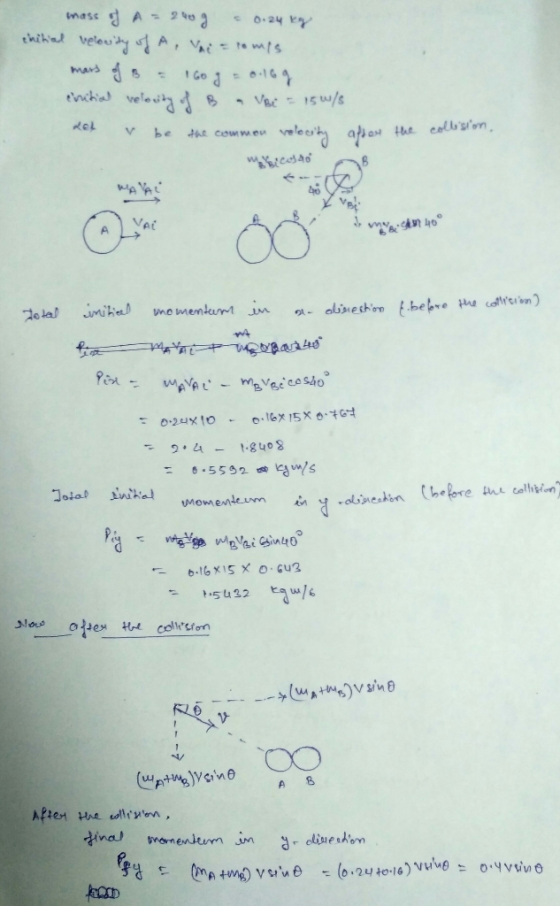
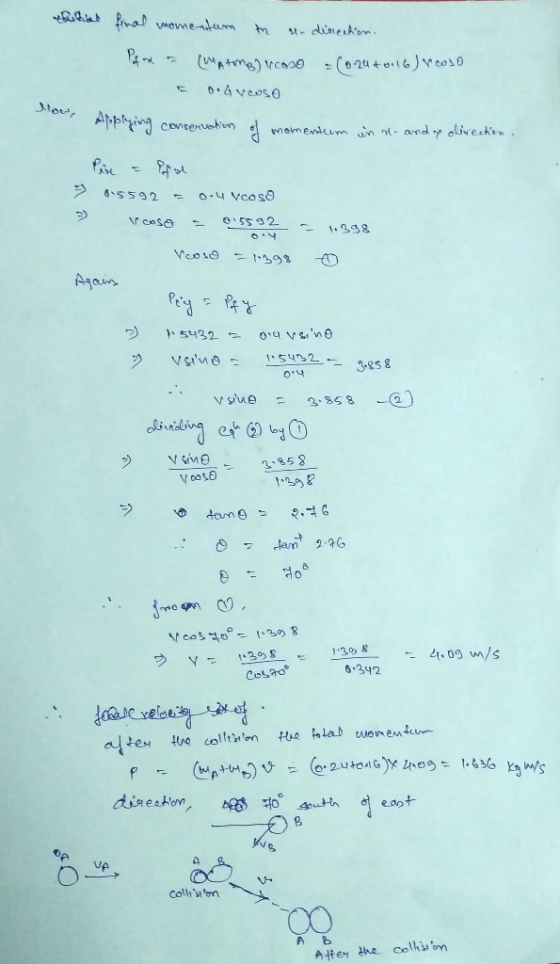
Puck A of mass 240-g is traveling due east with a speed, , on a level, frictionless air table when it collides with puck B of mass 160 g traveling at 40° south of west with a speed, , on the same table. (See the diagram below.) When the pucks collide, they stick together via Velcro surfaces that line the circular boundaries of both pucks. Find the magnitude and direction of the momentum of the tandem of pucks after the collision. Draw the final momentum vector into the diagram below at the point of the collision.

Homework Answers
Add Answer to:
Puck A of mass 240-g is traveling due east
with a speed, , on a level,...
Puck A of mass 240-g is traveling due east with a speed, v_Ai=10 m/s, on a...
 Puck A of mass 240-g is traveling due east with a speed, v_Ai=10
m/s, on a level, frictionless air table when it collides with puck
B of mass 160 g traveling at 40° south of west with a speed,
v_Bi=15 m/s, on the same table. (See the diagram below.) When the
pucks collide, they stick together via Velcro surfaces that line
the circular boundaries of both pucks. Find the magnitude and
direction of the momentum of the tandem of pucks...
Puck A of mass 240-g is traveling due east with a speed, v_Ai=10
m/s, on a level, frictionless air table when it collides with puck
B of mass 160 g traveling at 40° south of west with a speed,
v_Bi=15 m/s, on the same table. (See the diagram below.) When the
pucks collide, they stick together via Velcro surfaces that line
the circular boundaries of both pucks. Find the magnitude and
direction of the momentum of the tandem of pucks...
Initially, a light puck is moving east at 5.0 m/s and a heavy puck moves south...
Initially, a light puck is moving east at 5.0 m/s and a heavy puck moves south at 3.0 m/s there is velcro on the pucks so they stick together after they collide. If the heavy puck is twice the mass of the light puck then find the magnitude of the momentum vector after they collide. Include a picture.
A hockey puck of mass 1 kg is traveling at 2 m/s in a direction 40º...
A hockey puck of mass 1 kg is traveling at 2 m/s in a direction 40º south of east. It collides with a stationary puck of mass 0.9 kg. After the collision, the 1 kg puck is traveling at an angle of 60º south of west at a speed of 0.8 m/s. What is the speed and direction of the 0.9 kg puck?
wo pucks collide on an air hockey table. Puck A has a mass of 26.0 g...
 wo pucks collide on an air hockey table. Puck A has a mass of
26.0 g and is initially traveling in the +xdirection at
6.50 m/s. Puck B has a mass of 78.0 g and is initially at rest.
After the pucks collide, puck A moves away at an angle of
58.0
above the +x axis, while puck B travels at an angle of
26.0
below the +x axis.
Calculate puck A's final speed.
Calculate puck B's final speed.
What...
wo pucks collide on an air hockey table. Puck A has a mass of
26.0 g and is initially traveling in the +xdirection at
6.50 m/s. Puck B has a mass of 78.0 g and is initially at rest.
After the pucks collide, puck A moves away at an angle of
58.0
above the +x axis, while puck B travels at an angle of
26.0
below the +x axis.
Calculate puck A's final speed.
Calculate puck B's final speed.
What...
Two pucks collide on an air hockey table. Puck A has a mass of 17.0 g...
Two pucks collide on an air hockey table. Puck A has a mass of 17.0 g and is initially traveling in the +x direction at 7.80 m/s. Puck B has a mass of 68.0 g and is initially at rest. After the pucks collide, puck A moves away at an angle of 58.0 above the +x axis, while puck B travels at an angle of 24.0 below the +x axis. Calculate puck A's final speed? Calculate puck B's final speed?...
Two pucks collide on an air hockey table. Puck A has a mass of 28 g...
Two pucks collide on an air hockey table. Puck A has a mass of 28 g and is initially traveling in the +x direction at 7.8 m/s. Puck B has a mass of 112 g and is initially at rest. After the pucks collide, puck A moves away at an angle of 45$^\circ$ above the +x axis, while puck B travels at an angle of 42$^\circ$ below the +x axis. Calculate puck A's final speed and puck B's final speed....
Two pucks collide on an air hockey table. Puck A has a mass of 27.0 g...
Two pucks collide on an air hockey table. Puck A has a mass of 27.0 g and is initially traveling in the +x direction at 6.20 m/s. Puck B has a mass of 108.0 g and is initially at rest. After the pucks collide, puck A moves away at an angle of 54.0 deg above the +x axis, while puck B travels at an angle of 29.0 deg below the +x axis. A.Calculate puck A's final speed. B.Calculate puck B's...
A hockey puck, mass 0.24 kg, travelling with a speed of +20 m/s. collides with another...
 A hockey puck, mass 0.24 kg, travelling with a speed of +20 m/s. collides with another stationary puck of exactly half the mass, hitting it head-on, but instant superglue makes the pucks stick together. The collision is perfectly inelastic and one dimensional. Ignore any friction with the ice they are travelling on. Calculate the total momentum of the two-puck system both before and after the collision.
A hockey puck (1) of mass 120 g is shot east at a speed of 8.80...
A hockey puck (1) of mass 120 g is shot east at a speed of 8.80 m/s. It strikes a second puck (2), initially at rest, of mass 138 g. As a result of the collision, the first puck (1) is deflected at an angle of 46° south of east and the second puck (2) moves at an angle of 40° north of east. What is the magnitude of the velocity of puck (1) after the collision?
A hockey puck (1) of mass 160 g is shot east at a speed of 6.60...
A hockey puck (1) of mass 160 g is shot east at a speed of 6.60 m/s. It strikes a second puck (2), initially at rest, of mass 136 g. As a result of the collision, the first puck (1) is deflected at an angle of 70° south of east and the second puck (2) moves at an angle of 46° north of east. What is the magnitude of the velocity of puck (2) after the collision?
 Puck A of mass 240-g is traveling due east with a speed, v_Ai=10
m/s, on a level, frictionless air table when it collides with puck
B of mass 160 g traveling at 40° south of west with a speed,
v_Bi=15 m/s, on the same table. (See the diagram below.) When the
pucks collide, they stick together via Velcro surfaces that line
the circular boundaries of both pucks. Find the magnitude and
direction of the momentum of the tandem of pucks...
Puck A of mass 240-g is traveling due east with a speed, v_Ai=10
m/s, on a level, frictionless air table when it collides with puck
B of mass 160 g traveling at 40° south of west with a speed,
v_Bi=15 m/s, on the same table. (See the diagram below.) When the
pucks collide, they stick together via Velcro surfaces that line
the circular boundaries of both pucks. Find the magnitude and
direction of the momentum of the tandem of pucks...
 wo pucks collide on an air hockey table. Puck A has a mass of
26.0 g and is initially traveling in the +xdirection at
6.50 m/s. Puck B has a mass of 78.0 g and is initially at rest.
After the pucks collide, puck A moves away at an angle of
58.0
above the +x axis, while puck B travels at an angle of
26.0
below the +x axis.
Calculate puck A's final speed.
Calculate puck B's final speed.
What...
wo pucks collide on an air hockey table. Puck A has a mass of
26.0 g and is initially traveling in the +xdirection at
6.50 m/s. Puck B has a mass of 78.0 g and is initially at rest.
After the pucks collide, puck A moves away at an angle of
58.0
above the +x axis, while puck B travels at an angle of
26.0
below the +x axis.
Calculate puck A's final speed.
Calculate puck B's final speed.
What...
 A hockey puck, mass 0.24 kg, travelling with a speed of +20 m/s. collides with another stationary puck of exactly half the mass, hitting it head-on, but instant superglue makes the pucks stick together. The collision is perfectly inelastic and one dimensional. Ignore any friction with the ice they are travelling on. Calculate the total momentum of the two-puck system both before and after the collision.
Most questions answered within 3 hours.
-
Where is the error in this code sequence?
String s1 = "Hello";
String s2 = "ello";...
asked 11 months ago -
Financial data for Joel de Paris, Inc., for last year
follow:
Joel de Paris, Inc.
Balance...
asked 11 months ago -
Consider this reaction:
Al2(SO4)3 (aq)+ BaCl3
(aq) Al2Cl6 (aq)- +
3BaSO4(s) . What is the...
asked 11 months ago -
Suppose that Savneet is considering increasing her
recent random sample from 20 car rentals to 40...
asked 11 months ago -
Trucks arrive at an unloading terminal at an average rate of 120
per hour.
Trucks arrive...
asked 11 months ago -
Why are methanol and ethanol completely soluble in water while
octanol is not very little soluble....
asked 11 months ago -
A facilities manager at a university reads in a research report
that the mean amount of...
asked 11 months ago -
When the CuSO4 is rehydrated by adding water to the anhydrous
compound, is this an endothermic...
asked 11 months ago -
A ray of sunlight is passing from diamond into crown glass; the
angle of incidence is...
asked 11 months ago -
A block of mass 0.249 kg is placed on top of a light, vertical
spring of...
asked 11 months ago -
how do the kidneys compensate in the presences of acidosis
a) trigger hyperventilate
b) reserve acid...
asked 11 months ago -
Question 501 pts
The rental rate of capital to the firm increases. Which of the
following...
asked 11 months ago