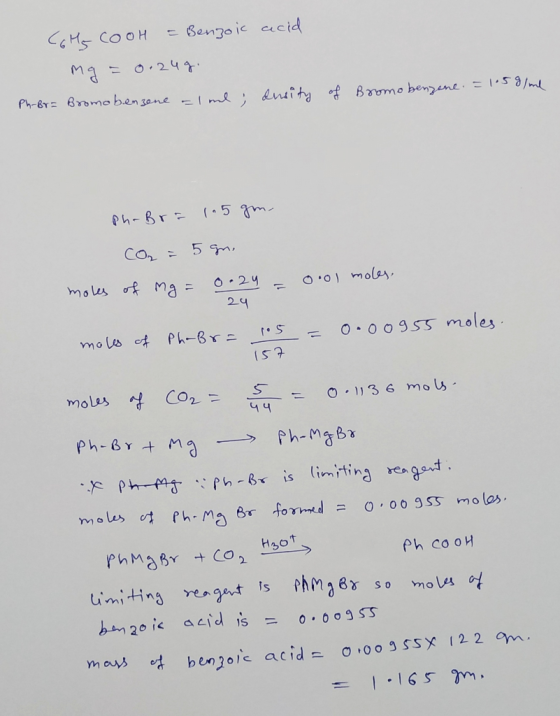
calculate the theoretical yield of benzoic acid. Given 0.24 g magnesium, 1.00 mL bromobenzene, and 5...
Homework Answers
Add Answer to:
calculate the theoretical yield of benzoic acid. Given 0.24 g
magnesium, 1.00 mL bromobenzene, and 5...
What would be the theoretical yield of this Grignard reaction with the product being benzoic acid?...
What would be the theoretical yield of this Grignard reaction with the product being benzoic acid? 0.70 mL of bromobenzene 0.15 g Mg 5g dry ice crude benzoic acid recovered: 0.08 g
I need help with E. I keep getting 393.21 3) Calculate the percent yield with following...
 I need help with E. I keep getting 393.21
3) Calculate the percent yield with following steps. (Assume that you obtain 0.4 g benzoic acid at the end of the reaction). (Show your calculations) (5 pts) a) Calculate the number of moles for each reagent listed below i) Bromobenzene (0.7 g) ii) Mg (0.15 g) iii) Dry ice (3 g) iv) 6 M HCl (5 mL) b) What is the limiting reagent? c) Calculate the expected number moles for the...
I need help with E. I keep getting 393.21
3) Calculate the percent yield with following steps. (Assume that you obtain 0.4 g benzoic acid at the end of the reaction). (Show your calculations) (5 pts) a) Calculate the number of moles for each reagent listed below i) Bromobenzene (0.7 g) ii) Mg (0.15 g) iii) Dry ice (3 g) iv) 6 M HCl (5 mL) b) What is the limiting reagent? c) Calculate the expected number moles for the...
Using the reaction shown below, calculate the percent yield obtained by a student when reacting 5.0 g of 3-methoxysalicylic acid with 3.9 mL of iodomethane in the presence of 10.3 g of potassium carbonate and obtaining 4.5 g of product, 2,3-dimethoxymethy
 Using the reaction shown below, calculate the percent yield obtained by a student when reacting 5.0 g of 3-methoxysalicylic acid with 3.9 mL of iodomethane in the presence of 10.3 g of potassium carbonate and obtaining 4.5 g of product, 2,3-dimethoxymethyl benzoate. You should determine which of the three reactants is the limiting reagent and the theoretical yield first.1a page 1.jpg
Complete the reaction table below. OOH or 1. ether 2. CO2(s) + Mg2+ + Br +...
 Complete the reaction table below. OOH or 1. ether 2. CO2(s) + Mg2+ + Br + CÍ + Mga 3. HCl(aq) benzoic acid Magnesium Bromobenzene CO2(s) (Dry ice) HCl(aq) Benzoic Acid Experimental quantity 1.2 g 5.2 mL excess 80 mL <ml Molar Mass Density N/A Concentration - - - 3.0 M Amount in moles Equivalents excess excess Answer the following questions using the Prelab Workbook Assignment Link provided on LEARN. Question 1: What is the limiting reagent for this reaction?...
The solubility of benzoic acid in water is 6.80 g per 100 mL at 100 °C...
The solubility of benzoic acid in water is 6.80 g per 100 mL at 100 °C and 0.34 g per 100 mL at 25 °C. Calculate the minimum volume of water needed to dissolve 1.00 g of benzoic acid at 100 °C. Calculate the maximum theoretical percent recovery from recrystallization of 1.00 g of benzoic acid from 15 mL of water, assuming the solution is filtered at 25 °C. How much benzoic acid can you dissolve in 25 mL of...
1.00 g of 2-naphtol is given initially in a mixture containing benzoic acid and 1,4-dimethoxybezene in...
1.00 g of 2-naphtol is given initially in a mixture containing benzoic acid and 1,4-dimethoxybezene in dichloromethane. After complete extraction and heating reflux, and drying, a dry mass of 0.0069 g of 2-Butoxynapthalene is obtained. Do I calculate % yield from 2-naphtol? if so how? Help!
calculate the theoretical and percent yield. what is the limiting reagent? Reaction: 4-bromoaniline from 4-bromoacetanilide in...
calculate the theoretical and percent yield. what is the limiting reagent? Reaction: 4-bromoaniline from 4-bromoacetanilide in HCl and EtOH 0.24 g 4-bromoacetanilide 0.38 mL of 95% ethanol 0.247 mL HCl 0.228 mL sodium hydroxide 0.19 g product (4-bromoaniline)
Calculate the theoretical yield and percent yield. What is the limiting reagent? Reaction: Aniline to Acetanilide...
Calculate the theoretical yield and percent yield. What is the limiting reagent? Reaction: Aniline to Acetanilide in acetic anhydride, HCl, and NaOAc 5 g of aniline 4.5 mL HCl 5.32 g sodium acetate 6.60 g acetic anhydride 4.33 g of acetanilide (product)
Preparation of Benzoic Acid using a Grignard Reagent URGENT 1. During your Grignard formation, a small...
Preparation of Benzoic Acid using a Grignard Reagent URGENT 1. During your Grignard formation, a small amount of benzene is formed. Provide a brief explanation and mechanism to explain this observation. 2. During your Grignard formation, a small amount of biphenyl is formed. Provide a brief explanation and mechanism to explain this observation. 3. What mass of water would be required to destroy the phenylmagnesium bromide that you prepared in this experiment? What volume does this represent? 4. Why is...
3. Calculate the theoretical yield of acetylsalicylic acid from 2.20 g of salicylic acid assuming the...
 3. Calculate the theoretical yield of acetylsalicylic acid from 2.20 g of salicylic acid assuming the salicylic acid is the limiting reactant. [3] 4. Assume that 1.65 g of acetylsalicylic acid is produced from the reaction above. Calculate the percent yield. [2]
 I need help with E. I keep getting 393.21
3) Calculate the percent yield with following steps. (Assume that you obtain 0.4 g benzoic acid at the end of the reaction). (Show your calculations) (5 pts) a) Calculate the number of moles for each reagent listed below i) Bromobenzene (0.7 g) ii) Mg (0.15 g) iii) Dry ice (3 g) iv) 6 M HCl (5 mL) b) What is the limiting reagent? c) Calculate the expected number moles for the...
I need help with E. I keep getting 393.21
3) Calculate the percent yield with following steps. (Assume that you obtain 0.4 g benzoic acid at the end of the reaction). (Show your calculations) (5 pts) a) Calculate the number of moles for each reagent listed below i) Bromobenzene (0.7 g) ii) Mg (0.15 g) iii) Dry ice (3 g) iv) 6 M HCl (5 mL) b) What is the limiting reagent? c) Calculate the expected number moles for the...
 Complete the reaction table below. OOH or 1. ether 2. CO2(s) + Mg2+ + Br + CÍ + Mga 3. HCl(aq) benzoic acid Magnesium Bromobenzene CO2(s) (Dry ice) HCl(aq) Benzoic Acid Experimental quantity 1.2 g 5.2 mL excess 80 mL <ml Molar Mass Density N/A Concentration - - - 3.0 M Amount in moles Equivalents excess excess Answer the following questions using the Prelab Workbook Assignment Link provided on LEARN. Question 1: What is the limiting reagent for this reaction?...
 3. Calculate the theoretical yield of acetylsalicylic acid from 2.20 g of salicylic acid assuming the salicylic acid is the limiting reactant. [3] 4. Assume that 1.65 g of acetylsalicylic acid is produced from the reaction above. Calculate the percent yield. [2]
Most questions answered within 3 hours.
-
Where is the error in this code sequence?
String s1 = "Hello";
String s2 = "ello";...
asked 11 months ago -
Financial data for Joel de Paris, Inc., for last year
follow:
Joel de Paris, Inc.
Balance...
asked 11 months ago -
Consider this reaction:
Al2(SO4)3 (aq)+ BaCl3
(aq) Al2Cl6 (aq)- +
3BaSO4(s) . What is the...
asked 11 months ago -
Suppose that Savneet is considering increasing her
recent random sample from 20 car rentals to 40...
asked 11 months ago -
Trucks arrive at an unloading terminal at an average rate of 120
per hour.
Trucks arrive...
asked 11 months ago -
Why are methanol and ethanol completely soluble in water while
octanol is not very little soluble....
asked 11 months ago -
A facilities manager at a university reads in a research report
that the mean amount of...
asked 11 months ago -
When the CuSO4 is rehydrated by adding water to the anhydrous
compound, is this an endothermic...
asked 11 months ago -
A ray of sunlight is passing from diamond into crown glass; the
angle of incidence is...
asked 11 months ago -
A block of mass 0.249 kg is placed on top of a light, vertical
spring of...
asked 11 months ago -
how do the kidneys compensate in the presences of acidosis
a) trigger hyperventilate
b) reserve acid...
asked 11 months ago -
Question 501 pts
The rental rate of capital to the firm increases. Which of the
following...
asked 11 months ago