
Homework Answers
The answer is given as follows

Add Answer to:
2. Methyllithium (CH3Li) is often used as base in organic reactions. a. Predict the product of...
use the above guidelines to predict the major organic product of the following reactions. JPB 2020...
 use the above guidelines to predict the major organic product of
the following reactions.
JPB 2020 8.18 Points -Exception-substitution can occur with weak bases (CN, N3, SH, SR) -Exception-3° alkyl halides undergo substitution (solvolysis) with alcohols. 3. Use the above guidelines to predict the major organic product of the following reactions. (5) CIK* -OC(CH3)3 CH3 C. CH3CH2-C-CH3 + CH,OH — Br + CH20- CH2OH n o -Br + NACN + NaCN - DMSO DMSO
use the above guidelines to predict the major organic product of
the following reactions.
JPB 2020 8.18 Points -Exception-substitution can occur with weak bases (CN, N3, SH, SR) -Exception-3° alkyl halides undergo substitution (solvolysis) with alcohols. 3. Use the above guidelines to predict the major organic product of the following reactions. (5) CIK* -OC(CH3)3 CH3 C. CH3CH2-C-CH3 + CH,OH — Br + CH20- CH2OH n o -Br + NACN + NaCN - DMSO DMSO
Explain why for condensation reactions occurring at the α-carbon you often use a weak base (like...
Explain why for condensation reactions occurring at the α-carbon you often use a weak base (like -OH) to create the enolate when for reactions such as halogenation you would use a strong base (like LDA). Under what conditions (give an example) could you use LDA for a condensation reaction? Explain as in-depth as possible and I will give you a thumbs up! Thanks :)
2 Predict the major organic product of each of the following reactions: нон Н3РО4 (a) CH...
 2 Predict the major organic product of each of the following reactions: нон Н3РО4 (a) CH - C— C—CH 3 13 Heat CH3 CH3 CH? OH CH3 H3PO4 (b) CHC-CH CH3 T CH, CH. CH3 Heat Assuming that they both involve El eliminations, show the structures of the carbocations formed as intermediates in each of the above reactions: (a)
1. For each reaction below Classify each acid, base, conjugate acid, and conjugate base as a...
 1. For each reaction below Classify each acid, base, conjugate acid, and conjugate base as a strong acid, weak acid, strong base, or a weak base. Calculate the value of the equilibrium constant II. I. Determine if these reactions need to be treated as an equilibrium (needing an ICE table) or a stoichiometry problem (assuming the reaction goes essentially to completion) a. F-(aq) H2O() HF(aq) + H3O*(aq) + H2O(1) NH3(aq) + b. NH4 (aq) OH (aq) + H3O*(aq) NH3(aq) +...
Triethylamine. (CH3CH2)3N, is commonly used in many synthetic organic chemistry applications
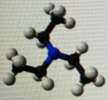 Triethylamine. (CH3CH2)3N, is commonly used in many synthetic organic chemistry applications. Consider the possibilities of both Brønsted-Lowry and Lewis acid/base behavior. Based on the chemical structure in the diagram, how would this molecule be predicted to behave in aqueous solution? as a strong base as a strong acid it would not illustrate acid/base behavior as a weak acid as a weak base
Acids are proton (H+) donors. Bases are proton (H+) acceptors. Acid-base reactions are often "rev...
Acids are proton (H+) donors. Bases are proton (H+) acceptors. Acid-base reactions are often "reversible", meaning that they can occur in both a left-to-right and a right-to-left direction. As a result, there is one acid and one base on each side of an acid-base reaction. 1. Identify the Acids and Bases on both sides of the following reactions: a. NH4+ + OH- ⟷ NH3 + H2O b. HCl + H2O ⟷ Cl- + H3O+ c. H2PO4- + H2O ⟷ HPO42- ...
H 3. a) Showing arrow-pushing, draw the products of these acid-base reactions. [10 pts Нас H-N...
 H 3. a) Showing arrow-pushing, draw the products of these acid-base reactions. [10 pts Нас H-N H b) From your knowledge of pKa values, predict whether the reactions in part (a) are favorable or not by circling an option below: [4 pts) K<1 reaction () K>1 K 1 K 1 K<1 K>1 reaction (i) 4. A chemist wishes to completely convert the acid shown in the equation below to its conjugate base. Complete the acid-base reaction by selecting one of...
3. Reactions: (21 pts) Draw the structure of the expected organic product(s) formed in the following...
 3. Reactions: (21 pts) Draw the structure of the expected organic product(s) formed in the following reactions including correct stereochemistry, if the product is racemic indicate this by either drawing both enantiomers or drawing one and writing racemic. Assume all reagents listed are present in excess unless otherwise noted. If no reaction occurs, state 'No Reaction'. HI H) 1) CH3Li CrO3, H2SO4 1) H 2) H30+ H20 (xs) CI mCPBA (CH3)3COK J) (CH3)3COH CHCI2 K) H2SO4, 1800C OH Nah, DMSO...
3. Reactions: (21 pts) Draw the structure of the expected organic product(s) formed in the following...
 3. Reactions: (21 pts) Draw the structure of the expected organic product(s) formed in the following reactions including correct stereochemistry, if the product is racemic indicate this by either drawing both enantiomers or drawing one and writing racemic. Assume all reagents listed are present in excess unless otherwise noted. If no reaction occurs, state ‘No Reaction'. HI H ) 1) CH3Li CrO2, H2S04 1) H 2) H30+ H2O (xs) CI mCPBA (CH3)3COK J) (CH3)3COH CH2Cl2 K) H2SO4, 1800C OH NaH,...
Organic Chemistry / CICG / Page 80 13. Predict the formula for the product, other than...
 Organic Chemistry / CICG / Page 80 13. Predict the formula for the product, other than water, for the following reactions. (a) 2 CH3CH,CH,OH H2SO4 135°C (1) CH3 (b) H2SO4 135°C CH3 -COH CH3 (1) [2] 14. Name the type of compound represented by each of the following formulae by stating whether the compound is an ether, alcohol, phenol, etc. Do not use the name of the particular compound. OH OH CH,OH OH CH3 c (a) (b) (d) le) (5)...
 use the above guidelines to predict the major organic product of
the following reactions.
JPB 2020 8.18 Points -Exception-substitution can occur with weak bases (CN, N3, SH, SR) -Exception-3° alkyl halides undergo substitution (solvolysis) with alcohols. 3. Use the above guidelines to predict the major organic product of the following reactions. (5) CIK* -OC(CH3)3 CH3 C. CH3CH2-C-CH3 + CH,OH — Br + CH20- CH2OH n o -Br + NACN + NaCN - DMSO DMSO
use the above guidelines to predict the major organic product of
the following reactions.
JPB 2020 8.18 Points -Exception-substitution can occur with weak bases (CN, N3, SH, SR) -Exception-3° alkyl halides undergo substitution (solvolysis) with alcohols. 3. Use the above guidelines to predict the major organic product of the following reactions. (5) CIK* -OC(CH3)3 CH3 C. CH3CH2-C-CH3 + CH,OH — Br + CH20- CH2OH n o -Br + NACN + NaCN - DMSO DMSO
 2 Predict the major organic product of each of the following reactions: нон Н3РО4 (a) CH - C— C—CH 3 13 Heat CH3 CH3 CH? OH CH3 H3PO4 (b) CHC-CH CH3 T CH, CH. CH3 Heat Assuming that they both involve El eliminations, show the structures of the carbocations formed as intermediates in each of the above reactions: (a)
 1. For each reaction below Classify each acid, base, conjugate acid, and conjugate base as a strong acid, weak acid, strong base, or a weak base. Calculate the value of the equilibrium constant II. I. Determine if these reactions need to be treated as an equilibrium (needing an ICE table) or a stoichiometry problem (assuming the reaction goes essentially to completion) a. F-(aq) H2O() HF(aq) + H3O*(aq) + H2O(1) NH3(aq) + b. NH4 (aq) OH (aq) + H3O*(aq) NH3(aq) +...
 H 3. a) Showing arrow-pushing, draw the products of these acid-base reactions. [10 pts Нас H-N H b) From your knowledge of pKa values, predict whether the reactions in part (a) are favorable or not by circling an option below: [4 pts) K<1 reaction () K>1 K 1 K 1 K<1 K>1 reaction (i) 4. A chemist wishes to completely convert the acid shown in the equation below to its conjugate base. Complete the acid-base reaction by selecting one of...
 3. Reactions: (21 pts) Draw the structure of the expected organic product(s) formed in the following reactions including correct stereochemistry, if the product is racemic indicate this by either drawing both enantiomers or drawing one and writing racemic. Assume all reagents listed are present in excess unless otherwise noted. If no reaction occurs, state 'No Reaction'. HI H) 1) CH3Li CrO3, H2SO4 1) H 2) H30+ H20 (xs) CI mCPBA (CH3)3COK J) (CH3)3COH CHCI2 K) H2SO4, 1800C OH Nah, DMSO...
 3. Reactions: (21 pts) Draw the structure of the expected organic product(s) formed in the following reactions including correct stereochemistry, if the product is racemic indicate this by either drawing both enantiomers or drawing one and writing racemic. Assume all reagents listed are present in excess unless otherwise noted. If no reaction occurs, state ‘No Reaction'. HI H ) 1) CH3Li CrO2, H2S04 1) H 2) H30+ H2O (xs) CI mCPBA (CH3)3COK J) (CH3)3COH CH2Cl2 K) H2SO4, 1800C OH NaH,...
 Organic Chemistry / CICG / Page 80 13. Predict the formula for the product, other than water, for the following reactions. (a) 2 CH3CH,CH,OH H2SO4 135°C (1) CH3 (b) H2SO4 135°C CH3 -COH CH3 (1) [2] 14. Name the type of compound represented by each of the following formulae by stating whether the compound is an ether, alcohol, phenol, etc. Do not use the name of the particular compound. OH OH CH,OH OH CH3 c (a) (b) (d) le) (5)...
Most questions answered within 3 hours.
-
Where is the error in this code sequence?
String s1 = "Hello";
String s2 = "ello";...
asked 10 months ago -
Financial data for Joel de Paris, Inc., for last year
follow:
Joel de Paris, Inc.
Balance...
asked 10 months ago -
Consider this reaction:
Al2(SO4)3 (aq)+ BaCl3
(aq) Al2Cl6 (aq)- +
3BaSO4(s) . What is the...
asked 10 months ago -
Suppose that Savneet is considering increasing her
recent random sample from 20 car rentals to 40...
asked 10 months ago -
Trucks arrive at an unloading terminal at an average rate of 120
per hour.
Trucks arrive...
asked 10 months ago -
Why are methanol and ethanol completely soluble in water while
octanol is not very little soluble....
asked 10 months ago -
A facilities manager at a university reads in a research report
that the mean amount of...
asked 10 months ago -
When the CuSO4 is rehydrated by adding water to the anhydrous
compound, is this an endothermic...
asked 10 months ago -
A ray of sunlight is passing from diamond into crown glass; the
angle of incidence is...
asked 10 months ago -
A block of mass 0.249 kg is placed on top of a light, vertical
spring of...
asked 10 months ago -
how do the kidneys compensate in the presences of acidosis
a) trigger hyperventilate
b) reserve acid...
asked 10 months ago -
Question 501 pts
The rental rate of capital to the firm increases. Which of the
following...
asked 10 months ago