Remember to explain all your steps and to show all formulas you
use before you put numbers into the equations.
-Write the formula, substitute the numbers into the formula, say
what is left to compute, compute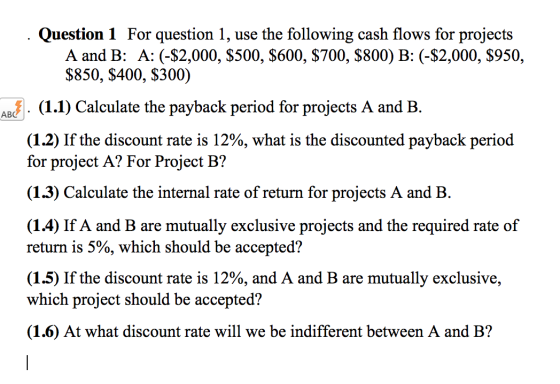
Homework Answers
Answer to 1.1:
Information given in the question is cash flows:
Cash outflows
Project A = -$2,000 and project B = -$2,000
Cash inflows
Project A; $500, $600, $700, $800 in year 1, 2,3,4 respectively
Project B; $950, $850, $400, $300 in year 1,2,3,4 respectively
Payback period is period in which we can be able to recover our initial cash outflow/investment
Payback period for Project A:
Sum of year 1,2,3($500+$600+$700=$1800) cash inflows were lower than $2,000.
That means payback period is more than 3 years
Payback period = 3 + 200/800
= 3 + 0.25 = 3.25
Payback period for project A(cash flows -$2,000,$500, $600, $700, $800 ) is 3.25 years
Payback period for Project B:
Sum of year 1,2 ($950+$850 =$1800) cash inflows were lower than $2,000.
That means payback period is more than 2 years
Payback period = 2 + 200/400
= 2 + 0.5 = 2.5
Payback period for project B(cash flows -$2,000,$950, $850, $400, $300 ) is 2.5 years
Add Answer to:
Remember to explain all your steps and to show all formulas you
use before you put...
Remember to explain all your steps and to show all formulas you use before you put...
 Remember to explain all your steps and to show all formulas you
use before you put numbers into the equations.
-Write the formula, substitute the numbers into the formula, say
what is left to compute, compute
Use the following information to answer questions 4 and 5 (including their appropriate subsections) D. Newcombe & Associates, Inc., is considering the introduction of a new product. Production of the new product requires an investment of $140,000 in equipment that has a five-year life....
Remember to explain all your steps and to show all formulas you
use before you put numbers into the equations.
-Write the formula, substitute the numbers into the formula, say
what is left to compute, compute
Use the following information to answer questions 4 and 5 (including their appropriate subsections) D. Newcombe & Associates, Inc., is considering the introduction of a new product. Production of the new product requires an investment of $140,000 in equipment that has a five-year life....
CH. 9 WORKSHEET NPV and Other Investment Criteria For Problems 1-4, use a 5% discount rate...
 CH. 9 WORKSHEET NPV and Other Investment Criteria For Problems 1-4, use a 5% discount rate and the following cash flows for projects A and B.: A: (-$2000, $500, $600, $700, $800) B: (-$2000, $950, $850, $400, $300) 1. Calculate the payback period for projects A and B. 2. Calculate the internal rate of return for projects A and B. 3. If A and B are mutually exclusive and the required rate of return is 5%, which should be accepted?...
Remember to explain all your steps and to show all formulas you use before you put...
 Remember to explain all your steps and to show all formulas you
use before you put numbers into the equations.
-Write the formula, substitute the numbers into the formula, say
what is left to compute, compute
Question 3 Use the following prompt to answer the subsections: Aunt Sally's Sauces, Inc., is considering expansion into a new line of all-natural, cholesterol- free, sodium-free, fat-free, low-calorie tomato sauces. Sally has paid $50,000 for a marketing study which indicates that the new product...
Remember to explain all your steps and to show all formulas you
use before you put numbers into the equations.
-Write the formula, substitute the numbers into the formula, say
what is left to compute, compute
Question 3 Use the following prompt to answer the subsections: Aunt Sally's Sauces, Inc., is considering expansion into a new line of all-natural, cholesterol- free, sodium-free, fat-free, low-calorie tomato sauces. Sally has paid $50,000 for a marketing study which indicates that the new product...
QUESTION 1 Star Industries is considering three alternative projects for the company's investment. The cash flows for three independent projects are as follows: Year 1 Project A ($50,000) $10,...
 QUESTION 1 Star Industries is considering three alternative projects for the company's investment. The cash flows for three independent projects are as follows: Year 1 Project A ($50,000) $10,000 $15,000 $20,000 $25,000 $30,000 Project B ($100,000) $25,000 $25,000 $25,000 $25,000 $25,000 Project C ($450,000) $200,000 $200,000 $200,000 a) If the discount rate for all three projects is 9.5 percent, calculate the profitability index (PI) of these three projects. Which project will be accepted if the projects are mutually exclusive? b)...
Please show all steps and calculations. Answers without steps and calculations will not receive full points....
 Please show all steps and calculations. Answers without steps and calculations will not receive full points. (1) A firm is considering an expansion project that will last three years. The project requires an immediate purchase of a new equipment that costs $900,000. The equipment will be fully depreciated using straight-line method over the next three years. The resale price of the equipment at the end of year three is estimated to be $200,000. The project will generate annual sales of...
KEY TERMS Define the following terms: a. Capital budgeting; strategic business plan b. Net present value...
 KEY TERMS Define the following terms: a. Capital budgeting; strategic business plan b. Net present value (NPV) c. Internal rate of return (IRR) d. NPV profile; crossover rate e. Mutually exclusive projects; independent projects f. Nonnormal cash flows; normal cash flows; multiple IRRS g. Modified internal rate of return (MIRR) h. Payback period; discounted payback CAPITAL BUDGETING CRITERIA You must analyze two projects, X and Y. Each project costs $10,000, and the firm's WACC is 12%. The expected cash flows...
18. Suppose your firm is considering two mutually exclusive, required projects with the cash flows shown...
18. Suppose your firm is considering two mutually exclusive, required projects with the cash flows shown below. The required rate of return on projects of both of their risk class is 9 percent, and that the maximum allowable payback and discounted payback statistic for the projects are 2 and 3 years, respectively. Time: 0 1 2 3 Project A Cash Flow -21,000 11,000 31,000 2,000 Project B Cash Flow -31,000 11,000 21,000 51,000 Use the NPV decision rule to evaluate...
NPV and Uher nvestment CrNErTa For Problems 1-4, use a 5% discount rate and the following...
 NPV and Uher nvestment CrNErTa For Problems 1-4, use a 5% discount rate and the following cash flows for projects A and B.: A: (-$2000, $500, $600, $700, $800) B: -$2000, $950, $850, $400, $300) 3. If A and B are mutually exclusive and the required rate of return is 5%, which should be ассеpted? 4. If the discount rate is 12%, and A and B are mutually exclusive, which project should be ассеpted? You can borrow $8,000, to be...
Suppose your firm is considering two mutually exclusive, required projects with the cash flows shown below....
Suppose your firm is considering two mutually exclusive, required projects with the cash flows shown below. The required rate of return on projects of both of their risk class is 12 percent, and that the maximum allowable payback and discounted payback statistic for the projects are 2 and 3 years, respectively. Time: 0 1 2 3 Project A Cash Flow -29,000 19,000 39,000 10,000 Project B Cash Flow -39,000 19,000 29,000 59,000 Use the discounted payback decision rule to evaluate...
PLEASE SHOW ALL WORK 1. (35 points) You are considering the following two mutually exclusiveprojects. Both projects...
PLEASE SHOW ALL WORK 1. (35 points) You are considering the following two mutually exclusiveprojects. Both projects will be depreciated using straight-line depreciation to a zero book value over the life of the project. Neither project has any salvage value. Year Project(A) Project (B) 0 -$30,000 -$30,000 1 13,000 5,000 2 11,000 5,000 3 9,000 5,000 4 7,000 5,000 5 0 5,000 6 7 8 9 10 0 0 0 0 0 5,000 5,000 5,000 5,000 5,000 The required rate...
 Remember to explain all your steps and to show all formulas you
use before you put numbers into the equations.
-Write the formula, substitute the numbers into the formula, say
what is left to compute, compute
Use the following information to answer questions 4 and 5 (including their appropriate subsections) D. Newcombe & Associates, Inc., is considering the introduction of a new product. Production of the new product requires an investment of $140,000 in equipment that has a five-year life....
Remember to explain all your steps and to show all formulas you
use before you put numbers into the equations.
-Write the formula, substitute the numbers into the formula, say
what is left to compute, compute
Use the following information to answer questions 4 and 5 (including their appropriate subsections) D. Newcombe & Associates, Inc., is considering the introduction of a new product. Production of the new product requires an investment of $140,000 in equipment that has a five-year life....
 CH. 9 WORKSHEET NPV and Other Investment Criteria For Problems 1-4, use a 5% discount rate and the following cash flows for projects A and B.: A: (-$2000, $500, $600, $700, $800) B: (-$2000, $950, $850, $400, $300) 1. Calculate the payback period for projects A and B. 2. Calculate the internal rate of return for projects A and B. 3. If A and B are mutually exclusive and the required rate of return is 5%, which should be accepted?...
 Remember to explain all your steps and to show all formulas you
use before you put numbers into the equations.
-Write the formula, substitute the numbers into the formula, say
what is left to compute, compute
Question 3 Use the following prompt to answer the subsections: Aunt Sally's Sauces, Inc., is considering expansion into a new line of all-natural, cholesterol- free, sodium-free, fat-free, low-calorie tomato sauces. Sally has paid $50,000 for a marketing study which indicates that the new product...
Remember to explain all your steps and to show all formulas you
use before you put numbers into the equations.
-Write the formula, substitute the numbers into the formula, say
what is left to compute, compute
Question 3 Use the following prompt to answer the subsections: Aunt Sally's Sauces, Inc., is considering expansion into a new line of all-natural, cholesterol- free, sodium-free, fat-free, low-calorie tomato sauces. Sally has paid $50,000 for a marketing study which indicates that the new product...
 QUESTION 1 Star Industries is considering three alternative projects for the company's investment. The cash flows for three independent projects are as follows: Year 1 Project A ($50,000) $10,000 $15,000 $20,000 $25,000 $30,000 Project B ($100,000) $25,000 $25,000 $25,000 $25,000 $25,000 Project C ($450,000) $200,000 $200,000 $200,000 a) If the discount rate for all three projects is 9.5 percent, calculate the profitability index (PI) of these three projects. Which project will be accepted if the projects are mutually exclusive? b)...
 Please show all steps and calculations. Answers without steps and calculations will not receive full points. (1) A firm is considering an expansion project that will last three years. The project requires an immediate purchase of a new equipment that costs $900,000. The equipment will be fully depreciated using straight-line method over the next three years. The resale price of the equipment at the end of year three is estimated to be $200,000. The project will generate annual sales of...
 KEY TERMS Define the following terms: a. Capital budgeting; strategic business plan b. Net present value (NPV) c. Internal rate of return (IRR) d. NPV profile; crossover rate e. Mutually exclusive projects; independent projects f. Nonnormal cash flows; normal cash flows; multiple IRRS g. Modified internal rate of return (MIRR) h. Payback period; discounted payback CAPITAL BUDGETING CRITERIA You must analyze two projects, X and Y. Each project costs $10,000, and the firm's WACC is 12%. The expected cash flows...
 NPV and Uher nvestment CrNErTa For Problems 1-4, use a 5% discount rate and the following cash flows for projects A and B.: A: (-$2000, $500, $600, $700, $800) B: -$2000, $950, $850, $400, $300) 3. If A and B are mutually exclusive and the required rate of return is 5%, which should be ассеpted? 4. If the discount rate is 12%, and A and B are mutually exclusive, which project should be ассеpted? You can borrow $8,000, to be...
Most questions answered within 3 hours.
-
Where is the error in this code sequence?
String s1 = "Hello";
String s2 = "ello";...
asked 10 months ago -
Financial data for Joel de Paris, Inc., for last year
follow:
Joel de Paris, Inc.
Balance...
asked 10 months ago -
Consider this reaction:
Al2(SO4)3 (aq)+ BaCl3
(aq) Al2Cl6 (aq)- +
3BaSO4(s) . What is the...
asked 10 months ago -
Suppose that Savneet is considering increasing her
recent random sample from 20 car rentals to 40...
asked 10 months ago -
Trucks arrive at an unloading terminal at an average rate of 120
per hour.
Trucks arrive...
asked 10 months ago -
Why are methanol and ethanol completely soluble in water while
octanol is not very little soluble....
asked 10 months ago -
A facilities manager at a university reads in a research report
that the mean amount of...
asked 10 months ago -
When the CuSO4 is rehydrated by adding water to the anhydrous
compound, is this an endothermic...
asked 10 months ago -
A ray of sunlight is passing from diamond into crown glass; the
angle of incidence is...
asked 10 months ago -
A block of mass 0.249 kg is placed on top of a light, vertical
spring of...
asked 10 months ago -
how do the kidneys compensate in the presences of acidosis
a) trigger hyperventilate
b) reserve acid...
asked 10 months ago -
Question 501 pts
The rental rate of capital to the firm increases. Which of the
following...
asked 10 months ago