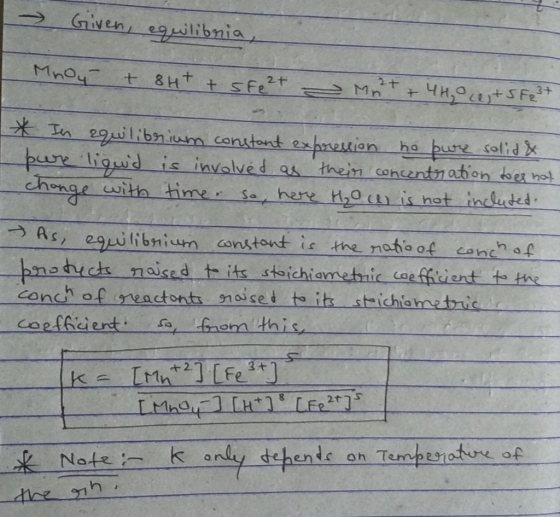
Calculate the equilibrium constant (K) for the following reaction under standard conditions: MnO4 - + 8...
Calculate the equilibrium constant (K) for the following reaction under standard conditions: MnO4 - + 8 H + + 5 Fe2+ → Mn2+ + 4 H2O + 5 Fe3+
Homework Answers
Add Answer to:
Calculate the equilibrium constant (K) for the following
reaction under standard conditions: MnO4 - + 8...
4. Calculate the cell potential for the half cells Fe3+/Fe2+ and MnO4- /Mn2+, where the Mn...
4. Calculate the cell potential for the half cells Fe3+/Fe2+ and MnO4- /Mn2+, where the Mn process occurs at the cathode, under the following conditions and predict whether the reaction is spontaneous: [Fe3+] = 1.0 M, [Fe2+] = 0.1 M, [MnO4 - ] = 0.01 M [Mn2+] = 1 x 10⁻⁴ M [H+ ] = 1 x 10⁻³ M Fe3+ + e− → Fe2+ +0.700 V MnO4 − (aq) + 8 H+ (aq)+ 5e− → Mn2+ (aq) + 4 H2O(l)...
Calculate Ecell (the reduction potential for the balanced chemical equation under nonstandard conditions) for the electrochemical...
Calculate Ecell (the reduction potential for the balanced chemical equation under nonstandard conditions) for the electrochemical cell shown below: Pt | Fe2+ (4.25x10⁻³ M), Fe3+ (1.50x10⁻³ M) || MnO4 - (6.50x10⁻³ M), Mn2+ (2.00x10⁻² M), H+ (0.100 M) | Pt. Use the following standard reduction potentials for each half reaction. The Eo for Fe3+/Fe2+ = 0.77 V and Eo for MnO4 - /Mn2+ = 1.51 V.
Calculate the equilibrium constant under normal conditions of the reaction: Fe3+ + Cu+ ⇄ Fe2+ +...
Calculate the equilibrium constant under normal conditions of the reaction: Fe3+ + Cu+ ⇄ Fe2+ + Cu2+ DATA: Fe3+ / Fe2+ = 0.714V; Cu2+ / Cu+ = 0.158V
What is the expected standard cell potential for the following unbalanced reaction under basic conditions? MnO4-(aq)...
What is the expected standard cell potential for the following unbalanced reaction under basic conditions? MnO4-(aq) + Fe+2(aq) ⟶ Fe+3 (aq) + MnO2(s) Given: Fe3+ + e− ⟶ Fe2+ E1/2= 0.771 MnO4−+ 2 H2O + 3e− ⟶ MnO2 + 4OH− E1/2 = 0.558 A. -0.213 V B. +0.213 V C. -1.329 V D. +1.329 V E. None of the above
Using std. electrode potentials listed, calculate the equilibrium constant at 25 ⁰C for the following reaction:...
Using std. electrode potentials listed, calculate the equilibrium constant at 25 ⁰C for the following reaction: O2 (g) + 4 H+ (aq) + 4 Fe2+ (aq) → 4 Fe3+ (aq) + 2 H2O (l) Fe3+ + e- = Fe2+ Ered= 0.77 O2 + 4H+ + 4e- = 2 H20 Ered= 1.23
4. Balance following stoichiometric reaction (a) KMnO4 + FeSO4 + H2SO4 → Fe2(SO4)3 + K2SO4 +...
 4. Balance following stoichiometric reaction (a) KMnO4 + FeSO4 + H2SO4 → Fe2(SO4)3 + K2SO4 + MnSO4 + H20 (b) MnO4 + Fe2+ +H - Fe3+ + Mn2+ + H2O
Question 31 4 pts 31. Determine which is reduced agent? MnO4 (aq) +5Fe2(aq) + 8 H(aq)...
 Question 31 4 pts 31. Determine which is reduced agent? MnO4 (aq) +5Fe2(aq) + 8 H(aq) 5 Fe(aq) + Mn2 (aq) + 4H2O(1) Mn in MnO4- H: Fe3+ Fe2+ Question 30 30. Calculate pH of 0.100 M HNO2(aq). K-2.8 x 10⁻⁵ 9.01 6.21 2.78 5.21
When the following reaction is balanced under basic conditions, what is the ratio of the coefficients...
 When the following reaction is balanced under basic conditions, what is the ratio of the coefficients of Mn(OH)2(s) to MnO4--(aq)? Mn(OH)2(s) + MnO4 (aq) + MnO42-(aq) (A) 3:1 (B) 1:3 (C) 1:4 (D) 1:5 What is the standard reduction potential for the reduction of permanganate ion to managanese dioxide in acidic solution? Half-Reaction E. V MnO4 (aq) + 8 H(aq) + 5 € → Mn²+ (aq) + +1.51 4 H2O(1) MnO2(s) + 4 H (aq) + 2 e → Mn2+(aq)...
Use standard reduction potentials to calculate ΔG° for the reaction: 2 MnO4- + 10 Cl- +...
Use standard reduction potentials to calculate ΔG° for the reaction: 2 MnO4- + 10 Cl- + 16 H3O+ →2 Mn2+ + 5 Cl2 + 24 H2O E°MnO4-/Mn2+, H3O+ = +1.507, E°Cl2/Cl- = +1.35827
Calculate the change in Gibbs free energy at standard conditions (TSS) and the equilibrium constant for...
Calculate the change in Gibbs free energy at standard conditions (TSS) and the equilibrium constant for each of the following reactions. (a) CH4(g) + H2O(g) equilibrium reaction arrow CO(g) + 3 H2(g); ?H° = +205.9 kJ, ?S° = +214.7 J/K ?G° 141.9 Correct: Your answer is correct. kJ K (b) CaCO3(s) equilibrium reaction arrow CaO(s) + CO2(g); ?H° = +179.2 kJ, ?S° = +160.2 J/K ?G° 131.5 Correct: Your answer is correct. kJ K
 4. Balance following stoichiometric reaction (a) KMnO4 + FeSO4 + H2SO4 → Fe2(SO4)3 + K2SO4 + MnSO4 + H20 (b) MnO4 + Fe2+ +H - Fe3+ + Mn2+ + H2O
 Question 31 4 pts 31. Determine which is reduced agent? MnO4 (aq) +5Fe2(aq) + 8 H(aq) 5 Fe(aq) + Mn2 (aq) + 4H2O(1) Mn in MnO4- H: Fe3+ Fe2+ Question 30 30. Calculate pH of 0.100 M HNO2(aq). K-2.8 x 10⁻⁵ 9.01 6.21 2.78 5.21
 When the following reaction is balanced under basic conditions, what is the ratio of the coefficients of Mn(OH)2(s) to MnO4--(aq)? Mn(OH)2(s) + MnO4 (aq) + MnO42-(aq) (A) 3:1 (B) 1:3 (C) 1:4 (D) 1:5 What is the standard reduction potential for the reduction of permanganate ion to managanese dioxide in acidic solution? Half-Reaction E. V MnO4 (aq) + 8 H(aq) + 5 € → Mn²+ (aq) + +1.51 4 H2O(1) MnO2(s) + 4 H (aq) + 2 e → Mn2+(aq)...
Most questions answered within 3 hours.
-
Where is the error in this code sequence?
String s1 = "Hello";
String s2 = "ello";...
asked 10 months ago -
Financial data for Joel de Paris, Inc., for last year
follow:
Joel de Paris, Inc.
Balance...
asked 10 months ago -
Consider this reaction:
Al2(SO4)3 (aq)+ BaCl3
(aq) Al2Cl6 (aq)- +
3BaSO4(s) . What is the...
asked 10 months ago -
Suppose that Savneet is considering increasing her
recent random sample from 20 car rentals to 40...
asked 10 months ago -
Trucks arrive at an unloading terminal at an average rate of 120
per hour.
Trucks arrive...
asked 10 months ago -
Why are methanol and ethanol completely soluble in water while
octanol is not very little soluble....
asked 10 months ago -
A facilities manager at a university reads in a research report
that the mean amount of...
asked 10 months ago -
When the CuSO4 is rehydrated by adding water to the anhydrous
compound, is this an endothermic...
asked 10 months ago -
A ray of sunlight is passing from diamond into crown glass; the
angle of incidence is...
asked 10 months ago -
A block of mass 0.249 kg is placed on top of a light, vertical
spring of...
asked 10 months ago -
how do the kidneys compensate in the presences of acidosis
a) trigger hyperventilate
b) reserve acid...
asked 10 months ago -
Question 501 pts
The rental rate of capital to the firm increases. Which of the
following...
asked 10 months ago