
Homework Answers
1) Electronic Configuration of Cyanide ion is σ1s2 > σ1s2* > σ2s2 >σ2s2* > π2px2 = π2py2 > σ2pz2 > π2px* = π2py* > σ2pz*
Bond Order = 1/2 [Nb -Na] where Nb is number of electron in bonding molecular orbitals and Na is number of electron in antibonding molecular orbitals.
Bond order of cyanide ion = 1/2 [10-4] =1/2[6] =3

Based on molecular orbital diagram, Cyanide ion is diamagnetic due to no unpaired electron and HOMO of cyanide ion is σg
Option b, d, f are correct.
2) diatomic 2p orbitals of a) C2
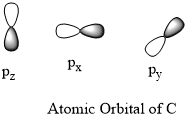


b) diatomic 2p orbital of O2


σ2p bonding orbital are gerade whereas π2p bonding orbital are ungerade
σ2p* antibonding orbital are ungerade whereas π2p* antibonding orbital are gerade
3) a) Electronic Configuration of OF- is σ1s2 > σ1s2* > σ2s2 >σ2s2* > π2px2 = π2py2 > σ2pz2 > π2px*2 = π2py*2 > σ2pz*2
Bond Order = 1/2 [Nb -Na] where Nb is number of electron in bonding molecular orbitals and Na is number of electron in antibonding molecular orbitals.
Bond order of OF- = 1/2 [10-10] =1/2[0] =0
b) HOMO is polarized towards fluorine atoms due to electronegativity,
c) σ2pz* sigma antibonding energy levels is HOMO

4) A) HOMO of NO- have more N character and so hydrogen attack the N atom instead of O atom to form HNO.


B) NO- is easily dimerize to N2O42- with a trans configuration using π*g (2p).
5) i) interaction 2pz orbitals to form molecular orbital of
a) σ bonding orbitals Option d)
 or
or 
b) σ* antibonding orbitals Option a)
 or
or 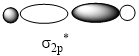
ii) interaction 2px orbitals to form molecular orbital of
c) π bonding orbitals Option c)
 or
or 
d) π* antibonding orbitals Option b)
 or
or 
6) a) Using Drago's Theory,
-ΔH = EaEb + CaCb
Where ΔH is enthalpy, E is electrostatic parameter and C is covalent parameter
-ΔH = EpyEBF3 +CpyCBF3
= (1.17*9.88) + (6.40*1.62)
-ΔH =1.1916
ΔH = -1.1916
Exothermic reaction
b) Using Drago's Theory,
-ΔH = EaEb + CaCb
Where H is enthalpy, E is electrostatic parameter and C is covalent parameter
-ΔH = EpyEBMe3 +CpyCBMe3
= (1.17*6.14) + (6.40*1.70)
-ΔH =-3.6962
ΔH = 3.6962
Endothermic reaction
Add Answer to:
question 1 2 3 4 5 6
Which are correct? In molecular orbital (MO) energy level...
13. (14 pts) MO Theory Draw the complete (core and valence) molecular orbital energy level diagram...
 13. (14 pts) MO Theory Draw the complete (core and valence) molecular orbital energy level diagram for the homonuclear diatomic molecule Be2. Use standard MO symbols to label the energy levels (That is: o, o, , or n*, as needed, with subscripts indicating which atomic orbitals formed them.) a. Sketch the molecular orbital formed when two 2p orbitals, one each on each Be atom, overlap to form a o antibonding MO b. Using your MO energy level diagram in (a),...
9. Construct the molecular orbital diagram for the cyanide ion. Calculate the bond order for this...
 9. Construct the molecular orbital diagram for the cyanide ion. Calculate the bond order for this ion. Molecular orbitals of CN Atomic arbitals of Atomic orbitals of Nitrogen Carbon 2p 77 TT 19, 2s b. Draw the Lewis structure for cyanide. Do the 2 models predict the same or different bond orders? 24 6-4
4. On the basis of molecular orbitals and molecular orbital diagrams, predict which molecule in each...
 4. On the basis of molecular orbitals and molecular orbital diagrams, predict which molecule in each series will have the longest bond. Be sure to provide a brief explanation a. B2, B2 b. 02*, 0,- c. HHe", Hz 5. Consider the hydroxide ion, OH and do the following: a. Prepare a molecular orbital diagram and fill with electrons given the following atomic orbital potential energies: O(2s) = -32.3 eV, O(2p) = -15.8 eV, H(s) -13.6 eV. Be sure to label...
7. Without using hybridization, construct a reasonable molecular orbital diagram showing the interaction between the oxygen...
 7. Without using hybridization, construct a reasonable molecular orbital diagram showing the interaction between the oxygen and the fluorines for OFs (oxygen is the central atom). Your diagram must account for the following: OFs is diamagnetic. OF, is paramagnetic. relative to OFs, the bond order for OF3 decreases. . relative to OF,, the bond order for OF, does not change. relative to OF, , the bond order for OF, does not change. For full credit, you must: . label the...
1) 2) 3) 4) 5) Use the molecular orbital energy diagram below to answer the questions...
 1)
2)
3)
4)
5)
Use the molecular orbital energy diagram below to answer the questions about bond order for the negative ion By. Number of Bonding Number of Antibonding B2 Valence Electrons Valence Electrons Bond Order This corresponds to: A. Single bond B. Double bond C. Triple bond D. Half of a bond E. Between a single and double bond F. Between a double and a triple bond G. No bond, B2" does not form. boron MO's boron 2p...
1)
2)
3)
4)
5)
Use the molecular orbital energy diagram below to answer the questions about bond order for the negative ion By. Number of Bonding Number of Antibonding B2 Valence Electrons Valence Electrons Bond Order This corresponds to: A. Single bond B. Double bond C. Triple bond D. Half of a bond E. Between a single and double bond F. Between a double and a triple bond G. No bond, B2" does not form. boron MO's boron 2p...
#2 2. Below is a molecular orbital (MO) diagram for 1,3,5 hexatriene in the excited state....
 #2
2. Below is a molecular orbital (MO) diagram for 1,3,5 hexatriene in the excited state. Please label the antibonding MO's, the bonding MO's, the HOMO, the LUMO and the nodes. (5 pt) 05 - antisymmetric 388 382388 388 symmetric antisymmetric Energy ton +- symmetric energy of the patomic orbitals > t antisymmetric no T symmetric molecular orbitals energy levels 2011 Production,
#2
2. Below is a molecular orbital (MO) diagram for 1,3,5 hexatriene in the excited state. Please label the antibonding MO's, the bonding MO's, the HOMO, the LUMO and the nodes. (5 pt) 05 - antisymmetric 388 382388 388 symmetric antisymmetric Energy ton +- symmetric energy of the patomic orbitals > t antisymmetric no T symmetric molecular orbitals energy levels 2011 Production,
Using the molecular orbital energy ordering for second-row homonuclear diatomic molecules in which the π2p orbitals...
Using the molecular orbital energy ordering for second-row homonuclear diatomic molecules in which the π2p orbitals lie at lower energy than the σ2p, predict the bond order in a molecule or ion with each of the following numbers of total valence electrons.(Use the drawing MO energy diagrams) Will the molecule or ion be diamagnetic or paramagnetic? Part A Determine the bond order in a molecule or ion with 4 valence electrons. Part B Will this molecule or ion be diamagnetic...
Diatomic Molecular Orbital Energy Diagram Given that the following MO-energy-level diagram applies to the the diatomic...
 Diatomic Molecular Orbital Energy Diagram Given that the following MO-energy-level diagram applies to the the diatomic molecular anion BC, match the letter label of each energy level with the corresponding orbital descriptor. . B BC . . c. c 1pts Submit Answer Tries 0/5 Does this diagram display the effect of s-p orbital mixing? Yes! No! 25pts Submit Answer Tries 0/1 Which kind of magnetism would be observed for this anion? O paramagnetism diamagnetism 25pts Submit Answer Tries 0/1 C...
2. Use the group orbitals of CH3 and CH2 to create a Qualitative Molecular Orbital Theory...
2. Use the group orbitals of CH3 and CH2 to create a Qualitative Molecular Orbital Theory diagram of the bonding in CH3NH2 (14 electrons) Draw a separate picture attempting to illustrate what the molecular orbital will look like A few points to help you in making this diagram: • Better overlap (as in head-on versus side-by-side) leads to greater stabilization of bonding orbital • If bonding interaction is highly stabilized, the anti-bonding interaction is even more destabilized • The 2p...
Construct a partial molecular orbital energy level diagram describing the r-bond in a ketone of the type R2C-O. Clearly label the HOMO and LUMO orbitals and indicate the direction of a nucleophil...
 Construct a partial molecular orbital energy level diagram describing the r-bond in a ketone of the type R2C-O. Clearly label the HOMO and LUMO orbitals and indicate the direction of a nucleophilic attaclk (f) 14 marks]
Construct a partial molecular orbital energy level diagram describing the r-bond in a ketone of the type R2C-O. Clearly label the HOMO and LUMO orbitals and indicate the direction of a nucleophilic attaclk (f) 14 marks]
Construct a partial molecular orbital energy level diagram describing the r-bond in a ketone of the type R2C-O. Clearly label the HOMO and LUMO orbitals and indicate the direction of a nucleophilic attaclk (f) 14 marks]
 13. (14 pts) MO Theory Draw the complete (core and valence) molecular orbital energy level diagram for the homonuclear diatomic molecule Be2. Use standard MO symbols to label the energy levels (That is: o, o, , or n*, as needed, with subscripts indicating which atomic orbitals formed them.) a. Sketch the molecular orbital formed when two 2p orbitals, one each on each Be atom, overlap to form a o antibonding MO b. Using your MO energy level diagram in (a),...
 9. Construct the molecular orbital diagram for the cyanide ion. Calculate the bond order for this ion. Molecular orbitals of CN Atomic arbitals of Atomic orbitals of Nitrogen Carbon 2p 77 TT 19, 2s b. Draw the Lewis structure for cyanide. Do the 2 models predict the same or different bond orders? 24 6-4
 4. On the basis of molecular orbitals and molecular orbital diagrams, predict which molecule in each series will have the longest bond. Be sure to provide a brief explanation a. B2, B2 b. 02*, 0,- c. HHe", Hz 5. Consider the hydroxide ion, OH and do the following: a. Prepare a molecular orbital diagram and fill with electrons given the following atomic orbital potential energies: O(2s) = -32.3 eV, O(2p) = -15.8 eV, H(s) -13.6 eV. Be sure to label...
 7. Without using hybridization, construct a reasonable molecular orbital diagram showing the interaction between the oxygen and the fluorines for OFs (oxygen is the central atom). Your diagram must account for the following: OFs is diamagnetic. OF, is paramagnetic. relative to OFs, the bond order for OF3 decreases. . relative to OF,, the bond order for OF, does not change. relative to OF, , the bond order for OF, does not change. For full credit, you must: . label the...
 1)
2)
3)
4)
5)
Use the molecular orbital energy diagram below to answer the questions about bond order for the negative ion By. Number of Bonding Number of Antibonding B2 Valence Electrons Valence Electrons Bond Order This corresponds to: A. Single bond B. Double bond C. Triple bond D. Half of a bond E. Between a single and double bond F. Between a double and a triple bond G. No bond, B2" does not form. boron MO's boron 2p...
1)
2)
3)
4)
5)
Use the molecular orbital energy diagram below to answer the questions about bond order for the negative ion By. Number of Bonding Number of Antibonding B2 Valence Electrons Valence Electrons Bond Order This corresponds to: A. Single bond B. Double bond C. Triple bond D. Half of a bond E. Between a single and double bond F. Between a double and a triple bond G. No bond, B2" does not form. boron MO's boron 2p...
 #2
2. Below is a molecular orbital (MO) diagram for 1,3,5 hexatriene in the excited state. Please label the antibonding MO's, the bonding MO's, the HOMO, the LUMO and the nodes. (5 pt) 05 - antisymmetric 388 382388 388 symmetric antisymmetric Energy ton +- symmetric energy of the patomic orbitals > t antisymmetric no T symmetric molecular orbitals energy levels 2011 Production,
#2
2. Below is a molecular orbital (MO) diagram for 1,3,5 hexatriene in the excited state. Please label the antibonding MO's, the bonding MO's, the HOMO, the LUMO and the nodes. (5 pt) 05 - antisymmetric 388 382388 388 symmetric antisymmetric Energy ton +- symmetric energy of the patomic orbitals > t antisymmetric no T symmetric molecular orbitals energy levels 2011 Production,
 Diatomic Molecular Orbital Energy Diagram Given that the following MO-energy-level diagram applies to the the diatomic molecular anion BC, match the letter label of each energy level with the corresponding orbital descriptor. . B BC . . c. c 1pts Submit Answer Tries 0/5 Does this diagram display the effect of s-p orbital mixing? Yes! No! 25pts Submit Answer Tries 0/1 Which kind of magnetism would be observed for this anion? O paramagnetism diamagnetism 25pts Submit Answer Tries 0/1 C...
 Construct a partial molecular orbital energy level diagram describing the r-bond in a ketone of the type R2C-O. Clearly label the HOMO and LUMO orbitals and indicate the direction of a nucleophilic attaclk (f) 14 marks]
Construct a partial molecular orbital energy level diagram describing the r-bond in a ketone of the type R2C-O. Clearly label the HOMO and LUMO orbitals and indicate the direction of a nucleophilic attaclk (f) 14 marks]
Construct a partial molecular orbital energy level diagram describing the r-bond in a ketone of the type R2C-O. Clearly label the HOMO and LUMO orbitals and indicate the direction of a nucleophilic attaclk (f) 14 marks]
Most questions answered within 3 hours.
-
Where is the error in this code sequence?
String s1 = "Hello";
String s2 = "ello";...
asked 10 months ago -
Financial data for Joel de Paris, Inc., for last year
follow:
Joel de Paris, Inc.
Balance...
asked 10 months ago -
Consider this reaction:
Al2(SO4)3 (aq)+ BaCl3
(aq) Al2Cl6 (aq)- +
3BaSO4(s) . What is the...
asked 10 months ago -
Suppose that Savneet is considering increasing her
recent random sample from 20 car rentals to 40...
asked 10 months ago -
Trucks arrive at an unloading terminal at an average rate of 120
per hour.
Trucks arrive...
asked 10 months ago -
Why are methanol and ethanol completely soluble in water while
octanol is not very little soluble....
asked 10 months ago -
A facilities manager at a university reads in a research report
that the mean amount of...
asked 10 months ago -
When the CuSO4 is rehydrated by adding water to the anhydrous
compound, is this an endothermic...
asked 10 months ago -
A ray of sunlight is passing from diamond into crown glass; the
angle of incidence is...
asked 10 months ago -
A block of mass 0.249 kg is placed on top of a light, vertical
spring of...
asked 10 months ago -
how do the kidneys compensate in the presences of acidosis
a) trigger hyperventilate
b) reserve acid...
asked 10 months ago -
Question 501 pts
The rental rate of capital to the firm increases. Which of the
following...
asked 10 months ago