Your boss wants you to determine if the initial velocity of the sled and the weight...
Your boss wants you to determine if the initial velocity of the
sled and the weight of the team
affect its acceleration down the ramp. To solve this problem, you
decide to model the situation
using a cart moving down an inclined track.
Write down the relationship between the velocity and the
position of the cart. Use that
relationship to construct a position vs. time graph, after an
initial push, just below each
velocity vs. time graph from question 2. Use the same scale for
your time axes. (The
connection between the derivative of a function and the slope of
its graph will be useful.)
Write down the equation that best represents each graph. If there
are constants in your
equations, what kinematics quantities do they represent? How would
you determine these
constants from your graphs? Can any of these constants be
determined from the equations
representing the velocity vs. time graphs?
Homework Answers
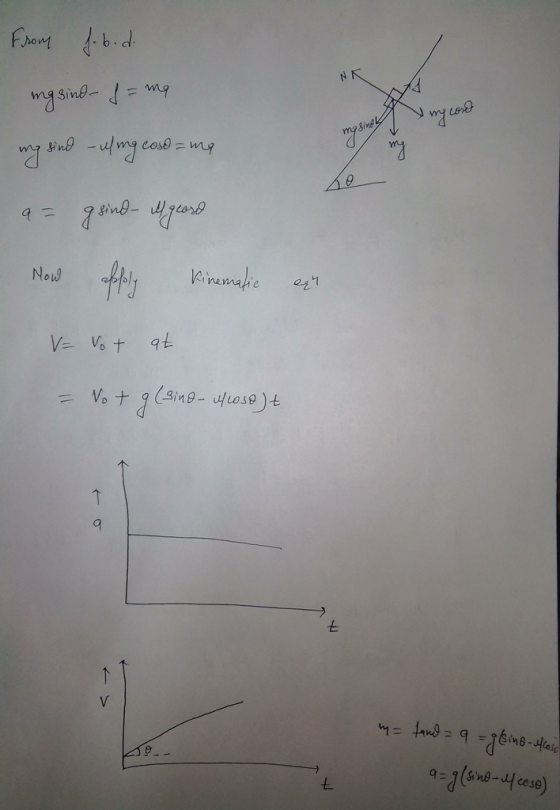
From velocity time graph we can determine acceleration which is equal to its slope
Add Answer to:
Your boss wants you to determine if the initial velocity of the
sled and the weight...
your boss wants you to determine if the initial velocity of the sled and the weight...
your boss wants you to determine if the initial velocity of the sled and the weight of the team affect its acceleration down the ramp. To solve this problem, you decide to model the situation using a cart moving down an inclined track. Write down the relationship between the acceleration and the velocity of the cart. Use that relationship to construct an instantaneous velocity vs. time graph, after an initial push, just below each of your acceleration vs. time graphs...
Choose a function to represent the acceleration vs. time graph. How can you calculate the values...
Choose a function to represent the acceleration vs. time graph. How can you calculate the values of the constants of this function from the function representing the position versus time graph? Check how well this works. You can also estimate the values of the constants from the graph. What kinematics quantities do these constants represent? Record the corresponding kinematic quantities and the values of the corresponding errors. From either the position vs. time, velocity vs. time, or acceleration vs. time...
10. Move the Motion Sensor. Place the Motion Sensor at the bottom of the track pointing...
 10. Move the Motion Sensor. Place the Motion Sensor at the bottom of the track pointing up the track. 11. Check the Motion Sensor. Start with the cart at least 50 em in front of the sensor. Practice pushing the cart up the track so the cart doesn't go over the top of the track and stopping the cart before it gets within the 50 em of the sensor. Start the sensor and push the carit up the track. Stop...
Part 2: Velocity vs. Time 1. For each velocity vs. time graph (Graph 3 and 4), describe how you w...
 Part 2: Velocity vs. Time 1. For each velocity vs. time graph (Graph 3 and 4), describe how you would walk in order to replicate the 1-D motion graph. Use words such as away, toward, at rest, speeding up, slowing down, constant speed. Be specific with your time periods. 2. For each velocity vs. time graph, create the corresponding position and acceleration versus time graphs. Construct your graph on a computer program such as Microsoft ExcelB. If you do not...
PHYS 121 – Special Problem 1 Multiple Representations and Kinematics Two children are playing a game...
PHYS 121 – Special Problem 1 Multiple Representations and Kinematics Two children are playing a game where they run towards each other and see who can reach a toy that is somewhere between them. In the beginning, Charlie is 23.7 m away from the toy, running towards it at a speed of 0.770 m/s, and is speeding up. At the same time, Amy is 12.5 m away from the toy, is running towards it in the opposite direction as Charlie...
Experiment AM Position and Velocity Comprehension Questions 1. You have worked with graphs for four different...
 Experiment AM Position and Velocity Comprehension Questions 1. You have worked with graphs for four different cart motions at nearly constant velocity for the cart moving slowly and more quickly as well as for the cart moving in the direction of increasing and decreasing z. The next few questions are about the similarities and differences among them. (a) What is the general shape of the position vs. time or r(t) graph for motion at constant velocity? (b) What is the...
Ball Thrown upward with an initial speed of 14.7m/s from a height of 89m a) Draw...
Ball Thrown upward with an initial speed of 14.7m/s from a height of 89m a) Draw the sketch of this motion b) State the theory that describes this motion (Newton's first, second, or third laws. Choose one) c) Write the velocity and position kinematics equations with the number obtained from the sketch d) Solve all unknowns (initial velocity, Final position, time etc..) -Maximum Height -Final velocity - time that ball go up and hin the ground (How long it takes...
Consider a block of wood given an initial velocity directed up an incline of angle θ....
Consider a block of wood given an initial velocity directed up an incline of angle θ. It reaches some maximum distance up the incline, turns around, and slides back down. There is friction present. Take the motion of the block to be after any push necessary to provide the initial velocity. (a) Draw and label separate free body diagrams (FBDs) for (i) the motion up the incline and (ii) the motion back down. Include coordinate axes and indicate acceleration. (b)...
please help with #7 and question 6 (the last question) 3. Rescale the axes if necessary...
 please help with #7 and question 6 (the last question)
3. Rescale the axes if necessary to see all of the graphs. Answer the following questions: a. At the instant the push ends, what does the force equal? F= b. At the instant the push ends, what does the acceleration equal? a= c. At the instant the push ends, what can you say about the speed of the cart? Look carefully at the graphs on the computer monitor. 4. Use...
please help with #7 and question 6 (the last question)
3. Rescale the axes if necessary to see all of the graphs. Answer the following questions: a. At the instant the push ends, what does the force equal? F= b. At the instant the push ends, what does the acceleration equal? a= c. At the instant the push ends, what can you say about the speed of the cart? Look carefully at the graphs on the computer monitor. 4. Use...
Two children are playing a game where they run towards each other and see who can...
Two children are playing a game where they run towards each other and see who can reach a toy that is somewhere between them. In the beginning, Charlie is 23.7 m away from the toy, running towards it at a speed of 0.770 m/s, and is speeding up. At the same time, Amy is 12.5 m away from the toy, is running towards it in the opposite direction as Charlie at a speed of 2.70 m/s, and is slowing down....
 10. Move the Motion Sensor. Place the Motion Sensor at the bottom of the track pointing up the track. 11. Check the Motion Sensor. Start with the cart at least 50 em in front of the sensor. Practice pushing the cart up the track so the cart doesn't go over the top of the track and stopping the cart before it gets within the 50 em of the sensor. Start the sensor and push the carit up the track. Stop...
 Part 2: Velocity vs. Time 1. For each velocity vs. time graph (Graph 3 and 4), describe how you would walk in order to replicate the 1-D motion graph. Use words such as away, toward, at rest, speeding up, slowing down, constant speed. Be specific with your time periods. 2. For each velocity vs. time graph, create the corresponding position and acceleration versus time graphs. Construct your graph on a computer program such as Microsoft ExcelB. If you do not...
 Experiment AM Position and Velocity Comprehension Questions 1. You have worked with graphs for four different cart motions at nearly constant velocity for the cart moving slowly and more quickly as well as for the cart moving in the direction of increasing and decreasing z. The next few questions are about the similarities and differences among them. (a) What is the general shape of the position vs. time or r(t) graph for motion at constant velocity? (b) What is the...
 please help with #7 and question 6 (the last question)
3. Rescale the axes if necessary to see all of the graphs. Answer the following questions: a. At the instant the push ends, what does the force equal? F= b. At the instant the push ends, what does the acceleration equal? a= c. At the instant the push ends, what can you say about the speed of the cart? Look carefully at the graphs on the computer monitor. 4. Use...
please help with #7 and question 6 (the last question)
3. Rescale the axes if necessary to see all of the graphs. Answer the following questions: a. At the instant the push ends, what does the force equal? F= b. At the instant the push ends, what does the acceleration equal? a= c. At the instant the push ends, what can you say about the speed of the cart? Look carefully at the graphs on the computer monitor. 4. Use...
Most questions answered within 3 hours.
-
Where is the error in this code sequence?
String s1 = "Hello";
String s2 = "ello";...
asked 10 months ago -
Financial data for Joel de Paris, Inc., for last year
follow:
Joel de Paris, Inc.
Balance...
asked 10 months ago -
Consider this reaction:
Al2(SO4)3 (aq)+ BaCl3
(aq) Al2Cl6 (aq)- +
3BaSO4(s) . What is the...
asked 10 months ago -
Suppose that Savneet is considering increasing her
recent random sample from 20 car rentals to 40...
asked 10 months ago -
Trucks arrive at an unloading terminal at an average rate of 120
per hour.
Trucks arrive...
asked 10 months ago -
Why are methanol and ethanol completely soluble in water while
octanol is not very little soluble....
asked 10 months ago -
A facilities manager at a university reads in a research report
that the mean amount of...
asked 10 months ago -
When the CuSO4 is rehydrated by adding water to the anhydrous
compound, is this an endothermic...
asked 10 months ago -
A ray of sunlight is passing from diamond into crown glass; the
angle of incidence is...
asked 10 months ago -
A block of mass 0.249 kg is placed on top of a light, vertical
spring of...
asked 10 months ago -
how do the kidneys compensate in the presences of acidosis
a) trigger hyperventilate
b) reserve acid...
asked 10 months ago -
Question 501 pts
The rental rate of capital to the firm increases. Which of the
following...
asked 10 months ago