Question 5 1 Point What is the most critical factor in determining non-ideal behaviour in a...
Question 5
1 Point
What is the most critical factor in determining non-ideal behaviour in a gas?
Select the correct answer
-
low temperature
-
high pressure
-
the size of the molecules
-
intermolecular forces between molecules
Homework Answers
The answer is

Add Answer to:
Question 5
1 Point
What is the most critical factor in determining non-ideal
behaviour in a...
Part A) Which of the following statements is true for ideal gases, but is not always...
Part A) Which of the following statements is true for ideal gases, but is not always true for real gases? Choose all that apply. Molecules are in constant random motion. Pressure is caused by molecule-wall collisions. The size of the molecules is unimportant compared to the distances between them. The volume occupied by the molecules is negligible compared to the volume of the container. Part B) Which of the following statements is true for real gases? Choose all that apply....
1. Which of the following statements is true for ideal gases, but is not always true...
1. Which of the following statements is true for ideal gases, but is not always true for real gases? Choose all that apply. A. Replacing one gas by another under the same conditions, has no effect on pressure. B. Collisions between molecules are elastic. C. There are no attractive forces between molecules. D. Molecules are in constant random motion. 2. Which of the following statements is true for real gases? Choose all that apply. A. As molecules increase in size,...
Question 1 (1 point) Calculate the density of nitrogen gas in a 4.32 L container at...
Question 1 (1 point) Calculate the density of nitrogen gas in a 4.32 L container at 1.0 atm and 25°C. Question 1 options: 0.57 g/L 0.74 g/L 1.15 g/L 1.31 g/L 1.56 g/L Save Question 2 (1 point) What volume is occupied by 1.00 kg of nitrogen gas at 5.00?C at a pressure of 735 Torr? Question 2 options: 1686 L 1242 L 843 L 738 L 621 L Save Question 3 (1 point) The ideal gas law fails to...
Which one of the following statements is not correct? a. An increase in temperature causes an...
Which one of the following statements is not correct? a. An increase in temperature causes an increase in gas pressure because the average force of molecules colliding with the walls of the container increases. b. An increase in temperature causes an increase in gas pressure because the frequency of molecules colliding with the walls of the container increases. c. Real gases deviate from ideal gases because of the finite size of the molecules and the attractive and repulsive interactions between...
Question 1 (a) Use the ideal gas equation to calculate the pressure (in atm) of 2.40...
Question 1 (a) Use the ideal gas equation to calculate the pressure (in atm) of 2.40 mol of krypton (Kr) at 455 K in a 4.50 L vessel. (b) In a 16.3 L vessel, the pressure of 2.40 mol of Kr at 455 K is 5.50 atm when calculated using the ideal gas equation and 5.40 atm when calculated using the van der waals equation of state (Note: a=5.121 and b = 0.0106). Why is the percent difference in...
- A 1.31 mol sample of Kr gas is confined in a 32.4 liter container at...
- A 1.31 mol sample of Kr gas is confined in a 32.4 liter container at 28.0 °C. If the temperature of the gas sample is raised to 43.1 °C holding the volume constant, the average molecular speed will a) not enough information to answer the question b) decrease c)remain the same d) increase -Which of the following statements is true for real gases? Choose all that apply. Attractive forces between molecules cause a decrease in pressure compared to the...
Question 1 (1 point) 1.50 Oxygen PV 1.ok Ideal gas 0.0 0 200 400 600 800...
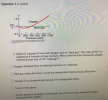 Question 1 (1 point) 1.50 Oxygen PV 1.ok Ideal gas 0.0 0 200 400 600 800 1000 Pressure (atm) 1. Above is a graph of one mole oxygen and an "ideal gas". The ratio of PV/T is plotted as a function of gas pressure. Why is the line that represents oxygen different from that of the "ideal gas"? Oxygen deviates from an ideal gas because it is diatomic Real gas molecules have a small but measurable intermolecular attraction Oxygen is...
just do the circle number only Applications 5.91 Would behave more like an ideal gas at...
 just do the circle number only
Applications 5.91 Would behave more like an ideal gas at 5 Kor 50 K? Explain your reasoning 5.92 Would CO behave more like an ideal gas at 2 atm or 20 atm? Explain your reasoning. The Liquid State Foundations 5.93 Compare the strength of intermolecular forces in liquids with those in gases 5.94 Compare the strength of intermolecular forces in liquids with those in solids. What is the relationship between the temperature of a...
just do the circle number only
Applications 5.91 Would behave more like an ideal gas at 5 Kor 50 K? Explain your reasoning 5.92 Would CO behave more like an ideal gas at 2 atm or 20 atm? Explain your reasoning. The Liquid State Foundations 5.93 Compare the strength of intermolecular forces in liquids with those in gases 5.94 Compare the strength of intermolecular forces in liquids with those in solids. What is the relationship between the temperature of a...
QUESTION 1 Identify the most important type of intermolecular force that would exist between neighboring molecules...
 QUESTION 1 Identify the most important type of intermolecular force that would exist between neighboring molecules in CH3CH2COOH A. London dispersion forces B. Dipole-dipole forces OC. Hydrogen bonding QUESTION 2 Identify the most important type of intermolecular force that would exist between neighboring molecules in NF3 O A. London dispersion forces B. Dipole-dipole forces OC. Hydrogen bonding QUESTION 3 Identify the most important type of intermolecular force that would exist between neighboring molecules in SO3 A. London dispersion forces B....
a) What is the effect of vapor pressure on a liquid’s boiling point? In your answer...
a) What is the effect of vapor pressure on a liquid’s boiling point? In your answer explain what two pressures must be equal in order for a substance to boil. How could you make a substance boil at a higher temperature? b) What is the difference between intermolecular and intramolecular forces (define each)? also give an example of each. c) Draw a diagram of NH2F molecules as they boil, and use Lewis Structures to label the most important intermolecular force and...
 Question 1 (1 point) 1.50 Oxygen PV 1.ok Ideal gas 0.0 0 200 400 600 800 1000 Pressure (atm) 1. Above is a graph of one mole oxygen and an "ideal gas". The ratio of PV/T is plotted as a function of gas pressure. Why is the line that represents oxygen different from that of the "ideal gas"? Oxygen deviates from an ideal gas because it is diatomic Real gas molecules have a small but measurable intermolecular attraction Oxygen is...
 just do the circle number only
Applications 5.91 Would behave more like an ideal gas at 5 Kor 50 K? Explain your reasoning 5.92 Would CO behave more like an ideal gas at 2 atm or 20 atm? Explain your reasoning. The Liquid State Foundations 5.93 Compare the strength of intermolecular forces in liquids with those in gases 5.94 Compare the strength of intermolecular forces in liquids with those in solids. What is the relationship between the temperature of a...
just do the circle number only
Applications 5.91 Would behave more like an ideal gas at 5 Kor 50 K? Explain your reasoning 5.92 Would CO behave more like an ideal gas at 2 atm or 20 atm? Explain your reasoning. The Liquid State Foundations 5.93 Compare the strength of intermolecular forces in liquids with those in gases 5.94 Compare the strength of intermolecular forces in liquids with those in solids. What is the relationship between the temperature of a...
 QUESTION 1 Identify the most important type of intermolecular force that would exist between neighboring molecules in CH3CH2COOH A. London dispersion forces B. Dipole-dipole forces OC. Hydrogen bonding QUESTION 2 Identify the most important type of intermolecular force that would exist between neighboring molecules in NF3 O A. London dispersion forces B. Dipole-dipole forces OC. Hydrogen bonding QUESTION 3 Identify the most important type of intermolecular force that would exist between neighboring molecules in SO3 A. London dispersion forces B....
Most questions answered within 3 hours.
-
Where is the error in this code sequence?
String s1 = "Hello";
String s2 = "ello";...
asked 11 months ago -
Financial data for Joel de Paris, Inc., for last year
follow:
Joel de Paris, Inc.
Balance...
asked 11 months ago -
Consider this reaction:
Al2(SO4)3 (aq)+ BaCl3
(aq) Al2Cl6 (aq)- +
3BaSO4(s) . What is the...
asked 11 months ago -
Suppose that Savneet is considering increasing her
recent random sample from 20 car rentals to 40...
asked 11 months ago -
Trucks arrive at an unloading terminal at an average rate of 120
per hour.
Trucks arrive...
asked 11 months ago -
Why are methanol and ethanol completely soluble in water while
octanol is not very little soluble....
asked 11 months ago -
A facilities manager at a university reads in a research report
that the mean amount of...
asked 11 months ago -
When the CuSO4 is rehydrated by adding water to the anhydrous
compound, is this an endothermic...
asked 11 months ago -
A ray of sunlight is passing from diamond into crown glass; the
angle of incidence is...
asked 11 months ago -
A block of mass 0.249 kg is placed on top of a light, vertical
spring of...
asked 11 months ago -
how do the kidneys compensate in the presences of acidosis
a) trigger hyperventilate
b) reserve acid...
asked 11 months ago -
Question 501 pts
The rental rate of capital to the firm increases. Which of the
following...
asked 11 months ago