

Homework Answers
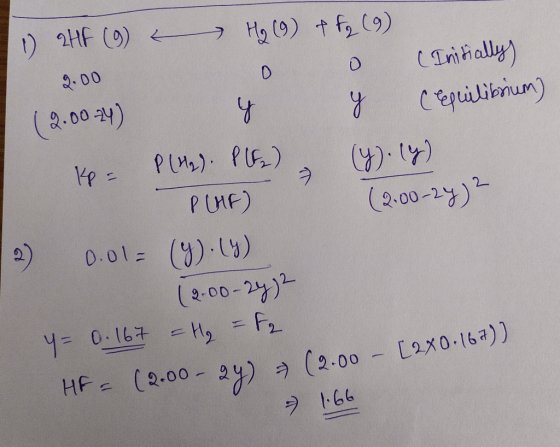
If you have any questions please comment
If you satisfied with the solution please rate it thanks
Add Answer to:
Consider the following reaction: 2HF(g) H2(g) + F2(g) Initially a container is filled with pure HF(g)...
3. Consider the following reaction: 2HF(g) = H2(g) + F2(g) Initially a container is filled with...
 3. Consider the following reaction: 2HF(g) = H2(g) + F2(g) Initially a container is filled with pure HF(g) at a pressure of 2 atm, after which equilibrium is reached. If y is the partial pressure of H2 at equilibrium, a) Express the value of Kp using y.
Consider the formation of hydrogen fluoride: H2(g) + F2(g) ↔ 2HF(g) If a 2.0 L nickel...
Consider the formation of hydrogen fluoride: H2(g) + F2(g) ↔ 2HF(g) If a 2.0 L nickel reaction container (glass cannot be used because it reacts with HF) filled with 0.0053 M H2 is connected to a 4.0 L container filled with 0.027 M F2. The equilibrium constant, Kp, is 7.8 x 10¹⁴ (Hint, this is a very large number, what does that imply?) Calculate the molar concentration of HF at equilibrium.
An empty steel container is filled with 0.0870 atm of HF. The system is allowed to...
 An empty steel container is filled with 0.0870 atm of HF. The system is allowed to reach equilibrium. If Kp = 2.76 for the reaction below, what is the equilibrium partial pressure of Hz? 2 HF (g) =H2 (g) + F2 (g) atm 1 2 3 +/- 0 x 100 up here or pull up for additional resources
H2(g) + F2(g) <——> 2HF(g) we determine that the equilibrium concentrations in a 5.00 L container...
H2(g) + F2(g) <——> 2HF(g) we determine that the equilibrium concentrations in a 5.00 L container are [H2] = 0.0500 M, [F2] = 0.0100 [HF] = 0.400 M. If 0.200 mol of F2 is added to this equilibrium mixture, calculate the concentration of all of the gases once equilibrium has been reestablished.
At a particular temperature, K = 1.00×10^2 for the reaction: H2(g) + F2(g)= 2HF(g) In an...
At a particular temperature, K = 1.00×10^2 for the reaction: H2(g) + F2(g)= 2HF(g) In an experiment, at this temperature, 1.00 mol of H2 and 1.00 mol of F2 are introduced into a 1.44-L flask and allowed to react. At equilibrium, all species remain in the gas phase. What is the equilibrium concentration (in mol/L) of H2? What is the equilibrium concentration (in mol/L) of HF? To the mixture above, an additional 4.60×10⁻¹ mol of H2 is added. What is...
At some temperature, K = 124 for the gas phase reaction H2 + F2 --> 2HF...
At some temperature, K = 124 for the gas phase reaction H2 + F2 --> 2HF What is the concentration of HF in an equilibrium mixture established by adding 4.72 mol each of H2 and F2 to a 1.00 L container at this temperature? [HF] = Incorrect: Your answer is incorrect. M What would be the equilibrium concentration of HF if 7.20 mol HF were removed from the above equilibrium mixture? [HF] = M
1. For the following balance: 2 HF (g) H2 (g) + F2 (g) 73Kcal Indicate what...
 1. For the following balance: 2 HF (g) H2 (g) + F2 (g) 73Kcal Indicate what will happen with each of the following changes: a) Decrease in HF concentratiorn b) Increase in temperature c) Decrease in pressure d) Increase in H2 concentration ej Increase in the concentration of F2 2. At 130 oc the sodium bicarbonate, NaHCO3, decomposes partially according to the following equilibrium: 2 NaHCO3 (s) sNa2CO3 (s) + CO2 (g)+ H20 (g) Ko= 6.25. 100 g of NaHCO3...
1. Consider the reaction H2(g) + F2(g) ----->2HF(g) Use the standard thermodynamic data in the tables...
1. Consider the reaction H2(g) + F2(g) ----->2HF(g) Use the standard thermodynamic data in the tables linked above. Calculate delta G for this reaction at 298.15K if the pressure of HF(g) is reduced to 11.42 mm Hg, while the pressures of H2(g) and F2(g) remain at 1 atm. ANSWER: _____ kJ/mol 2. Consider the reaction N2(g) + 3H2(g) ------>2NH3(g) Using the standard thermodynamic data in the tables linked above, calculate delta Grxn for this reaction at 298.15K if the pressure...
13. At a particular temperature the equilibrium constant for the reaction: H2(g)+F2(g) 2HF(g) is K 100.0....
 13. At a particular temperature the equilibrium constant for the reaction: H2(g)+F2(g) 2HF(g) is K 100.0. A reaction mixture in a 10.00-L flask contains 0.33 moles each of hydrogen and fluorine gases plus 0.40 moles of HF. What will be the concentration of H2 when this mixture reaches equilibrium? Submit Answer Tries 0/99
Consider the following chemical equilibrium: H2(g)+F2(g)⇌2HF(g) Now write an equation below that shows how to calculate...
Consider the following chemical equilibrium: H2(g)+F2(g)⇌2HF(g) Now write an equation below that shows how to calculate Kc from Kp for this reaction at an absolute temperature T. You can assume T is comfortably above room temperature. Kc=
 3. Consider the following reaction: 2HF(g) = H2(g) + F2(g) Initially a container is filled with pure HF(g) at a pressure of 2 atm, after which equilibrium is reached. If y is the partial pressure of H2 at equilibrium, a) Express the value of Kp using y.
 An empty steel container is filled with 0.0870 atm of HF. The system is allowed to reach equilibrium. If Kp = 2.76 for the reaction below, what is the equilibrium partial pressure of Hz? 2 HF (g) =H2 (g) + F2 (g) atm 1 2 3 +/- 0 x 100 up here or pull up for additional resources
 1. For the following balance: 2 HF (g) H2 (g) + F2 (g) 73Kcal Indicate what will happen with each of the following changes: a) Decrease in HF concentratiorn b) Increase in temperature c) Decrease in pressure d) Increase in H2 concentration ej Increase in the concentration of F2 2. At 130 oc the sodium bicarbonate, NaHCO3, decomposes partially according to the following equilibrium: 2 NaHCO3 (s) sNa2CO3 (s) + CO2 (g)+ H20 (g) Ko= 6.25. 100 g of NaHCO3...
 13. At a particular temperature the equilibrium constant for the reaction: H2(g)+F2(g) 2HF(g) is K 100.0. A reaction mixture in a 10.00-L flask contains 0.33 moles each of hydrogen and fluorine gases plus 0.40 moles of HF. What will be the concentration of H2 when this mixture reaches equilibrium? Submit Answer Tries 0/99
Most questions answered within 3 hours.
-
Where is the error in this code sequence?
String s1 = "Hello";
String s2 = "ello";...
asked 11 months ago -
Financial data for Joel de Paris, Inc., for last year
follow:
Joel de Paris, Inc.
Balance...
asked 11 months ago -
Consider this reaction:
Al2(SO4)3 (aq)+ BaCl3
(aq) Al2Cl6 (aq)- +
3BaSO4(s) . What is the...
asked 11 months ago -
Suppose that Savneet is considering increasing her
recent random sample from 20 car rentals to 40...
asked 11 months ago -
Trucks arrive at an unloading terminal at an average rate of 120
per hour.
Trucks arrive...
asked 11 months ago -
Why are methanol and ethanol completely soluble in water while
octanol is not very little soluble....
asked 11 months ago -
A facilities manager at a university reads in a research report
that the mean amount of...
asked 11 months ago -
When the CuSO4 is rehydrated by adding water to the anhydrous
compound, is this an endothermic...
asked 11 months ago -
A ray of sunlight is passing from diamond into crown glass; the
angle of incidence is...
asked 11 months ago -
A block of mass 0.249 kg is placed on top of a light, vertical
spring of...
asked 11 months ago -
how do the kidneys compensate in the presences of acidosis
a) trigger hyperventilate
b) reserve acid...
asked 11 months ago -
Question 501 pts
The rental rate of capital to the firm increases. Which of the
following...
asked 11 months ago